Golden Gate Strait, San Francisco · 27 May 1937 · Joseph Strauss and the bridge builders
The Mighty Task Is Done
They called it the bridge that couldn’t be built. In the depths of the Depression, the people of six counties voted to build it anyway, and four years later 200,000 of them walked across.

The moment · 06:00 · 27 May 1937
Six o’clock in the morning. The turnstiles open, and the 18,000 people already waiting pour onto the deck, 220 feet above the Golden Gate. They walk, run and roller-skate. One man crosses on stilts. By dusk, as many as 200,000 have crossed.
The Golden Gate is the strait where the Pacific pours into San Francisco Bay, swept by tides, gales and fog. Many said no bridge could stand there. In 1930, with the Depression deepening, the voters of six counties pledged their homes, farms and businesses to build one. Chief engineer Joseph Strauss and his builders finished it in four years, under budget.
The people vote
The Depression has begun. The new Golden Gate Bridge and Highway District asks the voters of six counties to approve $35 million in bonds, backed by their own homes, farms and businesses. They say yes, 145,657 to 46,954. Lawsuits and hard times keep the bonds from selling. In 1932 Strauss goes to A. P. Giannini, founder of the Bank of America, and asks for help.
A. P. Giannini to Joseph StraussWe will take the bonds.
Work begins
Crews start digging the anchorages that will hold the cables. Strauss sets a rigid safety code, determined to beat the industry’s grim average of one death for every million dollars spent. His men wear helmets on the job. On the Marin shore the north tower climbs in riveted steel from November, and by the summer of 1934 it stands complete, 746 feet above the water.
Out into the ocean
The south tower has to stand in open water, about 1,100 feet off Fort Point, where the tides rip through the strait. Crews build a trestle out from the shore to reach the site. On 14 August a steamship groping through the fog rams it and wrecks about 400 feet. On 13 December a gale smashes 800 feet more. Both times, they rebuild.
The fender
Strauss’s answer to the open sea is a fender: a great oval of reinforced concrete walls, built in the strait around the pier site. It is finished on 24 October 1934. On 27 November the crews pump the ocean out of it and build the pier inside, in the dry. By 3 January 1935 the pier stands 44 feet above the water. By June the south tower is up.
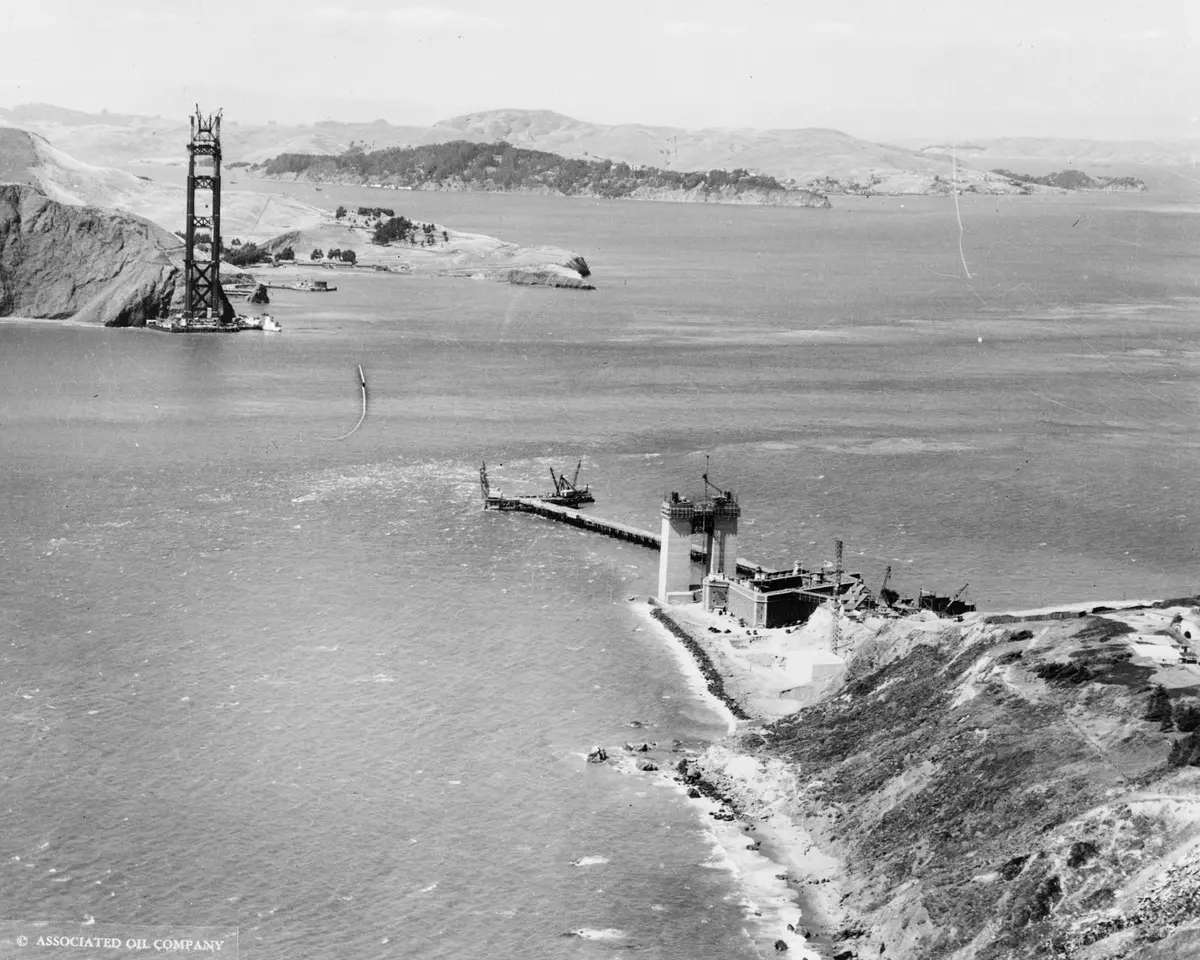
The work trestle reaches out from Fort Point toward the south pier site in the open strait, with the newly finished north tower beyond, 16 July 1934.. Associated Oil Company / Chas. M. Hiller, Library of Congress. Spinning the cables
John A. Roebling’s Sons, the family firm of the Brooklyn Bridge’s builders, spins the main cables in place. Spinning wheels race back and forth over the strait along the catwalks, laying wire on every pass, and soon carry six wires at a time. On a good eight-hour shift they lay 1,000 miles of wire. Each finished cable holds 27,572 wires. The spinning ends in May 1936, well ahead of schedule.
The net
Under the deck Strauss hangs a safety net of manila rope, a first in bridge building. It costs $130,000. It catches 19 men, who call themselves the Halfway to Hell Club. On 17 February 1937 a heavy scaffold tears through the net and ten men are killed. With Kermit Moore, killed the October before, eleven men gave their lives to the bridge. Their names are on a plaque at its south end.
Pedestrian Day
The turnstiles open at six in the morning, and 18,000 people are already waiting. Each pays a quarter. They pass through at about 15,000 an hour. Carmen and Minnie Perez cross on roller skates. A hotel houseman, Florentine Calegeri, crosses on stilts. Around ten o’clock Strauss arrives and reads a poem he has written for the bridge. By dusk, as many as 200,000 people have walked it.
Open to the world
At noon in San Francisco, President Franklin D. Roosevelt presses a telegraph key in the White House and declares the bridge open. Every fire siren in San Francisco and Marin sounds, church bells ring, ships blow their whistles and the foghorns answer. Cars roll on from both ends. Five hundred Navy planes fly over, and that afternoon 42 ships of the fleet arrive through the Golden Gate.
Chief Engineer Joseph Strauss, presenting the bridgeThis bridge needs neither praise, eulogy nor encomium. It speaks for itself.
The builders

Cincinnati-born engineer whose Chicago firm built drawbridges from Portland to St. Petersburg. He spent more than a decade selling the Golden Gate to voters, bankers and the War Department, set its safety code and drove the job home. He died a year after it opened.

Maine-born mathematician and engineer who wrote a standard textbook on framed structures. He made the computations and the structural design for the bridge and wrote the specifications for its contracts. Strauss dismissed him in December 1931. In 2007 the bridge district formally credited his work.

Oakland-born architect trained at Berkeley and the École des Beaux-Arts in Paris. He gave the towers their stepped Art Deco lines, designed the railings and streetlights, and chose International Orange because it suits the hills and stands out against sea and sky.
By the numbers
In pictures


Watch, listen, see
Films, photographs and first-hand accounts from across the web. Each opens in a new tab.

The full story of the bridge: Strauss, Ellis and Morrow, the Depression financing and the men who built it.
PBS
Film from the opening: crowds on the deck, cars crossing and ships of the fleet passing beneath.
Prelinger Archives
A detailed 3D animated tour of the towers, cables, anchorages and deck, and how they were built.
Animagraffs
The official souvenir program of the opening week, celebrating the world’s longest single span.
Internet ArchiveLarge-format federal photographs of the towers, cables, saddles and deck, from the tower tops down.
Library of Congress
How Roebling’s crews spun 80,000 miles of wire into two cables, six wires at a time.
PBS American Experience
The bridge district’s own record of the construction, from the trestle and fender to the last rivet.
Golden Gate Bridge DistrictThe papers of the engineer who made the computations and structural design for the bridge.
Purdue University Archives“At last the mighty task is done; resplendent in the western sun the Bridge looms mountain high; its titan piers grip ocean floor, its great steel arms link shore with shore, its towers pierce the sky.”
Joseph B. Strauss, chief engineer, “The Mighty Task Is Done,” 1937
After
The bridge held the record for the longest suspension span on earth for 27 years, until the Verrazzano-Narrows Bridge opened in New York in 1964. Its towers were the tallest of any suspension bridge in the world.
On 1 July 1971 the last of the original bonds was retired: $35 million in principal and nearly $39 million in interest, all of it paid by the people who drove across. In 2007, on the bridge’s 70th anniversary, the district formally credited Charles Ellis for the design, and in 2012 a plaque honoring him went up on the south tower.
In 1994 the American Society of Civil Engineers named it one of the Seven Wonders of the United States. Crews still paint it International Orange, the color Irving Morrow chose. More than 85 years after it opened, it carries about 40 million vehicles a year.
Primary sources