Black Canyon, Nevada–Arizona · 30 September 1935 · Six Companies
The Greatest Dam in the World
In the depths of the Depression, 21,000 Americans pushed a river out of its bed and poured a wall of concrete 726 feet high across it. They finished more than two years early.

The moment · June 1935
Every spring the Colorado has drowned the farms of the Southwest. Now 3.25 million cubic yards of ice-cooled, grouted concrete stand 726 feet high across Black Canyon. The spring flood comes roaring down out of the Grand Canyon. It hits the dam. The dam holds.
The Colorado River flooded the farms of the Southwest every spring and ran dry every fall. In 1928 Congress voted to plug it with the biggest dam ever attempted, in a canyon with no road, no rail line and no shade. The country slid into the Depression. Six Western builders took the job anyway. They had seven years. They needed five.
Six Companies
No single builder is big enough for this job, so six Western firms pool their money into one: Utah Construction, Kaiser and Bechtel, McDonald and Kahn, Morrison-Knudsen, J.F. Shea and Pacific Bridge. Their bid of $48,890,995 is the lowest, and the government awards them the contract. They get seven years. To run the job they pick Frank Crowe, who has spent twenty years building dams for the Reclamation Service.
Through the canyon walls
Before anything can be built, the river has to move. Crews start four tunnels, each 56 feet across, two through the Nevada wall and two through Arizona, more than three miles in all. Crowe mounts 30 drills on the back of a truck so a whole tunnel face is drilled at once. It takes a ton of dynamite for every 14 feet. They haul out 1.5 million cubic yards of rock.
A town from nothing
The first workers and their families camp by the river in tents and shacks they call Ragtown, with no fresh water and little shade. On the desert above the canyon, the government lays out a new town with streets, a park, dormitories for single men and cottages for families. There are no saloons and no casinos. By early 1932 the families are moving in. Boulder City will house about 5,000 workers.
The high scalers
Every loose rock on the canyon walls has to come off before concrete can touch them. High scalers do it. They swing out over the river on ropes with 44-pound jackhammers and dynamite. They coat cloth hats in tar until they set hard. When engineer Burl Rutledge falls from the rim, high scaler Oliver Cowan swings out and grabs his leg, and Arnold Parks pins him to the wall. Rutledge lives.
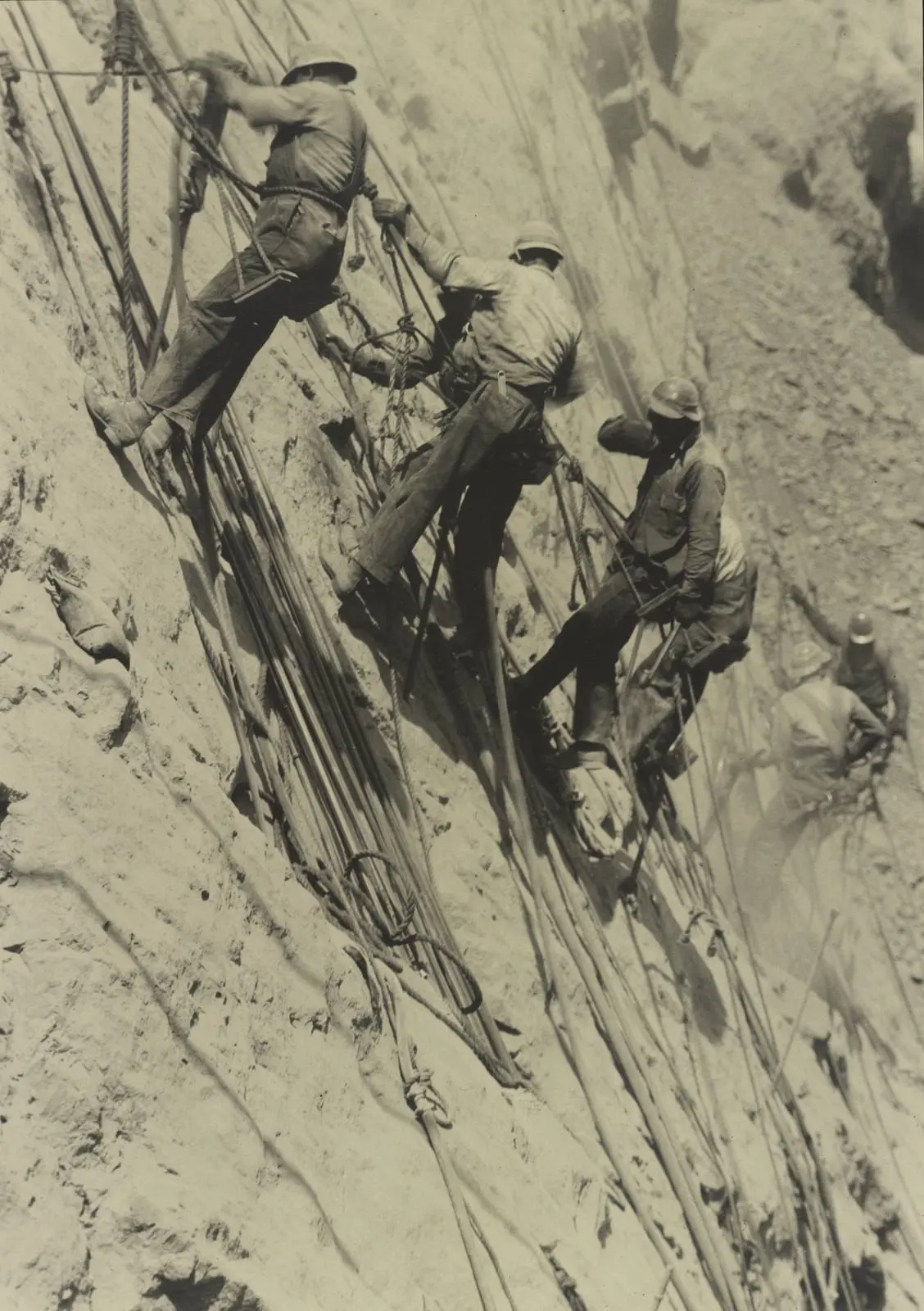
High scalers on ropes and bosun's chairs work the wall of Black Canyon, photographed by Ben Glaha, c. 1934. Ben D. Glaha / U.S. Bureau of Reclamation; Library of Congress. The river turns
Trucks dump rock into the channel until the Colorado gives up its bed and pours into the two Arizona tunnels. The contract allowed until 1 October 1933, with a $3,000 fine for every day late. Crowe beats the deadline by more than ten months. Cofferdams go up above and below the site, the riverbed is pumped dry, and the crews dig down to solid rock.
The first bucket
The first bucket of concrete goes into block J-3, nearly 18 months ahead of schedule. The dam rises as about 215 separate interlocking blocks, from 60 feet square at the upstream face to 25 feet square downstream, poured five feet at a time. Nine cableways strung across the canyon swing buckets of eight cubic yards to any block. The pour runs around the clock.
Ice water in the concrete
Concrete heats as it sets. Left alone, a mass this size would take 125 years to cool, and it would crack as it shrank. So the builders run 582 miles of one-inch steel pipe through the blocks and pump ice water through it. A plant on site can make 1,000 tons of ice a day. Once a block is cold, the pipes and the joints are pressure-filled with grout, and the blocks become one dam.
Lake Mead begins
The gates come down on the diversion tunnels and the Colorado begins to back up behind the dam. On 29 May the last concrete goes in: 3.25 million cubic yards, enough to pave a highway from San Francisco to New York. In June the spring flood comes roaring down through the Grand Canyon. The dam catches it and holds it.
Well done
President Roosevelt dedicates the dam before about 10,000 people standing in 102-degree heat, with millions more listening on the radio. He calls it the greatest dam in the world and thanks the thousands of workers who gave brain and brawn to it. He closes by speaking for the whole country to the men who built it: “Well done.”
President Roosevelt, at the damThis morning I came, I saw and I was conquered, as everyone would be who sees for the first time this great feat of mankind.

The builders

Born in Quebec in 1882 and trained at the University of Maine, he built dams for the Reclamation Service for twenty years. He strung the cableways, ran the job around the clock and finished two years early. “I was wild to build this dam.”

Purdue-trained engineer who wrote Wyoming’s water law and ran the irrigation works of Victoria, Australia. As Commissioner from 1924, he carried the dam from bid to dedication. He died in office in January 1936, and the lake behind it bears his name.

He rode a bosun’s chair down the walls of Black Canyon, setting charges and prying loose rock high above the river. The bronze high scaler that stands at the dam, unveiled for its 60th anniversary in 1995, is modeled on him.

Norwegian-born sailor turned American sculptor. He made the dam’s art: the two 30-foot bronze Winged Figures of the Republic, a star chart in the terrazzo that fixes the date of the dedication, and the memorial to the men who died building it.
By the numbers
In pictures


Watch, listen, see
Films, photographs and first-hand accounts from across the web. Each opens in a new tab.

Interior Department film of the dam rising, the spillways, and FDR at the 1935 dedication.
National Archives
Reclamation’s own history of how the agency and Six Companies built the dam.
Bureau of Reclamation
The men who swung from ropes to clear Black Canyon’s walls.
PBS American Experience
A 1976 interview with high scaler Joe Kine on working the canyon walls and early Boulder City.
UNLV Special Collections
Full text of Roosevelt’s 30 September 1935 address: “I came, I saw and I was conquered.”
The American Presidency Project
Official essays on the tunnels, cofferdams, concrete, high scalers, spillways and workforce.
Bureau of Reclamation
45 large-format photographs and 228 pages of history and engineering data.
Library of Congress
The official Reclamation photographer’s prints: high scalers, penstocks, night shifts.
Library of Congress“This is an engineering victory of the first order—another great achievement of American resourcefulness, American skill and determination.”
President Franklin D. Roosevelt, dedication of Boulder Dam, 30 September 1935
After
On 1 March 1936, Secretary of the Interior Harold Ickes formally accepted the finished dam from Six Companies, more than two years ahead of the contract deadline. That fall the first generators came on line. By 1939 Hoover was the largest hydroelectric plant in the world.
In February 1936, days after Elwood Mead died, the reservoir was named Lake Mead in his honor. It rose to the spillways for the first time in August 1941, a lake more than 110 miles long. A memorial at the dam honors the 96 men who died on the job.
Congress restored the name Hoover Dam in 1947, and the dam became a National Historic Landmark in 1985. Nine decades on, it still stores the Colorado and sends power and water to Nevada, Arizona and California.