Walter Reed Army Medical Center, Washington · 29 June 1956 · Eisenhower and the Bureau of Public Roads
Broader Ribbons Across the Land
In 1919 an Army convoy needed 62 days to cross the country on dirt and mud. An officer on that trip became President and signed the law that tied the continent together with 41,000 miles of freeway.

The moment · 21 August 1919 · Great Salt Lake Desert
The convoy detours onto a salt marsh under a thin crust of sand and alkali. Nearly every truck mires. Officers and men dig and haul side by side from 2 p.m. until past midnight. Water runs down to a cup a man. Lt. Col. Eisenhower, 28, takes notes.
In 1919 there was no paved road across America. An Army convoy proved it, grinding from Washington to San Francisco in 62 days. Thirty-seven years later, an officer who rode with it signed a law to build 41,000 miles of divided, limited-access highway, paid as it went from a trust fund filled by the gas tax. Today a quarter of all American driving happens on it.
The convoy rolls out
At the Zero Milestone on the Ellipse, south of the White House, with Secretary of War Newton Baker on hand, the Army's first transcontinental motor convoy sets out: 24 officers, 258 enlisted men and about 80 trucks, cars, motorcycles and a tractor. The mission is to find out whether an army can cross the continent by road. Lt. Col. Dwight D. Eisenhower, a Tank Corps officer, joins as an observer at Frederick, Maryland, that night.
Stuck on the salt
Past Salt Lake City the road becomes a desert trail of alkali dust two feet deep. On the Great Salt Lake Desert a detour breaks through the crust and nearly every vehicle is mired. The whole command, regardless of rank, digs and hauls from 2 p.m. until after midnight. Water and gasoline run short. In Utah and Nevada the men spend 42 hours in all rescuing the convoy from the quicksand.
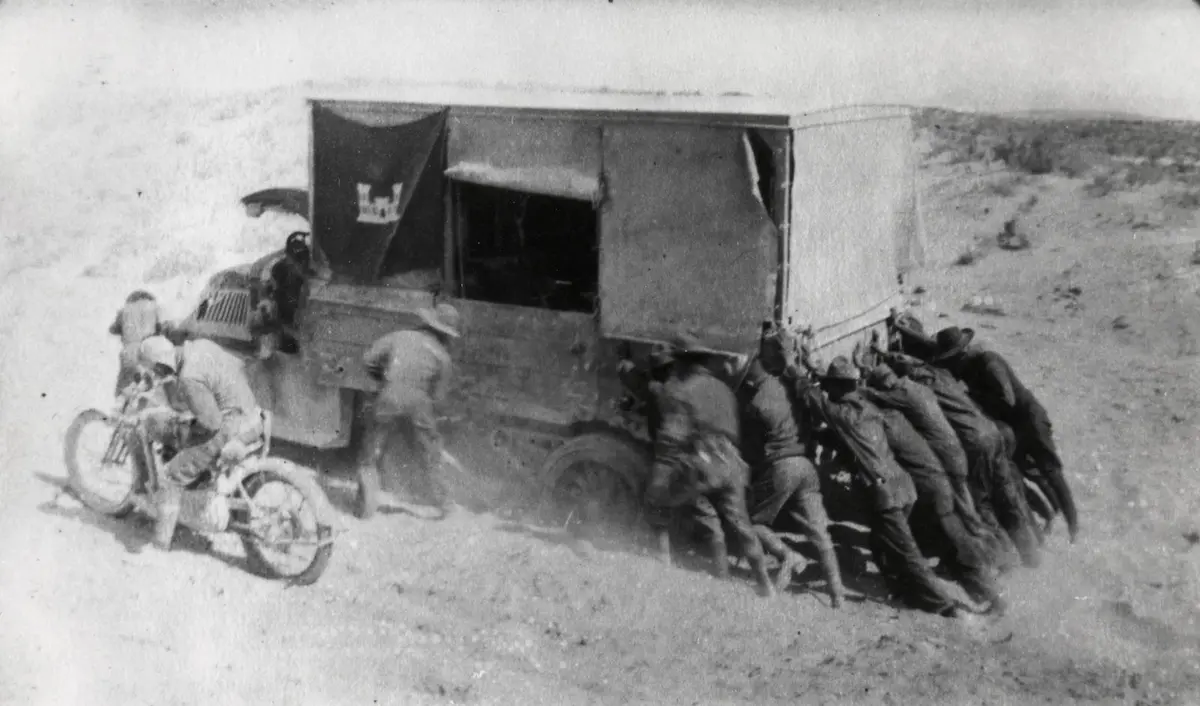
Soldiers of the 1919 Army transcontinental convoy put their shoulders to an engineer truck stuck in desert sand.. Eisenhower Presidential Library. 3,251 miles
Sixty-two days out of Washington, the convoy rolls into the Presidio. It has averaged 6 miles an hour and 58 miles a day. More than half the trip ran over dirt roads, wheel paths and desert sand. The men rebuilt 88 broken bridges and culverts along the way. Eisenhower writes in his report that the trip showed strong sentiment for better highways.
Lt. Col. Eisenhower, report of 3 November 1919From the standpoint of promoting this sentiment, the trip was an undoubted success.
Toll Roads and Free Roads
Congress has asked the Bureau of Public Roads whether six toll superhighways could pay for themselves. Chief Thomas H. MacDonald and Herbert Fairbank answer no. Their report recommends a toll-free interregional network instead, the first outline of the Interstate System. In 1944 Congress authorizes a 40,000-mile National System of Interstate Highways, and in 1947 the first 37,700 miles MacDonald recommended are approved. What it lacks is money to build them.
The autobahn
As Supreme Allied Commander, General Eisenhower sees how Germany's autobahns let the enemy shift forces fast, and how quickly his own armies move once they fight their way into Germany onto the same roads. The convoy had taught him what bad roads cost. Germany shows him what great ones can do. He later wrote that "Germany had made me see the wisdom of broader ribbons across the land."
A grand plan
President Eisenhower is called away by a death in the family, so Vice President Nixon reads his speech to the nation's governors. It calls for a $50 billion, 10-year highway program and surprises the room. Eisenhower then hands the job of paying for it to Gen. Lucius D. Clay, with Frank Turner of the Bureau of Public Roads as his executive secretary.
Eisenhower's message to the governors, read by Vice President NixonOur highway network is inadequate locally, and obsolete as a national system.
Signed in a hospital room
After a defeat in 1955, Congress tries again. The House renames the network the National System of Interstate and Defense Highways and creates a Highway Trust Fund, filled by a gas tax raised from two cents to three. The Senate passes the final bill 89 to 1. Eisenhower, recovering from surgery, signs it with no ceremony: 41,000 miles, $25 billion over 13 years, 90 percent federal.
Secretary of Commerce Sinclair WeeksThe greatest public works program in the history of the world.
The first contracts
Missouri moves first. Its highway commission awards a contract for 13.3 miles of U.S. 66, now I-44, in Laclede County, and Washington confirms it is the first Interstate contract under the new act. On 13 August crews start work on U.S. 40, now I-70, in St. Charles County, the first actual construction. Kansas claims the first finished project when its new paving west of Topeka opens on 14 November.
The last link
Federal Highway Administrator Thomas Larson opens 12.5 miles of I-70 through Glenwood Canyon, completing the highway from Baltimore to Cove Fort, Utah. It took 12 years, 40 bridges and viaducts, three tunnels and 15 miles of retaining walls, threaded between the Colorado River, a railroad and canyon walls. Builders hailed it as the final link of the original Interstate System. It won the ASCE Outstanding Civil Engineering Achievement award for 1993.

The builders

West Point class of 1915. Crossed the country with the 1919 Army convoy as a 28-year-old observer, then commanded the Allied armies that drove into Germany and saw its autobahns. As President he pushed the Interstate through Congress and signed it in a hospital room.

Iowa's state highway engineer before he ran the federal roads bureau for 34 years. His 1939 report, Toll Roads and Free Roads, written with Herbert Fairbank, first drew the toll-free national network, and in 1947 he recommended its first 37,700 miles.

Texas A&M engineer who joined the Bureau of Public Roads in 1929 and worked the Alaska Highway in World War II. He supplied the numbers behind the Clay plan and the House highway bills, then served as chief engineer and Federal Highway Administrator.

Army engineer, West Point class of 1918, and the general who ordered the Berlin Airlift. Eisenhower asked his longtime associate to work out how to pay for the system. His committee's 1955 report set the $27 billion goal Congress would build on.
By the numbers
In pictures


Watch, listen, see
Films, photographs and first-hand accounts from across the web. Each opens in a new tab.

Film of the 62-day Army convoy that showed young Lt. Col. Eisenhower how badly America needed roads.
U.S. National Archives
Eisenhower's 1919 report, the convoy's daily log and dozens of photos from the trip west.
Eisenhower Presidential Library
Scan and transcript of the law that authorized 41,000 miles of Interstate and the Highway Trust Fund.
National ArchivesHis 1955 message to Congress and the White House papers behind the Interstate program.
Eisenhower Presidential LibraryThe National Archives' history of the convoy, the Clay Committee and the 1956 act.
Prologue, National Archives
A 1956 film made to win public support for the new national system of Interstate highways.
Prelinger Archives / Internet Archive
Carol M. Highsmith's aerial photographs of I-70's viaducts clinging to the canyon walls.
Library of Congress
How engineers built I-70 through Glenwood Canyon with 40 bridges and viaducts and three tunnels.
ASCE Civil Engineering“Together, the united forces of our communication and transportation systems are dynamic elements in the very name we bear — United States. Without them, we would be a mere alliance of many separate parts.”
President Dwight D. Eisenhower, message to Congress, 22 February 1955
After
At the Defense Department's request, in 1960 the clearance under rural Interstate overpasses went from 14 feet to 16. In 1966 Congress required every mile of the system to have at least four lanes and no crossings at grade.
In 1990 President George H. W. Bush signed the law renaming the network for the man who launched it. It is now the Dwight D. Eisenhower National System of Interstate and Defense Highways. Frank Turner rose to run the Federal Highway Administration, and its research center in McLean, Virginia, bears his name and Fairbank's.
Today the Interstates run 48,830 miles, plus 286 in Puerto Rico. They connect every American city of more than a million people and 46 of the 50 state capitals. In 1957 they carried 1 percent of the nation's driving. Now they carry 26 percent, on 1 percent of its roads.
Primary sources
- Federal-Aid Highway Act of 1956: Creating the Interstate System. Richard F. Weingroff, Public Roads, Summer 1996. Federal Highway Administration.
- Report on Trans-Continental Trip, Lt. Col. D. D. Eisenhower, 3 November 1919, with the Daily Log of the First Transcontinental Motor Convoy. Eisenhower Presidential Library.
- Our Nation's Highways 2026: Roads. Federal Highway Administration, Office of Highway Policy Information.