Highland Park, Michigan · 1 December 1913 · Ford Motor Company
A Car for the Great Multitude
Henry Ford and his engineers set the work in motion and brought it to the men. Building a Model T chassis went from twelve and a half hours of labor to 93 minutes.

The moment · 1 December 1913 · Highland Park
A bare Model T frame starts down a 300-foot line. Parts wait in piles at each station, and each man adds his piece as the chassis passes. Axles, wheels, engine, steering. By the end of the nine-hour day, 177 men have finished 606 chassis.
In the summer of 1913, a team of skilled men needed twelve and a half hours of labor to assemble one Model T chassis. Henry Ford wanted a car for the great multitude, and every hour of labor kept the price up. At Highland Park, he and his engineers stopped walking the men to the work and started moving the work to the men. Within a year, the job took 93 minutes.
The Model T
Ford Motor Company puts the Model T on sale. The touring car costs $850. It has a 20-horsepower four-cylinder engine, parts of tough vanadium steel, and enough ground clearance for rutted farm roads. The next year Henry Ford announces that the company will build this one model and nothing else, with the same chassis under every car, so the factory can learn to make it cheaper every year.
Henry Ford, on the single modelAny customer can have a car painted any colour that he wants so long as it is black.
The Crystal Palace
Ford opens a new plant on Woodward Avenue in Highland Park, just north of Detroit. Architect Albert Kahn gives it widely spaced concrete columns, a glass roof and walls of windows, and Detroit calls it the Crystal Palace. Inside, Ford’s men place machines in the order of the work. The plant has the open floors and the light that a moving line will need.
The magneto line
Ford’s engineers try the idea small, on the flywheel magneto. One skilled man has been building a whole magneto in about 20 minutes. Now the job is split into 29 steps, with 29 men standing along a sliding line, each doing one step as the work passes. Ford later said the idea came from the overhead trolleys Chicago meatpackers use. On the first day, the time falls to 13 minutes 10 seconds.
Rope and windlass
The best Ford can do with stationary assembly is 12 hours 28 minutes of labor per chassis, with men walking to each car and parts carried to them. In the summer slow season, the engineers tie a rope to a bare frame and haul it with a windlass down a 250-foot line. Six assemblers walk with it and pick parts from piles along the way. The time drops to 5 hours 50 minutes.
The line runs
The chassis line has been lengthened to 300 feet so the men have room to work. Parts arrive at the station where they go on, and no one leaves his post to fetch them. In one nine-hour day, 177 men finish 606 chassis, about 2 hours 38 minutes of labor each. Outside on John R. Street, car bodies slide down a ramp and drop onto the finished chassis.
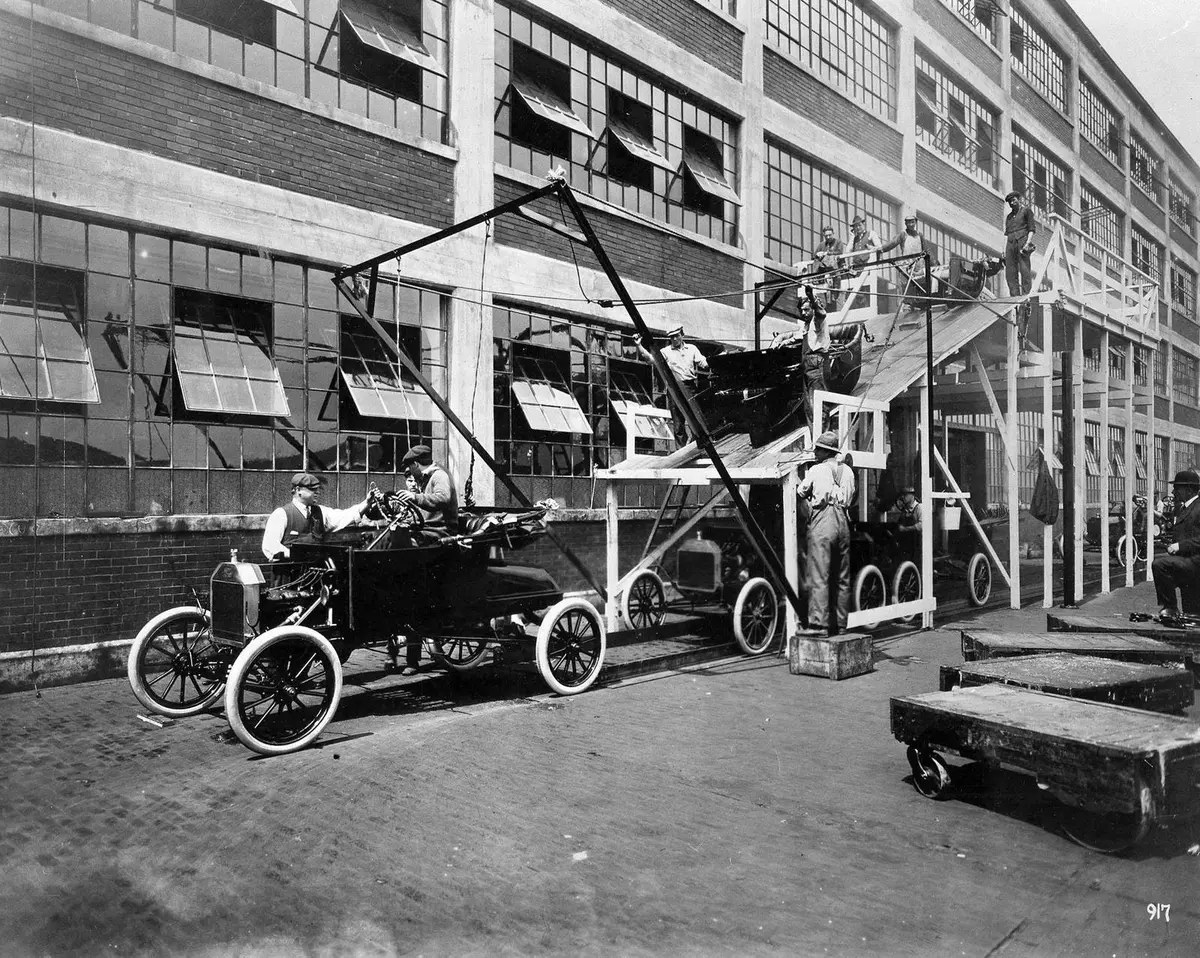
Car bodies slide down a ramp onto finished chassis outside the Highland Park plant, 1913.. Ford Motor Company / National Archives. The five-dollar day
Henry Ford and vice president James Couzens announce that starting 12 January, qualifying Ford men will earn $5 for an eight-hour day. They had been making about $2.34 for nine hours. The plant moves from two shifts to three, so the new lines can run around the clock. The next day, 10,000 people crowd the Highland Park gates looking for work.
Ford Motor Company statement, 5 January 1914The Ford Motor Company, the greatest and most successful in the world, will on January 12 inaugurate the greatest revolution in the matter of rewards for its workers ever known to the industrial world.
Man-high
Since 14 January an endless chain has pulled one line at a steady speed. Now the first raised line opens: steel rails 26¾ inches off the floor, so no one stoops. Two more go in at 24½ inches, and the shorter men work those while the tall men take the high line. The best time for a chassis on the new rails is 84 minutes.
Ninety-three minutes
Three chain-driven lines turn out more than 1,200 chassis in a single eight-hour day. Each one takes 1 hour 33 minutes of labor, against 12 hours 28 minutes the September before. The engineers’ own account, published in 1915, calls it an unbelievable reduction. Ford’s men go hunting for the same savings in every department of the plant, and the price of the car keeps falling.
Fifteen million
Henry and Edsel Ford drive the fifteen millionth Model T off the line at Highland Park. The car that cost $850 in 1908 has sold for as little as $260. The ten millionth came in 1924. Across nineteen years, Ford built one car, made it cheaper every year, and put the country on wheels.
The builders

A Michigan farm boy who became chief engineer at Detroit’s Edison Illuminating Company, built his first car in 1896 and founded Ford Motor Company in 1903. He demanded one car, cheaper every year, and backed every experiment that got there.

Born in Copenhagen in 1881, he came to America at four and joined Ford as a patternmaker in 1905. He drove the chassis line through its trials at Highland Park. Thirty years later he built Willow Run on the same idea.

A Michigan shop teacher whose student, Edsel Ford, introduced him to his father. Hired in 1912 as Sorensen’s assistant, he worked eight months in every department, then led the design of the moving lines. The men who built them called him its guiding light.

Born in Chatham, Ontario, he put $2,500 into the new Ford Motor Company and ran its business side. He stood with Ford to announce the five-dollar day. He later served as mayor of Detroit and as a United States senator from Michigan.
By the numbers
In pictures


Watch, listen, see
Films, photographs and first-hand accounts from across the web. Each opens in a new tab.

Ford’s own 1919 films follow a Model T down the line as each worker adds his part.
The Henry Ford
A walk through Albert Kahn’s Highland Park plant, the building where the moving assembly line was born.
WTTW
Two dozen photos, documents and film clips from Highland Park, the magneto line and the five-dollar day.
The Henry Ford
Workers build magnetos and flywheels on Ford’s first moving assembly line at Highland Park, 1913.
National Archives
How Ford doubled pay for an eight-hour day in January 1914 and drew thousands to Highland Park.
The Henry Ford
The illustrated story of the Model T, from the $850 touring car to fifteen million built.
The Henry Ford / Google Arts & Culture
The 1915 engineering account that timed every step of the new lines, down to the minute.
Internet ArchiveHenry Ford’s 1922 memoir, with his own account of the magneto line and the first chassis line.
Project Gutenberg“I will build a motor car for the great multitude. It will be large enough for the family but small enough for the individual to run and care for.”
Henry Ford, My Life and Work, 1922
After
The moving line spread to every department at Highland Park, then to Ford’s River Rouge plant and to factories around the world. Every industry that builds things in numbers still runs on the idea Ford’s men proved in 1913.
Charles Sorensen used it again in 1942, when Ford’s Willow Run plant built B-24 bombers on a moving line. Clarence Avery went on to run the Murray Corporation. James Couzens became mayor of Detroit and a United States senator, and Henry Ford was a pallbearer at his funeral.
The fifteen millionth Model T is in the collection of The Henry Ford in Dearborn. The Highland Park plant, the Crystal Palace where the line first ran, was named a National Historic Landmark in 1978.