Beaumont, Texas · 10 January 1901 · Lucas, Higgins and the Hamill brothers
Oil, Captain. Oil!
A Beaumont businessman swore there was oil under a low hill of salt. An engineer and two drillers from Corsicana proved it, and the oil age began.

The moment · About 10:30 · 10 January 1901
The crew is running pipe back into the hole with a fresh bit. Mud boils up through the rotary. Then six tons of drill pipe shoot out of the ground and through the top of the derrick. The men run. Then gas. Then oil, roaring into the sky.
Why, it’s oil, Captain. Oil!Al Hamill to Capt. Anthony F. Lucas, as Hamill recalled it
Most geologists said there was no oil on the Texas Gulf Coast. Pattillo Higgins, a self-taught Beaumont businessman, was sure there was, under a salt-dome hill south of town. Capt. Anthony F. Lucas, the country’s foremost expert on salt domes, bet his career on it. In the fall of 1900, with Pittsburgh money and a rotary rig, they drilled.
The prophet of Spindletop
Pattillo Higgins and his partners George W. Carroll and George W. O’Brien incorporate the Gladys City Oil, Gas and Manufacturing Company, named for Gladys Bingham, a girl in Higgins’s Sunday school class. Higgins is certain oil and gas lie under the salt dome on Spindletop Hill. Three shallow tries with cable tools, starting in 1893, all fail. Higgins advertises in papers and journals across the country for someone who will drill it right.
The captain answers
Anthony F. Lucas answers the ads. Born Antonio Luchich on the Dalmatian coast, he graduated from the Polytechnic Institute in Graz, served as a second lieutenant in the Austrian navy, and became an American citizen in 1885. He has spent years running salt mines in Louisiana. At the top of the mound he finds sulphur gas seeping from the ground. He leases the land and drills to 575 feet before his money runs out.
The money
Lucas takes his case to John H. Galey and James M. Guffey of Pittsburgh, the most successful wildcatting team in the country. Andrew and Richard Mellon back much of their stake. Galey comes to Beaumont and picks the spot on the hill. The drilling contract goes to Al and Curt Hamill of Corsicana, who run a steam-driven rotary rig: 1,200 feet for $2,400, paid in full when they reach it.
Mud and cattle
The well is spudded on 27 October. The hill is mostly sand, and the hole keeps caving in. Curt Hamill and hand Peck Byrd notice that muddy water holds the walls. Curt hires a local farmer, the Rev. John C. Chaney, who plows the bottom of the slush pit, floods it, and walks his cattle back and forth until the water turns thick. The mud holds the hole open and carries the cuttings out. Drilling mud is born on Spindletop.
A show of oil
Near 600 feet, gas blows water and sand out of the hole and damages the rig. The crew repairs it and keeps going on eighteen-hour shifts. One night around 3 a.m., Al feels the rotary turning easily. At daylight there are rainbow slicks of oil on the slush pit. Lucas wires Galey, who orders six-inch pipe set to 920 feet. The crew finishes on Christmas Eve and goes home for the holiday.
The crevice
Back at work on New Year’s Day, the bit hits something hard at 1,020 feet. Turn it one way and it gains five or six inches. Turn it further and it backs up. For days all three men try to make hole. Every fishtail bit wears down. On the morning of 10 January, Al Hamill goes into Beaumont for a new one and brings it back to the derrick.
The gusher
With about 700 feet of pipe back in the hole, mud boils up through the rotary. Then the pipe comes up, six tons of it, and shoots through the top of the derrick, carrying the crown block away. The men run. It goes quiet. Al picks up a shovel, and the hole fires mud like a cannon. Then gas. Then oil, rising past the crown to more than twice the derrick’s height.
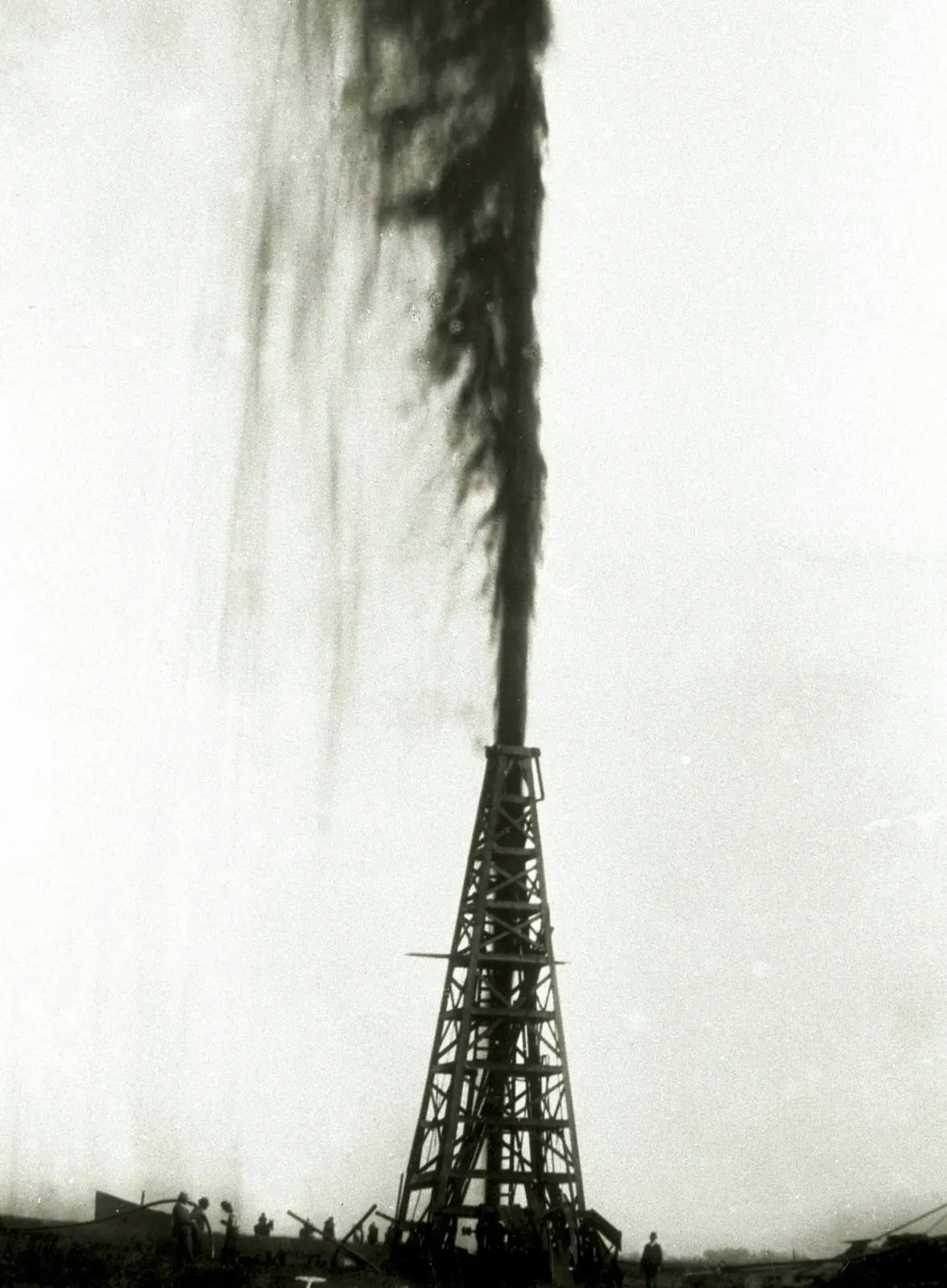
The Lucas gusher blows oil more than 150 feet into the air above its derrick on Spindletop Hill, January 1901. Frank J. Trost / Wikimedia Commons. Thank God
Peck Byrd goes for Lucas, who is in town at a dry goods store. Lucas races out to the hill. At the gate his horse balks and pitches him to the ground. He runs to Al Hamill, shouting to know what it is. Then he embraces all three men. Within an hour crowds arrive by buggy, on horseback and on foot. Lucas has Curt sworn in as a deputy to keep them back.
Lucas and Al Hamill at the derrick“Al, what is it?” “Why, it’s oil, Captain. Oil!”
The Christmas tree
For nine days the well flows. Lucas puts it at 75,000 barrels a day on the third day; later estimates run to 100,000. The Hamills bolt a rig of pipes and valves to the derrick. Al cuts a collar off the ten-inch pipe with a hacksaw, goggles taped on, under a rain of oil. Curt rushes in, lowers the valve and screws it tight, then collapses from the gas. They revive him in fresh air. The well is shut in.
Lucas, on fire danger at the wellKeep the people back and don’t let them smoke. Don’t let anybody smoke.

The men of Spindletop

Born at Sabine Pass, Texas. A one-armed Beaumont businessman and self-taught geologist, he founded the Gladys City company in 1892, insisted oil lay under the salt dome when experts said no, and advertised nationwide until Lucas answered.

Born in Split on the Dalmatian coast. Austrian naval officer turned American citizen and mining engineer, the nation’s foremost salt-dome expert. He staked everything on the hill and drilled the well that started the Texas oil age.

Corsicana driller who ran the rotary rig with his brother Curt and hand Peck Byrd. Fought sand, gas and rock for eleven weeks, struck oil at 1,139 feet, then helped cap the gusher with a valve rig the brothers built on the spot.

Veteran Pennsylvania oil producer who, with partner James M. Guffey, brought Mellon money to Lucas’s venture. He came to Beaumont, picked the spot on the hill, and directed the drilling by telegraph when the first oil showed.
By the numbers
In pictures


Watch, listen, see
Films, photographs and first-hand accounts from across the web. Each opens in a new tab.
An educational film on the events that led to the gusher and the Gladys City boomtown it built.
Texas Archive of the Moving Image
A visit to Beaumont’s Spindletop-Gladys City Boomtown Museum and the story of the 1901 oil boom.
The Texas Bucket List
Archival photos and the story of the 1901 discovery a few miles south of Beaumont.
KVUE
A museum figure of Capt. Anthony Lucas tells how the Spindletop gusher launched the Texas oil industry.
Texas Energy Museum
William A. Owens’s 1958 account, drawn from interviews with Al and Curt Hamill and Pattillo Higgins.
American Heritage
A 1901 album of the boom: gushers, derricks, tank cars, refineries, pumping stations and docks.
Library of CongressThe standard history of the field, from Higgins’s first company to the gusher and the boom.
Texas State Historical Association
How the Lucas gusher, drilling mud and the Christmas tree valve opened the modern petroleum age.
American Oil & Gas Historical Society“The pipe was shot into the air … to a height of 300 feet above the derrick, the upper works and heavy tackle of which it carried away.”
Capt. Anthony F. Lucas, “The Great Oil Well near Beaumont, Texas,” Transactions of the American Institute of Mining Engineers, 1902
After
By September 1901 at least six wells were flowing on the Gladys City company’s land. Beaumont grew from about 10,000 people to 50,000. A tract offered for $150 for three years sold for $20,000, then changed hands again fifteen minutes later for $50,000.
For a generation, John D. Rockefeller’s Standard Oil had refined most of America’s oil and made kerosene light cheap in homes across the country. Spindletop opened a new era of competition. Guffey’s company became Gulf Oil, with Andrew Mellon as president. Joseph Cullinan’s Texas Fuel Oil Company became the Texas Company, later Texaco. Sun Oil grew there too, and so did Magnolia and Humble, forerunners of Mobil and Exxon. Railroads switched from coal to oil, steamships followed, and cheap fuel was waiting when the automobile arrived.
The rotary rig and drilling mud the Hamills proved on Spindletop became the way the world drills for oil. In 1936 the American Institute of Mining and Metallurgical Engineers created the Anthony F. Lucas Gold Medal. Lamar University’s Spindletop-Gladys City Boomtown Museum keeps the story in Beaumont today.
Primary sources
- Spindletop Oilfield. Handbook of Texas Online, Texas State Historical Association.
- Anthony F. Lucas, “The Great Oil Well near Beaumont, Texas.” Transactions of the American Institute of Mining Engineers, vol. 31 (1902).
- William A. Owens, “Gusher at Spindletop.” American Heritage, June 1958.