Isthmus of Panama · 15 August 1914 · Roosevelt, Goethals, Gorgas and the canal builders
The Land Divided, the World United
France tried for eight years and quit. America took over in 1904, beat the fevers, cut through the Continental Divide and lifted ships 85 feet over the Isthmus. Ten years later the oceans were joined.

The moment · 20 May 1913 · Culebra Cut
Nine miles through the Continental Divide. The hills keep sliding back in, one slide alone half a million cubic yards. Gaillard keeps digging. Up to 160 dirt trains a day haul the rock out. Then steam shovels 222 and 230 grind toward each other and meet at the bottom.
Men had dreamed of a passage across Panama for four hundred years. The French tried from 1881 to 1889 and were beaten by mud, slides and fever. In 1898 the battleship Oregon needed more than two months to steam around South America to the war in Cuba. President Theodore Roosevelt decided America would build the canal itself.
America takes over
The United States pays the bankrupt French company $40 million for its rights, its railroad and its works, and Panama $10 million for the Canal Zone. What the Americans find is a jungle full of rusting French machines, a run-down railroad and towns with no clean water. Roosevelt wants the dirt to fly. First the Isthmus has to be made fit to live in.
Roosevelt, looking back at Berkeley in 1911I took the Isthmus, started the canal and then left Congress not to debate the canal, but to debate me.
The railroad man
John F. Stevens, the engineer who found Marias Pass for the Great Northern Railway, arrives as chief engineer. He nearly stops the digging. He rebuilds the Panama Railroad with heavy track and new cars, puts up housing, mess halls, warehouses and machine shops, and brings in thousands of workers, most of them from Barbados and the West Indies. “The digging,” he says, “is the least thing of all.”
The last case of yellow fever
Col. William Gorgas, the Army doctor who drove yellow fever out of Havana, knows the mosquito carries it. His men drain swamps, oil standing water, screen windows, fumigate every house in Panama City and Colón and pipe in clean water. Stevens gives him everything he asks for. On 11 November 1905 the last case of yellow fever on the Isthmus is reported. Yellow fever is beaten on the Isthmus.
A lake in the sky
A board of engineers votes eight to five for a sea-level ditch, the plan that broke the French. Stevens has seen the Chagres River in flood and calls a sea-level canal an entirely untenable proposition. His plan: dam the Chagres at Gatun, make a lake 85 feet above the sea and lift ships up to it with locks. The Senate agrees, 36 to 31, and Roosevelt signs it into law.
The President goes to see
No sitting president has ever left the country. Roosevelt sails to Panama on the battleship Louisiana and walks the works in a tropical downpour, twelve to eighteen hours a day. He rides through the Culebra Cut, climbs into the cab of a steam shovel and works the levers himself. At Colón he tells the canal force what they are doing.
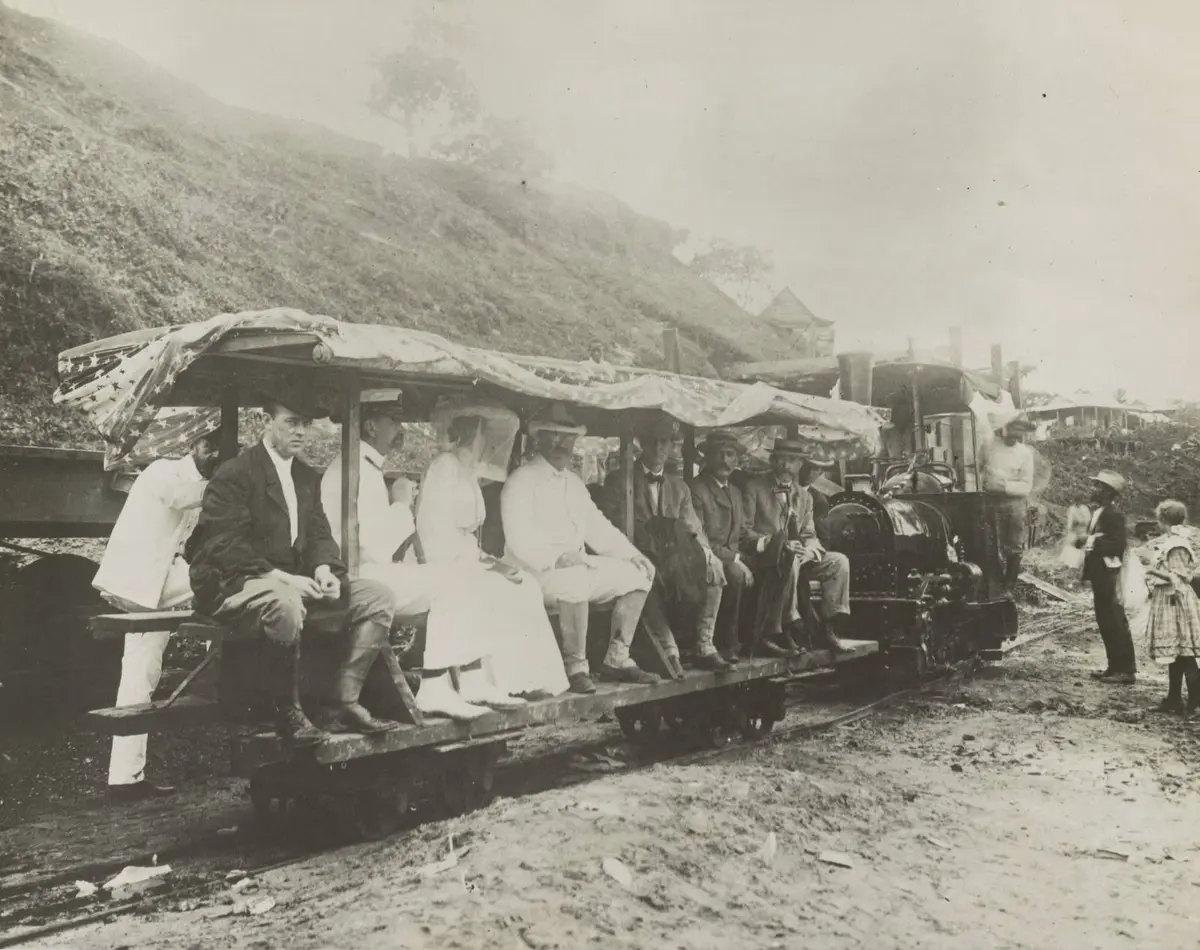
President Roosevelt, in white, and his party tour the canal works on a flag-draped rail car, November 1906. Library of Congress (LCCN 2013650928). Roosevelt to the canal force at ColónYou are doing the biggest thing of the kind that has ever been done.
The Army takes charge
Stevens resigns, and Roosevelt gives the canal to an Army engineer, George W. Goethals. Goethals splits the job three ways. Maj. William Sibert takes the Atlantic side, with the Gatun Dam and Locks. Maj. David Gaillard takes the Culebra Cut. The civilian Sydney Williamson takes the Pacific locks. By August the crews are moving a million cubic yards a month. At the peak they move three million.
Through the divide
The Culebra Cut runs nine miles through the mountains of the Continental Divide. Drillers set dynamite, steam shovels load the rock, and up to 160 dirt trains a day haul it out. The hills keep sliding back in. The first Cucaracha slide, in October 1907, dumps 500,000 cubic yards. Gaillard keeps digging. On 20 May 1913, steam shovels 222 and 230 meet at the bottom, 40 feet above sea level.
The locks work
At Gatun, earth and rock from the Cut have built a dam a mile and a half long across the Chagres, and the lake behind it is rising toward 85 feet. Beside it stand three steps of concrete locks, every chamber 1,000 feet long. The tug Gatun makes the first trial lockage. On 10 October, President Wilson presses a key in Washington and blows the Gamboa dike. Lake water floods the Cut.
The oceans are joined
The steamer Ancon, which has spent years hauling cement for the locks, leaves Cristóbal with about 200 guests aboard and Capt. John A. Constantine piloting. She climbs the three Gatun steps, crosses the lake, runs the Cut and steps down to the Pacific. Goethals rides the railroad ahead from lock to lock. Nine hours and 40 minutes after she started, the Panama Canal is open.
The builders

Rough Rider and champion of a canal since the Oregon’s voyage of 1898. He secured the Canal Zone, backed Gorgas against his critics and chose the lock plan. In 1906 he became the first sitting president to leave the country, to see the work himself.

Brooklyn-born Army engineer, second in the West Point class of 1880. On the Tennessee River he built the Riverton Lock, with a world-record lift of 26 feet. He finished the canal, became the first governor of the Canal Zone and received the thanks of Congress.

Alabama-born Army doctor who caught yellow fever as a young officer in Texas and lived. He drove it out of Havana, then out of Panama by November 1905, by going after the mosquito that carried it. He became Surgeon General of the Army in 1914.

Self-taught engineer from Maine who found Marias Pass through the Rockies for the Great Northern Railway. In Panama he rebuilt the railroad, housed and fed the workforce, backed Gorgas, and convinced Roosevelt and Congress to build a lock canal.
By the numbers
In pictures


Watch, listen, see
Films, photographs and first-hand accounts from across the web. Each opens in a new tab.

Silent film from the era: dirt trains in the Culebra Cut, the new locks and ships lifted 85 feet.
Prelinger Archives · Internet Archive
The canal’s own centennial film of the construction and the 1914 opening, in archival footage.
Panama Canal Authority · YouTube
A digital exhibition built on an engineer’s albums from the job, with maps, blueprints and a timeline.
Linda Hall Library
The Smithsonian’s exhibition on the engineering, the war on disease and the American town on the Isthmus.
Smithsonian Libraries
The President talks with canal workers beside a steam shovel at Bas Obispo, November 1906.
Theodore Roosevelt CenterHis full report on the 1906 trip: the steam shovels, Gorgas’s results and the men on the job.
Miller Center
The Ancon’s crossing of 15 August 1914 and the trial runs that came before it.
Panama Canal Museum Collection, University of Florida
The canal’s official history of the American years: the engineers, the workforce and the war on disease.
Panama Canal Authority“This conquest of peace will, in its great and far-reaching effect, stand as among the greatest conquests, whether of peace or of war, which have ever been won by any of the peoples of mankind.”
President Theodore Roosevelt, message to Congress on the Panama Canal, 17 December 1906
After
The canal cost about $375 million, $23 million under the 1907 estimate. Congress gave Goethals its thanks and the two stars of a major general, and in 1914 he and Gorgas shared the first Public Welfare Medal of the National Academy of Sciences. David Gaillard died in December 1913, nine months before the opening. In 1915 the Culebra Cut was renamed the Gaillard Cut in his honor.
The canal cut nearly 8,000 miles from the sea voyage between New York and San Francisco. American engineers ran it for 85 years before it passed to Panama at noon on 31 December 1999.
More than a century on, the locks the Americans poured still lift ships 85 feet to Gatun Lake every day. In 1994 the American Society of Civil Engineers named the Panama Canal one of the Seven Wonders of the Modern World.
Primary sources
- Special Message on the Panama Canal, President Theodore Roosevelt, 17 December 1906. Miller Center.
- End of the Construction. Panama Canal Authority.
- The Panama Canal: An Army’s Enterprise. U.S. Army Center of Military History, 2009.