Sea of Tranquility, the Moon · 20 July 1969 · Armstrong, Aldrin, Collins
The Eagle Has Landed
Eight years after a president promised it, three Americans flew a quarter of a million miles and two of them walked on the Moon.

The moment · 16:17 EDT · 20 July 1969
The autopilot is flying Eagle into a field of boulders. Neil Armstrong takes the controls and skims past it by hand, hunting for flat ground, with the fuel almost gone. Sixty seconds left. Thirty. Then the contact light.
Houston, Tranquility Base here. The Eagle has landed.Neil Armstrong
On 25 May 1961 President Kennedy told Congress the United States would land a man on the Moon and return him safely before the decade was out. At the time, the country had fifteen minutes of human spaceflight to its name. Eight years and 400,000 workers later, it was done.
Liftoff
Launch Complex 39A, Kennedy Space Center. Five F-1 engines light and 7.5 million pounds of thrust push the Saturn V off the pad. Under twelve minutes later, Armstrong, Aldrin and Collins are in Earth orbit. Two and a half hours after that, the third stage fires again and sends them to the Moon.
Behind the Moon
After three days coasting across 240,000 miles of space, Columbia fires its engine on the far side of the Moon, out of radio contact with Earth. When it comes back around, it is in lunar orbit, right on the numbers.
The Eagle has wings
Armstrong and Aldrin crawl into the lunar module and undock. Collins inspects Eagle from Columbia’s window, confirms the landing legs are down and locked, and wishes them well. From here, Eagle has one job: land.
Go for powered descent
In Houston, flight director Gene Kranz polls every console in the room. Each one answers go. Eagle lights its descent engine for the twelve-minute ride to the surface. Minutes in, the guidance computer flashes a 1202 alarm, then 1201. Guidance officer Steve Bales, 26 years old, has seconds to decide. He calls go, and the landing continues.
Manual control
The autopilot is steering Eagle into a crater strewn with boulders the size of cars. Armstrong takes over and flies on past it by hand, hunting for a clear spot, while Aldrin reads out altitude and speed. The fuel callouts come down to 60 seconds, then 30. Then the contact light.
Armstrong to Mission ControlHouston, Tranquility Base here. The Eagle has landed.
One small step
Armstrong climbs down the ladder and steps onto the Moon. Aldrin follows twenty minutes later. They plant the flag, set up a seismometer and a laser reflector that scientists still bounce lasers off today, and collect 47 pounds of lunar rock in two and a half hours on the surface.
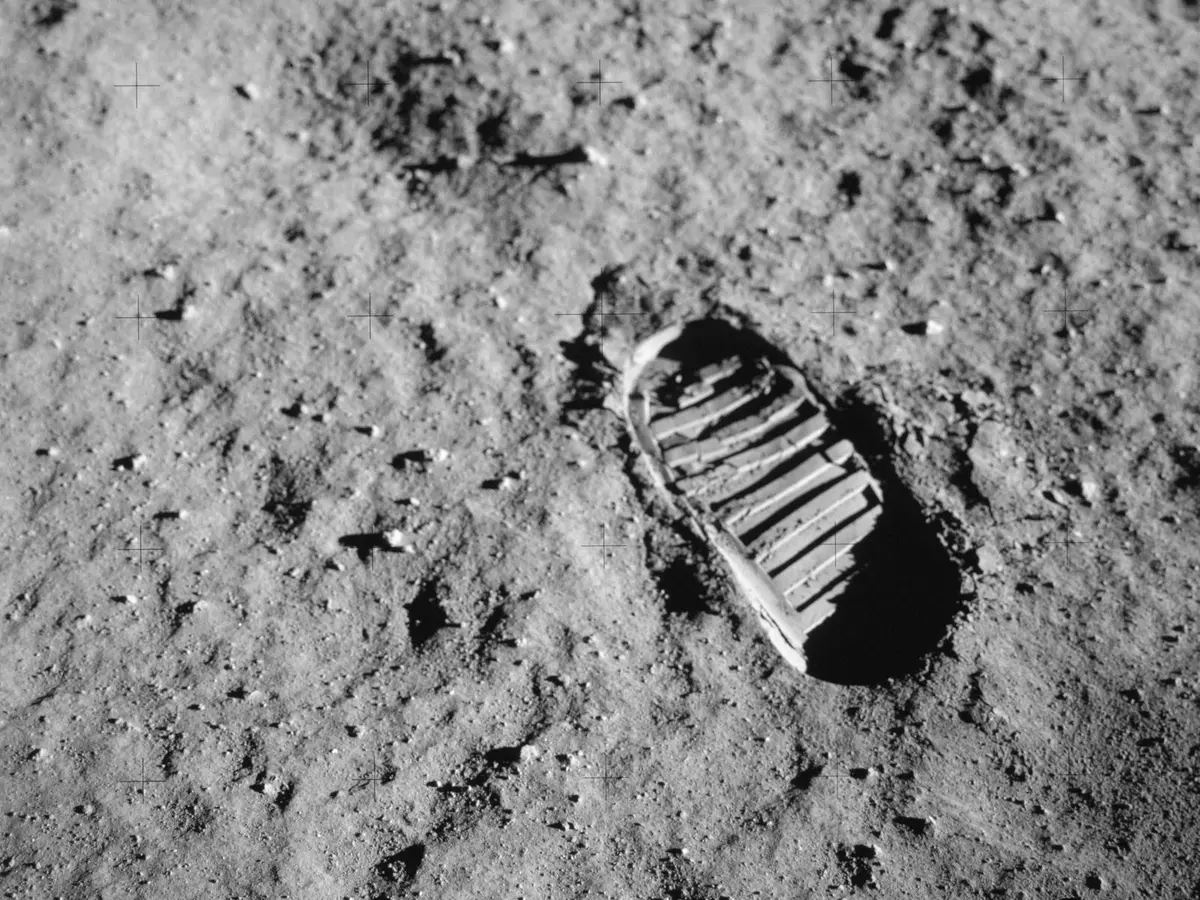
Buzz Aldrin's bootprint in the lunar soil, July 20, 1969 (AS11-40-5878). Buzz Aldrin / NASA. Armstrong, on the surfaceThat’s one small step for man, one giant leap for mankind.
A call from the Oval Office
President Nixon calls the two men on the Moon from the Oval Office and tells them it has to be the most historic telephone call ever made. Armstrong answers that it is an honor to be there representing not only the United States but men of peace of all nations.
Off the Moon
Eagle’s ascent engine has no backup. It has to work the first time, and it does. Overhead, Collins has spent more than a day circling the Moon alone, cut off from every other human being each time he passes behind the far side. Four hours after liftoff from the surface, the crew is back together in Columbia, headed home.
Splashdown
Columbia hits the Pacific southwest of Hawaii. Navy frogmen reach the capsule within minutes, and the carrier USS Hornet brings the crew aboard, with President Nixon on deck to welcome them home. Kennedy’s deadline is met with five months to spare.

The crew

Navy fighter pilot with 78 combat missions over Korea, then an X-15 test pilot who flew it to 207,500 feet. In 1966 he saved Gemini 8 from a violent spin. First human to walk on the Moon.

Air Force fighter pilot who flew 66 combat missions in Korea and shot down two MiGs. Earned a doctorate at MIT in orbital rendezvous, the technique spacecraft still use to meet in space.

Air Force test pilot and Gemini 10 spacewalker. Flew Columbia alone around the Moon and brought his crewmates home. Later ran the Smithsonian’s National Air and Space Museum and opened its building on the Mall.

Former Air Force fighter pilot who led the team that landed Eagle. He polled the room for go or no-go and held his controllers steady through the alarms.
By the numbers
In pictures


Watch, listen, see
Films, photographs and first-hand accounts from across the web. Each opens in a new tab.

NASA’s complete broadcast of the first moonwalk, from Armstrong’s first step to the hatch closing.
NASA
President Kennedy’s 1962 Rice University address that set America’s course for the Moon.
NASA
Film and mission audio of Eagle’s powered descent, from engine ignition to touchdown.
Apollo Flight Journal
Every minute of Apollo 11 replayed as it happened: Mission Control audio, film, TV and photos.
Apollo in Real Time
A high-resolution 3D scan, inside and out, of the command module that carried the crew home.
Smithsonian
130 high-resolution scans of the film roll that holds Apollo 11’s most famous surface photographs.
Project Apollo Archive
The annotated, minute-by-minute transcript of the landing and moonwalk, with photos, audio and video.
Apollo Lunar Surface Journal
The landing’s flight director recounts the alarms and split-second calls of the first lunar descent.
NASA JSC Oral History Project“We choose to go to the Moon in this decade and do the other things, not because they are easy, but because they are hard.”
President John F. Kennedy, Rice University, 12 September 1962
After
They left a plaque on Eagle’s descent stage. It reads: “Here men from the planet Earth first set foot upon the Moon, July 1969 A.D. We came in peace for all mankind.”
After three weeks in quarantine, the crew came home to ticker-tape parades in New York, Chicago and Los Angeles on a single day, 13 August 1969. That night President Nixon awarded all three the Presidential Medal of Freedom.
Five more crews followed. Between 1969 and 1972, twelve men walked on the Moon. All twelve were Americans, and no other nation has put a person there since.
Primary sources
- Apollo 11 Mission Report. NASA Manned Spacecraft Center, November 1969.
- Apollo Lunar Surface Journal: Apollo 11. NASA.
- Address at Rice University on the Nation’s Space Effort, President John F. Kennedy, 12 September 1962.