Orbit of the Moon · 24 December 1968 · Borman, Lovell, Anders
All of You on the Good Earth
Three Americans rode a rocket no crew had ever flown, left the Earth behind and circled the Moon on Christmas Eve. They came home with a picture of the whole world.

The moment · 11:39 EST · 24 December 1968
Apollo 8 is on its fourth orbit, rolling slowly 69 miles above the Moon. Bill Anders looks out his window and sees the Earth coming up over the gray horizon, blue and white. He shoots one black-and-white frame. Then he shouts for color film.
Oh, my God! Look at that picture over there! Here’s the Earth coming up. Wow, is that pretty!Bill Anders, onboard recording
In August 1968 the lunar module was running months late, and the Soviet Union was racing to send cosmonauts around the Moon. George Low, who ran the Apollo spacecraft program, proposed a bold answer: send the next crew to the Moon without a lander, on the Saturn V’s first flight with people aboard. Four months later, Apollo 8 was on the pad.
A plan to go now
George Low lays out his idea for center director Bob Gilruth and flight operations chief Chris Kraft. Kraft has already checked it: Mission Control and the spacecraft computer can do it. Deke Slayton orders Frank Borman back to Houston and offers him the Moon. Borman says yes on the spot. That afternoon Low sells the plan in Wernher von Braun’s office in Huntsville. NASA makes it official on 12 November.
Liftoff
Launch Complex 39A, Kennedy Space Center. The Saturn V has flown twice, both times without a crew, and on its last flight in April it shook violently and lost two engines. This time it carries three men. Five F-1 engines put out 7.5 million pounds of thrust. “Lift off. The clock is running,” Borman reports. Under twelve minutes later, Apollo 8 is in orbit.
Go for TLI
The call comes from Michael Collins, who trained on this crew until spine surgery cost him his seat. Twenty-three minutes later the third stage relights for translunar injection and burns for 5 minutes 19 seconds. Apollo 8 climbs out of Earth orbit at 24,200 miles per hour. No human has ever been higher than 850 miles. They are headed for 240,000.
Mike Collins, capsule communicatorApollo 8. You are Go for TLI.
Behind the Moon
After 66 hours of coasting, Apollo 8 swings behind the Moon and out of radio contact. On the far side, alone, the crew fires the main engine for four minutes. It has to light and it has to stop on time, and no one on Earth can see it happen. Houston waits. Then Lovell’s voice: “Burn complete.” They are the first humans in lunar orbit, and the first to see the far side with their own eyes.
Earthrise
On the fourth orbit the ship rolls, and Anders sees the Earth coming up over the lunar horizon. He takes one black-and-white frame, then shouts for color film. Lovell digs out a magazine and hands it over. Anders shoots two color frames through the right-hand window. The first, AS08-14-2383, becomes one of the most famous photographs ever taken.
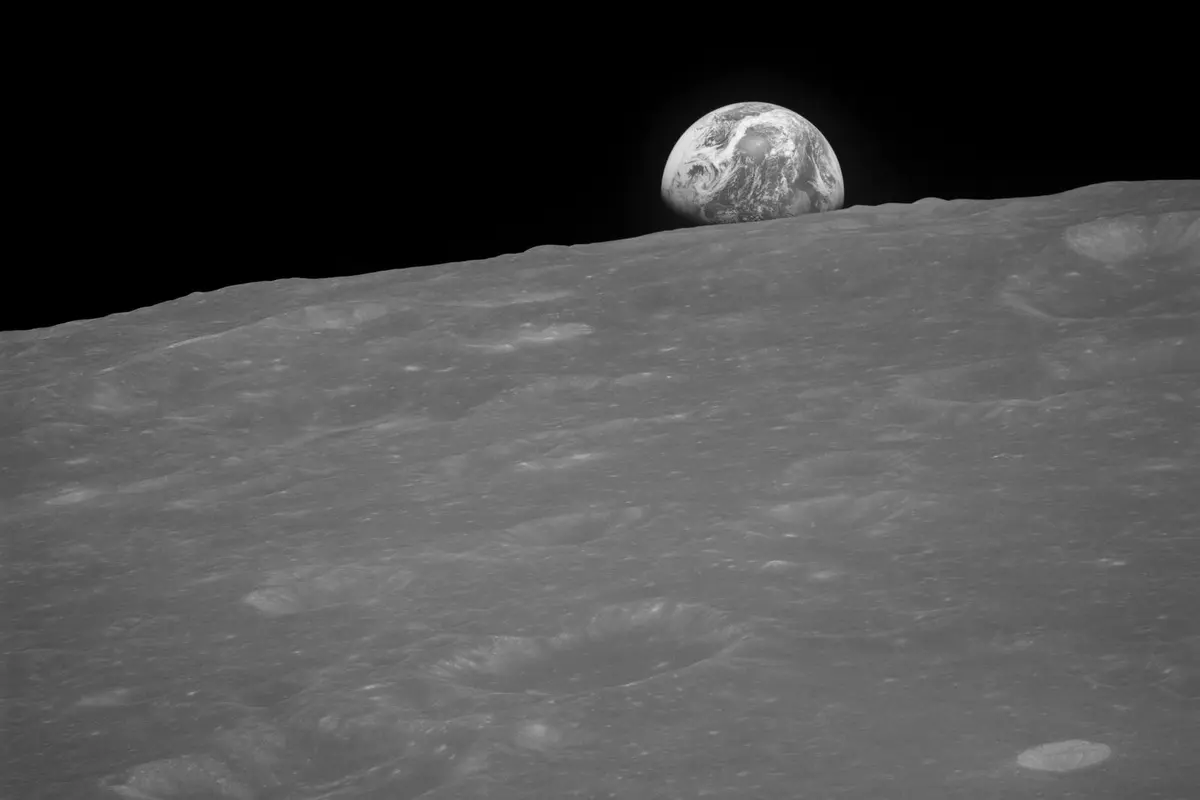
The first photograph of an Earthrise, the black-and-white frame Anders took seconds before he got color film (AS08-13-2329). Bill Anders / NASA. Christmas Eve
On the ninth orbit the crew goes live on television. Borman calls the Moon “a vast, lonely, forbidding-type existence.” Lovell calls the Earth “a grand oasis in the big vastness of space.” As lunar sunrise nears, Anders begins: “In the beginning, God created the Heaven and the Earth.” Lovell and Borman take turns through the tenth verse. An estimated one billion people in 64 countries are watching.
A Santa Claus
On the tenth orbit, behind the Moon again, the main engine must fire for three and a half minutes or the crew stays in lunar orbit for good. It fires for 204 seconds. Minutes later Apollo 8 comes around the edge of the Moon headed for home, and it is Christmas morning in Houston. Lovell keys the radio.
Jim Lovell, after the burnPlease be informed there is a Santa Claus.
Splashdown
The command module hits the atmosphere at 24,700 miles per hour, faster than any crew has ever come home. It lands in the dark in the central Pacific, about 1,000 miles south-southwest of Hawaii and within 5,000 yards of the carrier USS Yorktown. The crew rides the swells until first light. Navy swimmers reach them at dawn, and by 12:20 EST all three are aboard.
The crew and the man who sent them

West Point graduate, Air Force fighter pilot and test pilot. Commanded Gemini 7’s record two weeks in orbit. After the 1967 fire he led the team that rebuilt the Apollo spacecraft. Offered the Moon in August 1968, he said yes on the spot.

Naval Academy graduate and Navy test pilot who flew Gemini 7 with Borman and commanded Gemini 12. On Apollo 8 he was the navigator, fixing their path to the Moon and home with star sightings through the sextant.

Naval Academy graduate who flew Air Force all-weather interceptors and earned a master’s in nuclear engineering. A rookie on Apollo 8, he ran the photography and took Earthrise. Later first chairman of the Nuclear Regulatory Commission and ambassador to Norway.

Born in Vienna, he came to America in 1940 and served in the U.S. Army. After the 1967 fire he took over the Apollo spacecraft and made it flightworthy. In August 1968 he proposed sending Apollo 8 to the Moon.
By the numbers
In pictures


Watch, listen, see
Films, photographs and first-hand accounts from across the web. Each opens in a new tab.

NASA rebuilds the moment from orbiter data, window by window, with the crew’s own onboard audio.
NASA Goddard
NASA’s short film on the first crew to leave Earth and their Christmas Eve in lunar orbit.
NASA
NASA’s 1969 film of the first flight around the Moon, with the crew at work and the Earth from lunar orbit.
U.S. National Archives
All three astronauts tell the story of the first flight to the Moon, 40 years later, in Washington.
Smithsonian National Air and Space MuseumThe commander on taking the mission, the burns behind the Moon and choosing Genesis for Christmas Eve.
NASA JSC Oral History ProjectThe lunar module pilot on the mission change, the flight and the first Earthrise he saw.
NASA JSC Oral History Project
Every word from launch to splashdown, onboard and air-to-ground, with photos, audio and expert notes.
Apollo Flight Journal
All 152 high-resolution scans of magazine 14/B, the color roll that holds Earthrise.
Project Apollo Archive“And from the crew of Apollo 8, we close with good night, good luck, a Merry Christmas and God bless all of you, all of you on the good Earth.”
Frank Borman, commander, from lunar orbit, 24 December 1968
After
Telegrams poured in when they got home. One, from a well-wisher no one could name, read: “Thank you Apollo 8. You saved 1968.” Time magazine named the three its Men of the Year, and on 9 January 1969 they addressed a joint session of Congress.
In May 1969 the Post Office put Earthrise on a six-cent stamp with four words from the broadcast: “In the beginning God.”
Apollo 8 proved the Saturn V, the spacecraft, the navigation and Mission Control at the distance of the Moon. Seven months later, Apollo 11 landed. Lovell went back on Apollo 13 and became the first man to fly to the Moon twice.