Between Earth and the Moon · 13 April 1970 · Lovell, Swigert, Haise and Mission Control
Houston, We’ve Had a Problem
An oxygen tank blew up more than 200,000 miles from home. Three astronauts and Mission Control worked out the way back, one problem at a time.

The moment · 21:08 CST · 13 April 1970
Swigert flips the switch to stir the oxygen tanks. A bang. A shudder runs through Odyssey and the warning lights come on. More than 200,000 miles from home, with the Moon still ahead, he keys the radio. Seconds later Lovell says it again.
Okay, Houston, we’ve had a problem here.Jack Swigert, Command Module Pilot
Apollo 13 was bound for the Fra Mauro highlands, America’s third Moon landing. Fifty-six hours out, an oxygen tank in the service module exploded and took most of the ship’s oxygen, power and water with it. The landing was off. The new mission was to bring three men home alive in a spacecraft that was dying around them.
Liftoff
Apollo 13 lifts off from Launch Complex 39A. Jack Swigert is aboard because the prime command module pilot, Ken Mattingly, was exposed to German measles; Swigert took his seat two days before launch. Five and a half minutes up, the second stage’s center engine shuts down 132 seconds early. The other four burn 34 seconds longer, the third stage makes up the rest, and Apollo 13 heads for the Moon.
The bang
Nine minutes after the crew signs off a TV tour of Aquarius, Houston asks Swigert to stir the oxygen tanks. He flips the switch. A bang, a shudder, warning lights. CapCom Jack Lousma asks him to say again, and Lovell answers: “Houston, we’ve had a problem. We’ve had a Main B Bus Undervolt.” Fourteen minutes later Lovell looks out the window. They are venting something, a gas, into space.
Jack Swigert to Mission ControlOkay, Houston, we’ve had a problem here.
Into the lifeboat
Flight director Gene Kranz steadies his room: “Let’s everybody keep cool, we got the LM still attached, the LM spacecraft’s good.” Oxygen tank 1 is draining too, and Odyssey is dying. Glynn Lunney’s team takes the next shift and moves the crew into Aquarius. Lovell and Haise power up the lunar module while Swigert shuts Odyssey down, saving its batteries for reentry. A ship built to carry two men to the Moon now has to keep three alive.
Around the Moon
A 34-second burn of Aquarius’s descent engine has put them back on a path that swings around the Moon and falls home. Behind the far side, about 160 miles up, they reach 248,655 miles from Earth, farther than humans had ever gone. Two hours past the Moon, Kranz polls his controllers, and the descent engine fires for 4 minutes 24 seconds. Splashdown moves from about 152 hours to about 143, and from the Indian Ocean to the Pacific.
Square peg, round hole
Aquarius carries round carbon dioxide canisters meant for two men. With three aboard, the CO2 reading climbs to 14.9 millimeters of mercury. Odyssey has plenty of canisters, but they are square. In Houston, Ed Smylie’s Crew Systems team builds an adapter from things the crew has on board. CapCom Joe Kerwin reads it up step by step: plastic bags, a cardboard cue card, suit hoses and gray tape. Swigert builds it in about an hour, and the level falls.
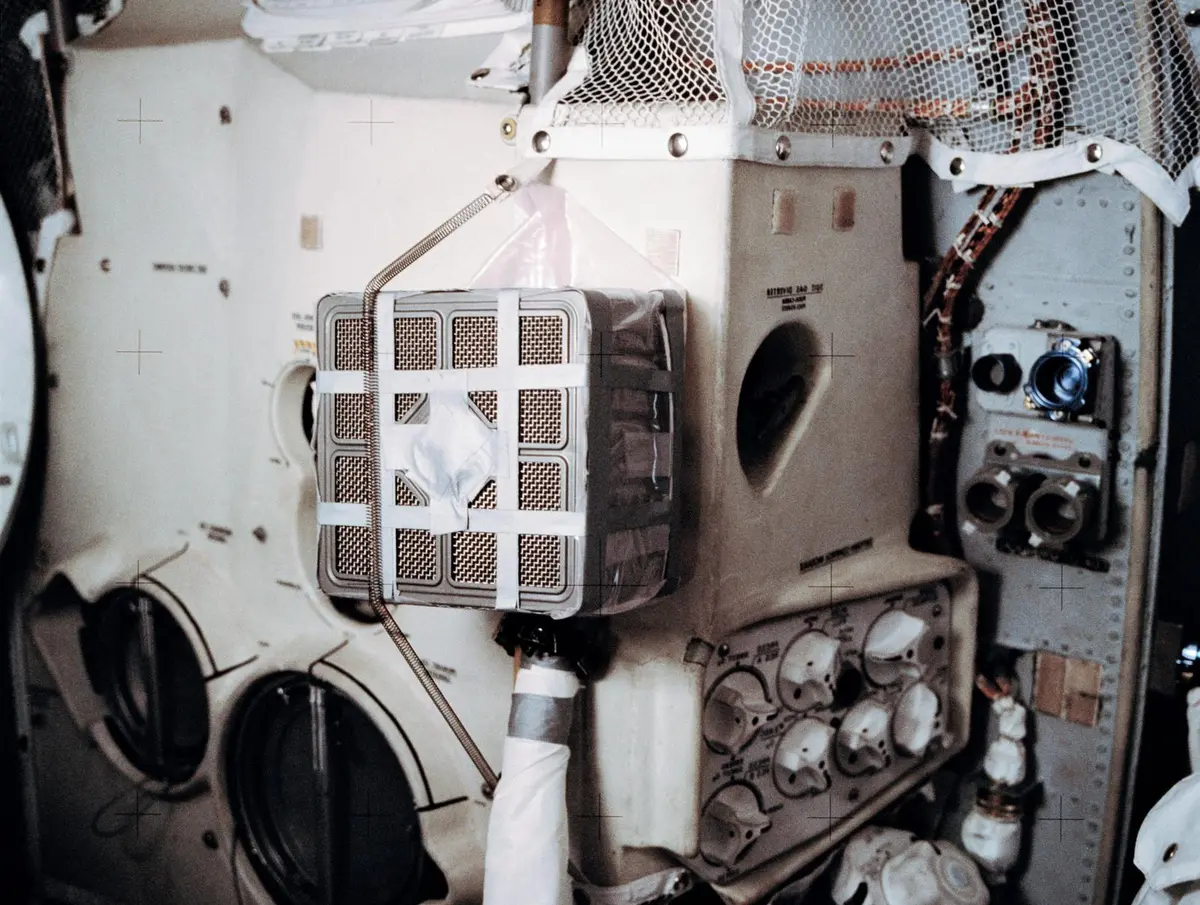
The “mailbox”: square command module canisters taped into Aquarius’s air system to scrub carbon dioxide (AS13-62-8929). Apollo 13 crew / NASA. Steering by the Earth
Their path is drifting too shallow for a safe entry, and the guidance computer is off to save power. So the crew aims by eye. Lovell lines up the Earth’s day-night line in the crosshairs of Aquarius’s window sight, with the Sun at the top of the telescope. Haise holds pitch, Lovell holds roll and Swigert calls the start and stop. The descent engine fires for 14 seconds at 10 percent thrust. It works.
One whole side missing
The evening before, Ken Mattingly, bumped from the flight by the measles scare, read up the checklist to bring Odyssey back to life on the little battery power left. The cabin has fallen to about 43 degrees. Now the crew casts off the service module and sees the damage for the first time. Lovell: “There’s one whole side of that spacecraft missing.” Swigert powers Odyssey up, and it wakes.
Splashdown
The crew casts off Aquarius an hour before entry. Odyssey hits the atmosphere at about 36,000 feet per second and the radio goes silent. The blackout runs longer than predicted. Then Swigert’s voice comes through: “Okay, Joe.” Three good main parachutes. Odyssey splashes down four miles from the USS Iwo Jima, and the crew is aboard within 45 minutes. In Mission Control, the flight directors cheer and the cigars come out.
CapCom Joe Kerwin, as Aquarius drifts awayFarewell, Aquarius, and we thank you.

The crew

Naval Academy graduate and Navy test pilot. Flew Gemini 7, commanded Gemini 12 and flew Apollo 8, the first crew to orbit the Moon. On Apollo 13 he brought a crippled ship home and became the first man to fly to the Moon twice.

Air Force fighter pilot in Japan and Korea, then a test pilot for Pratt & Whitney and North American. A command module specialist, he joined the crew two days before launch, shut Odyssey down to save it, then brought it back to life for reentry.

Marine Corps fighter pilot and NASA research pilot, backup lunar module pilot for Apollo 8 and 11. He knew Aquarius switch by switch, brought it to life as a lifeboat and kept it running for three and a half days. Later flew the shuttle Enterprise.

Air Force fighter pilot who served in Korea, then joined NASA’s Space Task Group. His team was on console when the tank blew. He kept the room calm, then led the planning of the trip home: power, water, course corrections and the power-up of Odyssey.
By the numbers
In pictures


Watch, listen, see
Films, photographs and first-hand accounts from across the web. Each opens in a new tab.

Lovell, Haise, Gene Kranz and Glynn Lunney retell the rescue, partly from the restored Apollo Mission Control room.
NASA
NASA’s 50th-anniversary film of the explosion and the teamwork in Mission Control that brought the crew home.
NASA
Apollo 13 replayed minute by minute as it happened, with Mission Control voice loops, film and photos.
Apollo in Real Time
The full air-to-ground transcript, annotated minute by minute, from launch through the bang to splashdown.
Apollo Flight Journal
Crew Systems chief Ed Smylie on designing the carbon dioxide adapter that kept the crew breathing.
NASA JSC Oral History Project
The flight director tells his story, from landing Apollo 11 to bringing the Apollo 13 crew home.
C-SPAN
95 scans of the film magazine that caught the blown-out service module and Aquarius drifting away.
Project Apollo Archive
President Nixon honors the Mission Operations Team in Houston for “one of the most dramatic rescues of all time.”
The American Presidency Project“The three astronauts did not reach the moon but they reached the hearts of millions of people in America and in the world.”
President Richard Nixon, Manned Spacecraft Center, Houston, 18 April 1970
After
The day after splashdown, President Nixon flew to Houston and presented the Presidential Medal of Freedom to the Apollo 13 Mission Operations Team, with Gene Kranz and his fellow flight directors standing beside him. The same day, at Hickam Air Force Base in Hawaii, he gave the medal to Lovell, Swigert and Haise.
Within two months a NASA review board traced the explosion to heater switches inside the oxygen tank, and the system was rebuilt. On 5 February 1971, Apollo 14 landed at Fra Mauro, the site Apollo 13 never reached.
Odyssey is on display today at the Cosmosphere in Hutchinson, Kansas. Apollo 13’s record of 248,655 miles from Earth stood for 56 years, until the Artemis II crew passed it on 6 April 2026.