Valley Forge, Pennsylvania · 19 December 1777 – 19 June 1778 · Washington’s Continental Army
Without a Murmur
Twelve thousand beaten, hungry men marched into the woods for the winter. Six months later a drilled, disciplined American army marched out.

The moment · Midday · 6 May 1778
The army stands in two long lines on the Grand Parade. Thirteen cannon fire. Then a running fire of muskets races down the front line and back up the second, man after man, without a break. Three times over. Then thousands of voices shout together.
God save the American States!The army’s shout, as officer George Ewing recorded it
In the fall of 1777 the British took Philadelphia, the American capital. Washington’s army fought them at Brandywine and Germantown and lost both times. On 19 December about 12,000 tired, hungry men marched into winter quarters at Valley Forge, 20 miles away, many without shoes. They had to survive the winter and come out ready to beat the best army in the world.
Into the woods
The army comes up the road from Gulph Mills in the cold and takes the high ground above the Schuylkill River. The plateau is a natural fortress, and from it the army can watch the roads to Philadelphia, 20 miles off. Lt. Samuel Armstrong writes that on the march they had nothing to eat or drink. Once in camp they bake bread and, he writes, eat like insatiate monsters. Most men sleep in tents or brush shelters.
A city of logs
Washington’s general orders have already laid it out. Every squad of twelve builds its own hut, 14 by 16 feet, with log walls 6½ feet high chinked with clay, a roof of split slabs and a fireplace in the rear lined with 18 inches of clay. He offers $12 to the fastest, best-built hut in each regiment. Within weeks 1,500 or more huts stand in brigade streets. The camp becomes the fourth-largest city in America.
Starve, dissolve or disperse
The commissaries have failed. Meat runs out, and men live on firecake, flour and water baked on hot stones. Washington writes Henry Laurens, the President of Congress, that unless a great and capital change comes, the army must starve, dissolve or disperse. Soon he moves from his tent into a small stone house by the forge. He stays with his army all winter.
Washington to the President of CongressStarve—dissolve—or disperse.
Naked and starving
A committee of Congress arrives on 24 January and sees the camp for itself. In mid-February Washington writes that there has been little less than a famine in camp. He adds that, naked and starving as they are, he cannot enough admire the incomparable patience and fidelity of the soldiers. Disease is the real killer. Typhus, typhoid, dysentery and influenza will take nearly 2,000 lives before June. The army does not break.
A Prussian volunteer
Friedrich Wilhelm von Steuben rides into camp. He served as a captain in the Prussian army, the most disciplined in Europe, and as an aide to Frederick the Great. He comes as a volunteer and agrees to be paid only after the war is won. He speaks little English, so each night he writes the next day’s drill in French. Pierre Duponceau, Alexander Hamilton and John Laurens put it into English.
Greene takes the supply job
Congress makes Nathanael Greene quartermaster general at Washington’s urging. Greene wants to fight, not keep accounts, but takes the job on 23 March. He hires wagons and drivers, buys horses and tents, and with his forage chief Clement Biddle orders 200,000 bushels of grain stocked in depots along the army’s routes. The Schuylkill thaws, and supplies come downriver from Reading. By spring the army is eating.
The model company
Steuben’s school opens with 100 picked men drawn from every brigade. He drills them himself, in the open, with the army watching. How to stand. How to march at 75 steps a minute, and 120 at the quick step. How to load fast, wheel in line and charge with the bayonet. The men he trains go back and train their regiments. Within weeks the whole army is drilling. Private Joseph Plumb Martin calls it a continual drill.
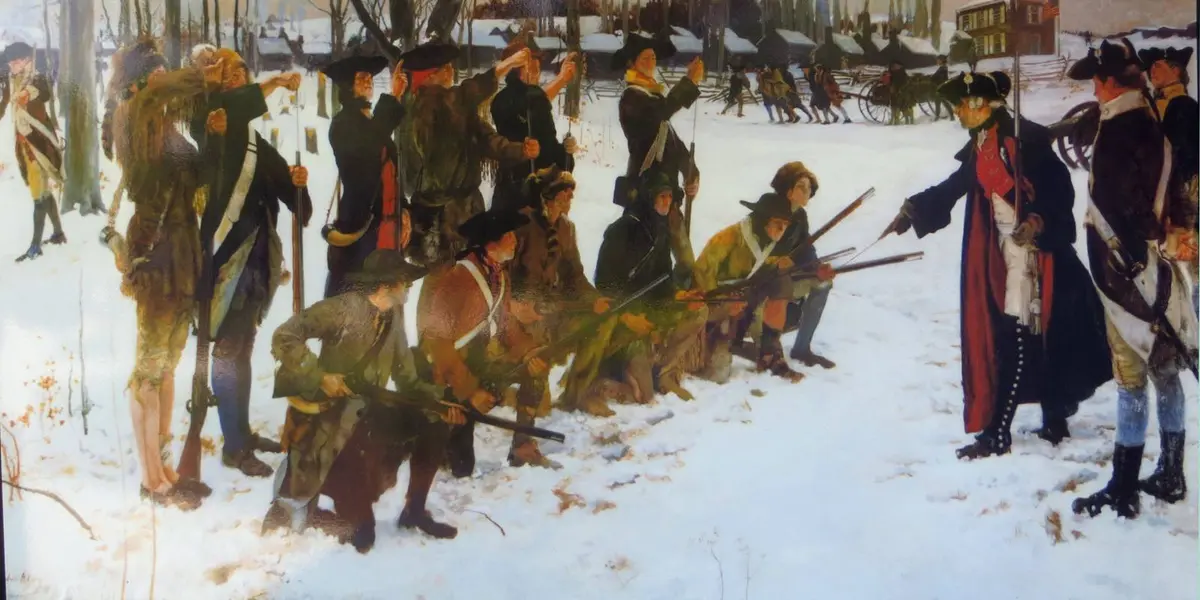
Baron von Steuben drills American troops in the snow at Valley Forge (Edwin Austin Abbey).. Edwin Austin Abbey. Steuben, writing to an old Prussian comradeYou say to your soldier, ‘Do this,’ and he doeth it; but I am obliged to say, ‘This is the reason why you ought to do that,’ and then he does it.
Fire of joy
France has signed a treaty of alliance and recognized the United States. The army’s password for the day is France, the countersigns Franklin and Frederick. Chaplains read the news to every brigade. Then the army parades and fires a feu de joie: three rounds of thirteen cannon, each followed by a running fire of muskets down the whole line. Washington pardons two men under sentence of death, and every soldier gets a gill of rum.
The test
The British leave Philadelphia for New York. On 19 June the last brigades march out, six months to the day after the army marched in. Nine days later they catch the British at Monmouth Court House, New Jersey, in brutal heat. When the advance guard falls back, Washington rides forward and rallies it. The regiments keep their order, as Steuben taught them, and form a line that holds. That night the British slip away and leave the Americans the field.

The men

Virginia planter and veteran of the French and Indian War, commander in chief since June 1775. At Valley Forge he stayed with his men all winter, pressed Congress for food and clothing and backed Steuben’s drill from the first day.

Prussian army veteran and aide to Frederick the Great who came to America as a volunteer. He trained the army in weeks and wrote the drill into the Blue Book. Made a major general in May 1778, and later an American citizen.

Raised a Quaker in Rhode Island, he ran his family’s iron forge, taught himself war from books and was a general at 32. He took the supply job no one wanted, rebuilt it in three months and got the army fed and ready to march.
By the numbers
In pictures


Watch, listen, see
Films, photographs and first-hand accounts from across the web. Each opens in a new tab.

The Valley Forge park film: the winter encampment of 1777–78, told where it happened.
National Park Service
Park ranger David Lawrence on the hardships and achievements of the winter at Valley Forge.
American Battlefield Trust · YouTube
The park’s classic orientation film on the Continental Army’s six months at Valley Forge.
Valley Forge NHP · YouTube
How the soldiers built their own huts, and who lived in each kind of shelter.
National Park Service
Follow a ranger’s drill commands, then watch a musket-firing demonstration on the old camp.
National Park Service
The 1779 first edition of Regulations for the Order and Discipline of the Troops, with its plates.
Library of Congress
Washington’s 21 April 1778 letter from Valley Forge praising his soldiers’ patience and obedience.
Library of Congress
Huts, rations, ovens, trees and soldiers: the encampment counted out by the park’s rangers.
National Park Service“To see men without Cloathes to cover their nakedness—without Blankets to lay on—without Shoes, by which their Marches might be traced by the Blood from their feet… and submitting to it without a murmur, is a Mark of patience & obedience which in my opinion can scarce be parallel’d.”
George Washington to John Banister, Valley Forge, 21 April 1778
After
Congress ordered Steuben’s Regulations observed by every soldier of the United States on 29 March 1779. Bound in blue paper covers, the Blue Book stayed the Army’s drill manual until the War of 1812. Valley Forge is remembered as the birthplace of the American army.
Steuben became an American citizen and served as Washington’s inspector general to the end of the war. Greene went south in 1780 to command the Southern army and drove the British back into Charleston and Savannah.
Valley Forge became Pennsylvania’s first state park in 1893 and a national historical park on 4 July 1976. The National Memorial Arch, dedicated on 19 June 1917, carries Washington’s words: Naked and starving as they are, we cannot enough admire the incomparable patience and fidelity of the soldiery.
Primary sources
- What Happened at Valley Forge. Valley Forge National Historical Park, National Park Service.
- General Orders, 18 December 1777, and 5–6 May 1778. George Washington Papers, Library of Congress.
- Erna Risch, Supplying Washington’s Army. U.S. Army Center of Military History, 1981.