St. Joseph, Missouri, to Sacramento, California · 3 April 1860 · Russell, Majors and Waddell’s riders
Ten Days to San Francisco
Before the telegraph crossed the West, young men on fast horses carried the news. They ran the mail 1,966 miles from Missouri to California in ten days, through desert, snow and war.

The moment · May 1860 · Buckland’s Station, Nevada
Pony Bob Haslam rides into Buckland’s with 75 miles behind him. His relief refuses to take the mail into the war country ahead. The superintendent offers fifty dollars. Within ten minutes Haslam is back in the saddle, rifle and revolver ready, riding east into the desert.
I will go at once.Robert “Pony Bob” Haslam, to superintendent W. C. Marley
In 1860 California had 380,000 people and no fast way to hear from the rest of the Union. The fastest message ever carried between New York and San Francisco by stagecoach had taken 21 days. William H. Russell promised ten days on horseback, from the end of the telegraph at St. Joseph, Missouri, to Sacramento. His firm built the line in about two months. Then the riders kept his promise.
The race is announced
Russell, Majors and Waddell have built the line in about two months: some 190 stations, 400 to 500 horses, 200 station keepers and 80 riders. Every rider swears an oath on the Bible not to curse, drink or fight. Now the firm takes out advertisements in the New York Herald and the Missouri Republican. The first rider will leave the Missouri River on Tuesday, 3 April.
Advertisement, New York Herald, 26 March 1860The letter mail will be delivered in San Francisco in ten days from the departure of the express.
Away from St. Joseph
The mail train from the East runs two hours late, and the railroad sends a special locomotive racing across Missouri. The pouch holds 49 letters, five telegrams and some newspapers. Mayor M. Jeff Thompson, Russell and Majors make speeches. Then Russell hands the mochila to the first rider. A cannon fires, the crowd cheers, and he gallops for the ferry Denver and Kansas Territory. Accounts disagree on his name: Johnny Fry or Billy Richardson.
Eastbound
The same day, the first eastbound mail leaves San Francisco by steamer for Sacramento. In the small hours Harry Roff rides out of Sacramento in a hard rain. Relays carry the pouch over the Sierra Nevada, where pack trains of mules have tramped a trail through the snow, then across the Nevada desert. On 7 April the first rider from the West reaches Salt Lake City.
Across the Great Basin
The westbound mail reaches Salt Lake City at 6:45 p.m. on 9 April. The Deseret News gives the credit to the enterprising and persevering men behind it. Each rider runs 75 to 100 miles, changing horses every 10 to 15, and the pouch keeps moving at about 10 miles an hour, day and night. It crosses the deserts of Utah and Nevada and reaches Carson City at 2:30 p.m. on 12 April.
Ten days
The rider gallops into Sacramento exactly ten days out of St. Joseph. The legislature adjourns in his honor. Bells ring, cannon boom and ladies crowd the balconies. The mail, with President Buchanan’s congratulations to Governor Downey, goes on by the steamer Antelope. San Francisco greets it after midnight with bonfires and a band playing “See the Conquering Hero Comes.” The Pony Express has crossed the continent on schedule.
Pony Bob rides on
War has broken out with the Paiutes, and stations across Nevada are raided and burned. Haslam reaches Buckland’s after 75 miles and his relief refuses to go. Superintendent W. C. Marley offers fifty dollars. Haslam rides on: 35 miles to the Carson Sink, 30 to Sand Springs, 37 to Cold Springs, 30 to Smith’s Creek. After nine hours’ rest he carries the return mail back, finds the Cold Springs keeper killed, and warns Sand Springs to clear out.
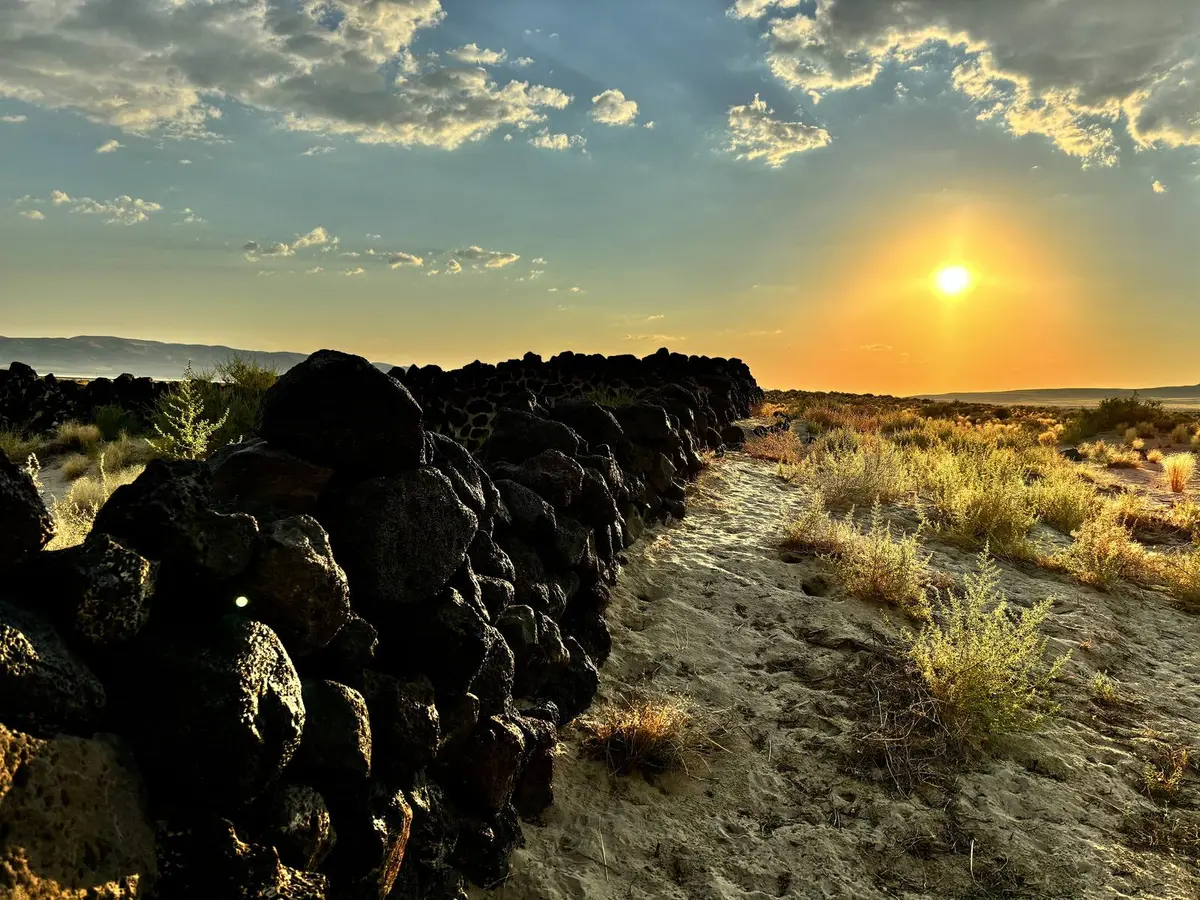
Sunset over the lava-rock walls of Sand Springs station, Nevada, where Pony Bob Haslam changed horses on his 380-mile ride in May 1860.. BLM Nevada / Bureau of Land Management. Haslam, recalling the rideI had travelled three hundred and eighty miles within a few hours of schedule time, and was surrounded by perils on every hand.
Lincoln is elected
The eastern telegraph ends at Fort Kearny, Nebraska, and the company has put every station on alert. At 1 p.m. a rider and horse decked in ribbons leave with the news of Abraham Lincoln’s election. Through heavy snow, the relays reach Salt Lake City in three days and four hours. From the telegraph at Fort Churchill, Nevada, the news reaches San Francisco within the five days the company promised.
The fastest run
Seven states have left the Union, and California waits to hear what the new president will say. Lincoln’s first inaugural address, given on 4 March, goes west by pony. Station keepers lead fresh horses out to meet incoming riders. Pony Bob Haslam covers 120 miles from Smith’s Creek to Fort Churchill in a little over eight hours. The address crosses from St. Joseph to Sacramento in 7 days and 17 hours, the fastest run the Pony Express ever made.
The wire
All summer, telegraph crews have pushed east from California and west from Nebraska, and every 50 miles of new wire cuts five hours off the news. On 24 October the lines meet at Salt Lake City. Chief Justice Stephen J. Field wires President Lincoln California’s loyalty to the Union. Two days later the Pony Express ends. In 308 runs each way, its riders have covered 616,000 miles.

The founders and the riders

Vermont-born merchant who built the country’s leading freight line with Majors and Waddell. He talked his doubtful partners into the Pony Express, had it running in about two months, and handed the first mochila to the first rider at St. Joseph.

Kentucky-born freighter who once took an ox train to Santa Fe and back in a record 92 days. He bought up to 500 horses, hired the station men and riders, and had every rider swear an oath against cursing, drinking and fighting.

London-born rider who helped build the Nevada stations. In May 1860 he rode some 380 miles through war country when his relief refused to go. On the record Lincoln run in 1861 he covered 120 miles in a little over eight hours.

Wiry young rider of under 125 pounds who ran the 80-mile leg out of St. Joseph at about 12½ miles an hour. Many accounts make him the first rider of all; others name Billy Richardson. He fell fighting for the Union in 1863.
By the numbers
In pictures


Watch, listen, see
Films, photographs and first-hand accounts from across the web. Each opens in a new tab.

The Smithsonian on the Pony Express and its 1,966-mile relay that tied Missouri to California.
Smithsonian National Air and Space Museum
A living-history interpreter, as the Sierra rider “Boston,” tells what life in the saddle was like.
Smithsonian National Postal Museum
Writer Will Grant on riding the whole 2,000-mile trail on horseback over four and a half months.
Smithsonian Sidedoor
The Postal Service’s own history: the oath, the mochila, and Lincoln’s address in 7 days 17 hours.
United States Postal Service Historian
The opening run of April 1860, from the cheering crowds at St. Joseph to San Francisco.
National Park Service
The Park Service’s full history of the Pony Express, station by station along the route.
National Park Service
A rare photograph of a working Pony Express rider and his horse, about 1861.
National ArchivesSeventy Years on the Frontier, Alexander Majors’ 1893 memoir, including his chapter on the Pony Express riders.
Project Gutenberg“Another instant a whoop and a hurrah from our upper deck, a wave of the rider’s hand, but no reply, and man and horse burst past our excited faces, and go winging away like a belated fragment of a storm!”
Mark Twain, Roughing It (1872), on the Pony Express rider he saw cross the plains in 1861
After
The Pony Express never paid its way. Majors wrote that its business did not cover a tenth of its costs. But it did what Russell built it to do. It proved that a central route to California could run in every season, and in 1861 the overland mail contract moved to that route.
Pony Bob Haslam rode express for Wells, Fargo & Co. for years afterward. Johnny Fry joined the Union Army and was killed in action in 1863. Alexander Majors went on to supply ties for the Union Pacific Railroad, which joined the continent by rail in 1869.
In 1992 Congress made the route the Pony Express National Historic Trail, across eight states. Hollenberg Station still stands on its original site in Kansas. Every year volunteers of the National Pony Express Association carry the mail over the whole route again, horse to horse, in ten days.