North Atlantic · 19 August 1812 · USS Constitution
Her Sides Are Made of Iron
Two months into a war against the world’s largest navy, a Boston frigate shot a British frigate to pieces in under half an hour and came home with a nickname.

The moment · 18:05 · 19 August 1812
Guerriere has been firing for an hour. Hull holds his fire and closes until the frigates are less than pistol shot apart. Then every American gun fires. British round shot strikes Constitution’s oak side and drops into the sea. In under fifteen minutes, Guerriere’s mizzenmast goes over the side.
Huzza! Her sides are made of iron!A Constitution sailor, as seaman Moses Smith remembered it
In the summer of 1812 the U.S. Navy had 22 commissioned warships. Britain had more than 80 off the American coast alone. On land the war was going badly. On 16 August Gen. William Hull surrendered Detroit. Three days later, far out in the Atlantic, his nephew gave the country its answer.
Built to beat anything her size
The Naval Act of 27 March 1794 orders six frigates. Philadelphia shipbuilder Joshua Humphreys designs them longer, stronger and more heavily armed than any frigate afloat. Constitution goes down the ways at Edmund Hartt’s shipyard in Boston. Her timbers come from Maine to Georgia. Paul Revere supplies her copper bolts and spikes. She costs $302,719.
Five against one
A month into the war, dawn shows Capt. Isaac Hull a British squadron in chase: a ship of the line and four frigates, Shannon and Guerriere among them. Then the wind dies. Hull’s boats tow the 2,200-ton frigate by oar, but British boats tow faster. First Lt. Charles Morris notes the water is only 24 fathoms deep and proposes kedging: row an anchor ahead, drop it, and haul the ship up to it on the capstan.
Capt. Hull to the Secretary of the NavyIt soon appeared that we must be taken, and that our Escape was impossible.
The squall
Hour after hour the crew kedges, pumps drinking water over the side to lighten her, and wets the sails to catch every breath of air. By late afternoon Constitution leads by three or four miles. A rain squall comes on. Hull shortens sail as if to ride it out, and the British copy him. Then he crowds on canvas and runs at 11 knots. By morning the squadron gives up.
Sail ho
Constitution has sailed from Boston on 2 August. Now, southeast of Halifax, the masthead spots a sail. It is HMS Guerriere, 49 guns, the frigate that started the July chase, and this time she is alone. Hull clears for action. His crew gives three cheers and asks to be laid close alongside.
Less than pistol shot
For an hour Guerriere fires broadsides and wears back and forth. Hull answers with nothing and keeps closing. Then he sets the main topgallant and runs up alongside. Every gun fires, loaded with round shot and grape. In less than fifteen minutes Guerriere’s mizzenmast goes by the board and her main yard is shot through. Hull crosses her bow and pours more broadsides into it.
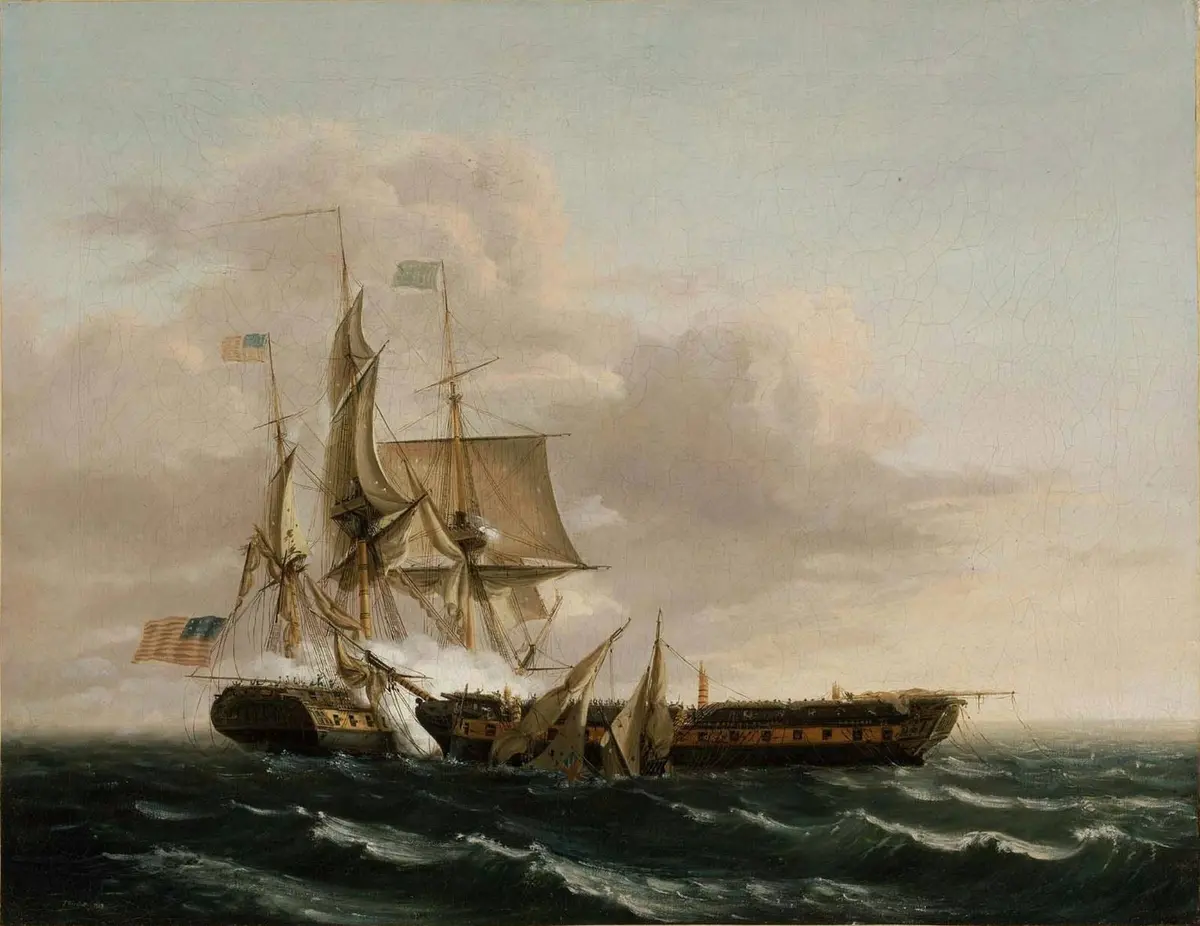
Guerriere’s masts come down under Constitution’s guns (Thomas Birch, 1813).. Thomas Birch. Capt. Hull’s reportBeing alongside, and within less than Pistol Shot, we commenced a very heavy fire from all of our Guns.
Without a spar standing
Guerriere’s bowsprit fouls Constitution’s stern. Hull calls boarders. Marine Lt. William Bush is killed at their head, and Lt. Morris is shot through the body. Then Guerriere’s foremast and mainmast crash over the side, taking every spar but the bowsprit. Hull hauls off to repair rigging and comes back. Capt. James Dacres strikes his colors.
Burned at sea
At daylight Guerriere is a wreck, with more than six feet of planking shot out below the wales. She cannot be towed. Constitution’s boats work through the night and into the afternoon bringing the prisoners and wounded across. Then Lt. George Read sets fire to her storerooms, and she blows up. Constitution sails home to Boston and a hero’s welcome.
Java
Under Commodore William Bainbridge, Constitution meets the British frigate Java. A shot smashes her wheel and Bainbridge is wounded twice. He steers by relaying orders to the tiller room below and keeps fighting. Java is dismasted, her captain mortally wounded. She strikes at 17:25 and is burned. Afterward the Admiralty orders its frigates not to fight American frigates one on one.
Two at once
Capt. Charles Stewart catches two British warships together, Cyane and Levant, and opens fire at 18:05. When Cyane comes up astern, he backs his sails, drives Constitution backward and rakes her. Cyane strikes at 18:45. Levant comes back, is run down after a 90-minute chase, and strikes after 22:00. It is Constitution’s last battle. She has never fired a shot in combat since.
The men

Connecticut merchant master who joined the Navy in 1798 as a lieutenant in Constitution herself and fought Tripoli in Enterprize and Argus. In 1812 he outran a British squadron in July and took Guerriere in August. Congress voted him a gold medal.

Connecticut-born officer whose idea to kedge in 24 fathoms saved the ship in the July calm. Shot through the body against Guerriere, he survived. Hull praised him in both reports. Promoted captain in 1813, he rose to commodore and Navy commissioner.

Philadelphia Quaker shipbuilder appointed naval constructor in 1794. He argued a small navy needed frigates strong enough to beat bigger ships in heavy weather and fast enough to escape them in light winds. Constitution’s iron sides are his design.

Philadelphia-born veteran of the Quasi-War and the fight against Tripoli. On 20 February 1815 he fought Cyane and Levant at once, outmaneuvered both and captured both. Congress voted him a gold medal. He died a rear admiral in 1869, aged 91.
By the numbers
In pictures


Watch, listen, see
Films, photographs and first-hand accounts from across the web. Each opens in a new tab.

The museum’s historian walks through the August 1812 fight that made Constitution “Old Ironsides.”
USS Constitution Museum
Navy historian Margherita Desy on how Constitution beat four British warships and became a legend.
American Battlefield Trust
Footage of the Navy’s oldest commissioned ship heading out of Boston with today’s crew, May 2024.
DVIDSCaptain Hull’s own account of the battle to the Secretary of the Navy, with Captain Dacres’s British report.
Naval History and Heritage CommandHull’s letter on towing, kedging and outsailing a British squadron off New Jersey in July 1812.
Naval History and Heritage Command
Cornelius Tiebout’s 1813 engraving after Thomas Birch of Constitution capturing Guerriere.
Library of Congress
A timeline from first sighting to surrender, with seaman Moses Smith’s eyewitness account of the iron sides.
USS Constitution Museum
Oliver Wendell Holmes’s 1830 poem that roused the country to save the ship from the scrapyard.
Wikisource“Never before in the history of the world did an English frigate strike to an American.”
The Times, London, 1812
After
Congress voted Hull a gold medal and $50,000 for his crew. Bainbridge and Stewart won gold medals of their own. In three battles Constitution beat four British warships, a War of 1812 record no other American warship matched, and she captured 33 vessels in her career.
In 1830 a survey found her unseaworthy, and she faced sale or the scrapyard. A 21-year-old Oliver Wendell Holmes answered with a poem that began “Ay, tear her tattered ensign down!” The country rose up, and Congress paid to rebuild her. A century later American schoolchildren gave $154,000 in pennies to restore her again, and she toured 76 ports from 1931 to 1934.
Today Constitution is the oldest commissioned warship afloat in the world and America’s Ship of State, crewed by active-duty U.S. Navy sailors at the Charlestown Navy Yard in Boston. She sailed on her own in 1997 for her 200th birthday, again on 19 August 2012 for Guerriere’s 200th, and on 4 July 2026 she got under way in Boston Harbor and fired a 21-gun salute for America’s 250th.
Primary sources
- Constitution I (Frigate). Dictionary of American Naval Fighting Ships, Naval History and Heritage Command.
- Capt. Isaac Hull to Secretary of the Navy Paul Hamilton, 28 August 1812, and Capt. James R. Dacres to Vice Adm. Herbert Sawyer, 7 September 1812. Old Ironsides’ Battle Record, Navy Department Library.
- USS Constitution in the War of 1812. Naval History and Heritage Command.