Off Flamborough Head, England · 23 September 1779 · Bonhomme Richard
I Have Not Yet Begun to Fight
His ship was burning and sinking under him. John Paul Jones lashed her to a stronger British frigate and fought on until the British captain struck.

The moment · About 21:00 · 23 September 1779
The two ships lie lashed together under a full moon, and both are on fire. Bonhomme Richard is filling with water. Her gunner is screaming for quarter. Across the rail, Captain Pearson calls out: has she struck? Jones answers with the most determined negative.
I have not yet begun to fight.Capt. John Paul Jones, as Lt. Richard Dale remembered it
In 1779 Britain ruled the sea and the Continental Navy had a handful of ships. John Paul Jones took the war to Britain’s own coast anyway, in a worn-out French merchantman he named for Benjamin Franklin. Off Yorkshire he met a convoy guarded by HMS Serapis, a brand-new frigate with more guns. He closed with her and would not let go.
Whitehaven and the Drake
In the sloop Ranger, Jones lands a raiding party at Whitehaven, on England’s northwest coast. They spike the guns of the fort and set fire to ships in the harbor. The next evening, off Carrickfergus in Ireland, the Royal Navy sloop Drake, 20 guns, comes out to fight. After an hour, Drake strikes her colors. It is the first American victory over a Royal Navy warship in British home waters.
A ship named for Franklin
King Louis XVI buys the French East Indiaman Duc de Duras and gives her to Jones. Jones renames her Bonhomme Richard for his friend and patron Benjamin Franklin, whose Poor Richard’s Almanack sells in France as Les Maximes du Bonhomme Richard. With a crew of Americans, French, Scots, Irish and more, he leads a squadron out of France to sail around the British Isles and strike at British shipping.
A convoy from the Baltic
Off Flamborough Head on the Yorkshire coast, a lookout calls down from the rigging. A great fleet is coming from the north: 41 merchant ships from the Baltic, guarded by the new frigate HMS Serapis and the sloop Countess of Scarborough. Jones crowds on every sail. The wind is so light it takes three and a half hours to close. Captain Richard Pearson sends the convoy in toward shore and turns to meet him.
Answer directly
Jones comes on under British colors. Pearson hails: what ship is that? Jones answers Princess Royal. Pearson demands an answer or he will fire. Jones hauls down the British flag, runs up American colors and fires a full broadside. Serapis answers at once. On Richard’s lower deck, two of the six old 18-pounders burst at the first fire and kill almost every man working them. Jones abandons the rest.
Capt. Richard Pearson, HMS SerapisAnswer directly or I’ll fire into you.
Lashed together
Outgunned, Jones has one chance: get close and stay there. The ships collide. Serapis’s rigging falls across Richard’s deck, and Jones grabs a severed forestay and makes it fast with his own hands, calling for more rope. Pearson drops anchor to tear free, but the lashings hold. The two ships lie side by side, gun muzzles touching. Half of Serapis’s guns now point at empty sea.
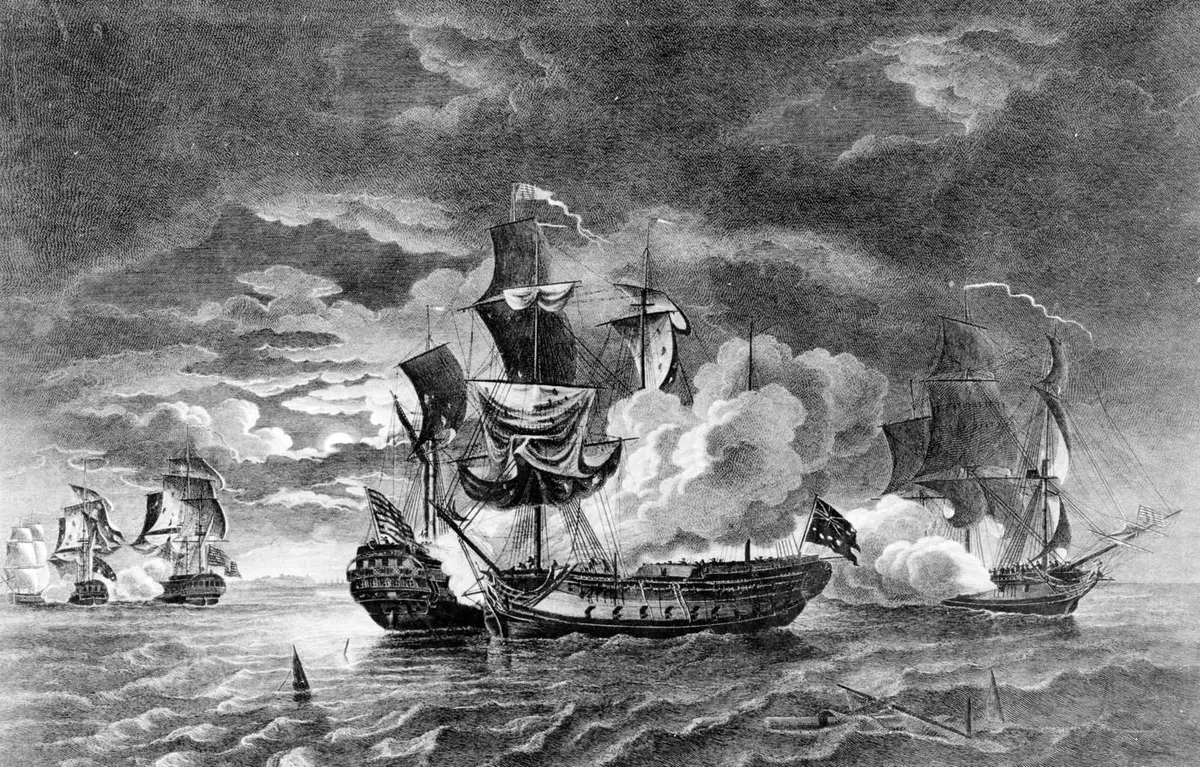
Bonhomme Richard and Serapis side by side in a cloud of gunsmoke, engraved after Robert Dodd’s painting of the action.. After Robert Dodd / U.S. Naval Institute, Beverly R. Robinson Collection via Naval History and Heritage Command (NH 42902). Not yet begun
Richard’s main battery is silenced. Jones works one of three 9-pounders left on the quarterdeck himself, firing at Serapis’s mainmast, while his men in the tops clear the British decks with musket fire. Below, the gunner thinks the ship is sinking and runs to strike the colors, crying for quarter. Jones hurls his pistol at him. Pearson calls across: does he ask for quarter? Jones refuses.
Jones’s reply, as Lt. Richard Dale remembered itI have not yet begun to fight.
Fire and water
The American frigate Alliance finally comes up and fires full broadsides into Bonhomme Richard. Her crew shout to stop. She fires again. Richard has five feet of water in her hold and fires burning within inches of the powder magazine. Her master-at-arms lets the prisoners loose, and they are set to work the pumps. Jones will not give up the fight.
Serapis strikes
A sailor crawls out on Richard’s main yard, right above Serapis’s main hatch, and drops a grenade below. It lands among loose powder cartridges. The explosions blow guns off their carriages and kill more than twenty men. Serapis’s mainmast begins to shake. At 22:30 Pearson strikes his flag. Lt. Richard Dale swings across on a brace, finds Pearson on his quarterdeck and brings him aboard Bonhomme Richard.
The good old ship
For a day and a half the crew fight the fires and the leaks, and lose. Bonhomme Richard settles lower in a rising wind. Her men cross to Serapis, and no lives are lost with the ship. Jones watches from his prize with inexpressible grief as she goes down. Then he sails his prize, the British frigate Serapis, to the Texel in Holland. He arrives on 3 October.
The men

Born in Kirkcudbright, Scotland, he went to sea at 12 and made America his country. Commissioned a lieutenant in the first Continental Navy in 1775. Raided Whitehaven, took the Drake, then fought Serapis to a finish from a sinking ship.

Virginian. Captured in the brig Lexington in 1777 and locked in England’s Mill Prison, he escaped to France and joined Jones. Commanded Richard’s main battery, was first aboard Serapis to take Pearson’s surrender, and was badly wounded. Later commodore against Tripoli.

Printer, scientist and signer of the Declaration, America’s envoy in Paris. Jones’s friend and patron, he backed the cruise from France. Jones named his ship for Franklin’s Poor Richard and sent Franklin his full report of the battle from the Texel.
By the numbers
In pictures


Watch, listen, see
Films, photographs and first-hand accounts from across the web. Each opens in a new tab.

Jones’s own account of the cruise and the battle, written aboard Serapis off the Texel on 3 October 1779.
Founders Online · National Archives
The Navy’s one-minute salute to Jones and Bonhomme Richard’s victory over HMS Serapis.
U.S. Navy · YouTube
A 3D tour of the marble crypt beneath the Naval Academy Chapel where Jones lies.
U.S. Naval Academy
The 1825 Jones biography with Dale’s narrative of the battle, the first printing of Jones’s famous line.
Internet Archive
Biographer Evan Thomas on the Scottish-born sailor who became the father of the American Navy.
C-SPAN
The Navy’s history of the ship and the battle, with paintings, artifacts and portraits of both captains.
Naval History and Heritage Command
The official record of the search for Jones’s body, the voyage home and Roosevelt’s Annapolis address.
Internet Archive
Navy divers and archaeologists have surveyed over 500 square nautical miles of North Sea for Jones’s flagship.
Naval History and Heritage Command“Every officer in our Navy should know by heart the deeds of John Paul Jones.”
President Theodore Roosevelt, U.S. Naval Academy, 24 April 1906
After
Jones brought Serapis and the captured Countess of Scarborough into the Texel on 3 October 1779. Paris made him a hero. Louis XVI gave him the Cross of Military Merit, and in 1787 Congress voted him a gold medal.
He died in Paris on 18 July 1792 and was buried in a lead coffin in a Paris cemetery that was soon closed and later built over. In 1899 the American ambassador, Gen. Horace Porter, began a six-year search for him. In 1905 Jones was found and identified, and President Theodore Roosevelt sent four cruisers under Rear Adm. Charles Sigsbee to bring him home.
On 24 April 1906, the anniversary of the Drake, Roosevelt honored him at the Naval Academy. On 26 January 1913 Jones was laid in a marble crypt beneath the Academy chapel, ringed by the names of his ships. Midshipmen stand watch over the father of the American Navy.
Primary sources
- John Paul Jones to Benjamin Franklin, 3 October 1779. The Papers of Benjamin Franklin, vol. 30. Founders Online, National Archives.
- Bonhomme Richard I (Frigate). Dictionary of American Naval Fighting Ships. Naval History and Heritage Command.
- Lt. Richard Dale, “Particulars of the engagement between the Bon homme Richard and the Serapis,” in John Henry Sherburne, Life and Character of the Chevalier John Paul Jones (1825).