Iwo Jima, Volcano Islands · 19 February 1945 · V Amphibious Corps
Uncommon Valor
Thirty-six days on eight square miles of volcanic rock. Three Marine divisions took Iwo Jima cave by cave, and 27 Americans earned the Medal of Honor doing it.

The moment · About 10:20 · 23 February 1945
Four days in, forty Marines from Easy Company work their way up the volcano, crawling when they have to. They fight to the crater rim. A small flag goes up on a length of pipe. Across the south end of the island, Marines cheer. Offshore, ships sound their whistles.
Holland, the raising of that flag on Suribachi means a Marine Corps for the next 500 years.Navy Secretary James Forrestal
Iwo Jima sat halfway between the B-29 bases in the Marianas and Tokyo. Its radar warned Japan of every raid, and its fighters hunted the bombers. The Joint Chiefs wanted it taken. About 21,000 Japanese troops waited underground in caves, bunkers and tunnels. The job went to the V Amphibious Corps: the 3rd, 4th and 5th Marine Divisions.
H-Hour
Two divisions land abreast on the black sand, the 4th Marine Division on the right and the 5th on the left. Sixty-eight armored amtracs lead 380 troop-laden tractors in, and the first waves hit the beach within two minutes of H-Hour. The terraces of loose volcanic ash swallow boots and wheels. The defenders hold their fire until the beach is crowded, then open up from Suribachi and the cliffs. The Marines keep moving.
Manila John
Within ninety minutes, 5th Division Marines cross the island at its narrow neck and cut Mount Suribachi off from the rest of the garrison. Near the first airfield, Gunnery Sgt. John Basilone, a Medal of Honor man from Guadalcanal, destroys a blockhouse with grenades and demolitions, then guides a trapped tank through a minefield under fire. A mortar shell kills him at the edge of the airfield. By nightfall 30,000 Marines are ashore.
Two grenades
Pfc. Jack Lucas forged his mother’s signature to join the Marines at 14, then stowed away on a transport to get into this fight. He turned 17 at sea. On D+1, two grenades land in his fire team’s trench. Lucas dives over a buddy, jams one into the ash, covers it with his body and pulls the other beneath him. One explodes. Lucas lives, and so do the three Marines beside him.
Old Glory on Suribachi
At 08:00, Lt. Harold Schrier leads a 40-man patrol from Easy Company, 2nd Battalion, 28th Marines up the volcano, sometimes crawling on hands and knees. They fight their way to the crater rim, lash a small flag to a length of pipe and raise it. Leatherneck photographer Staff Sgt. Lou Lowery takes the picture. Marines across the south end of the island cheer, and the ships offshore sound their sirens and whistles.
Navy Secretary James Forrestal to Lt. Gen. Holland Smith, on the beachHolland, the raising of that flag on Suribachi means a Marine Corps for the next 500 years.
The second flag
The first flag is too small to see from the beaches. A runner carries a larger one up from LST-779. Sgt. Michael Strank’s team ties it to a heavier pipe, and six Marines push it upright as the first flag comes down. AP photographer Joe Rosenthal catches the moment in a single frame. Marine cameraman Sgt. Bill Genaust films it in color. Rosenthal’s picture becomes the most famous photograph of the war.
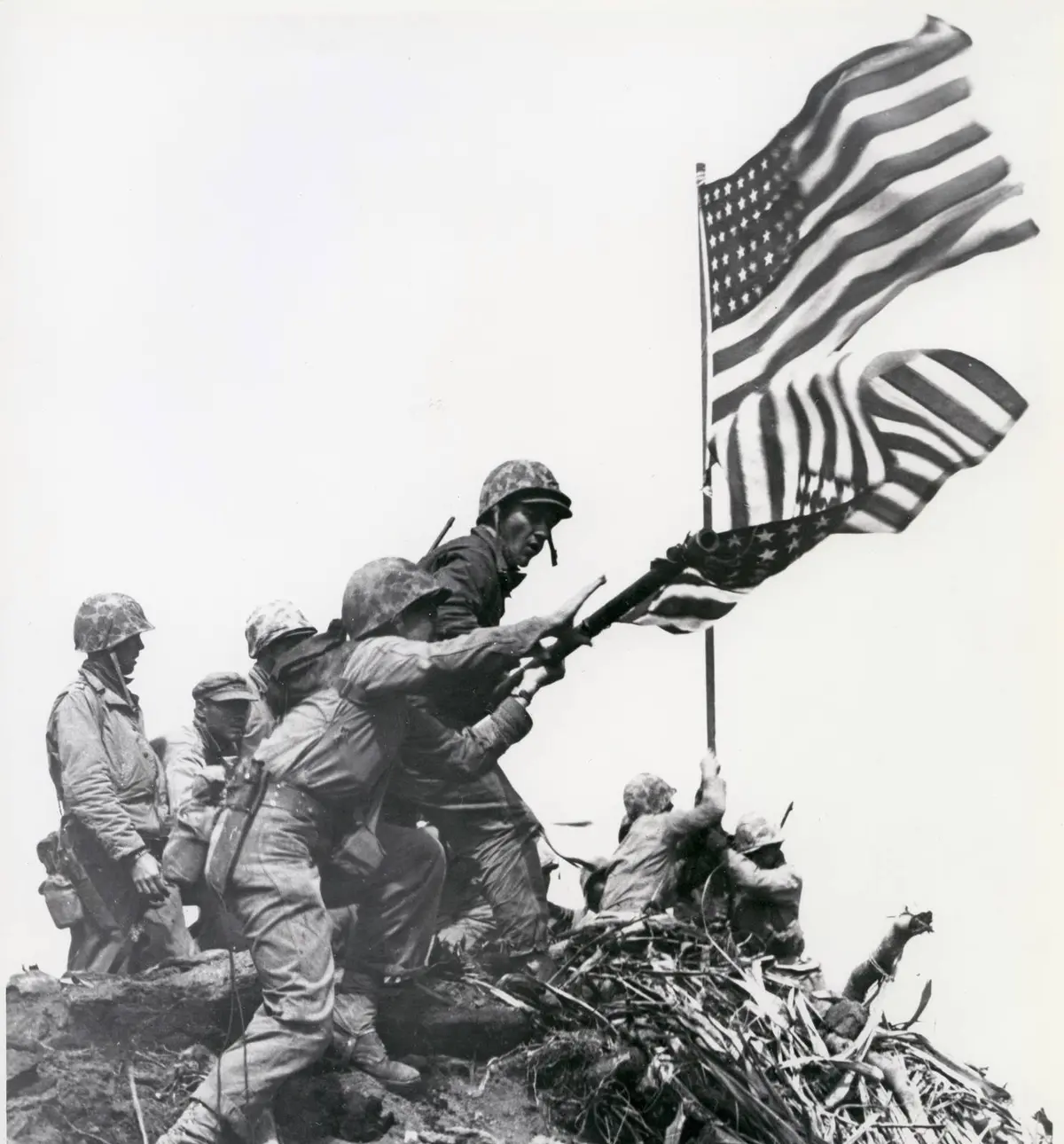
Marines raise the larger second flag as the first comes down atop Mount Suribachi, 23 February 1945. Pvt. Robert R. Campbell, USMC / Navy Medicine (BUMED). The flamethrower
The same day, the 3rd Division runs into a belt of reinforced concrete pillboxes that its tanks cannot crack. Cpl. Hershel “Woody” Williams goes forward with a flamethrower, covered by four riflemen. For four hours he works through the line, going back again and again for fresh flamethrowers and demolition charges. When enemy riflemen charge him with bayonets, he stops them with a burst of flame.
Dinah Might
The fight north is a grind through ground the Marines name the Meatgrinder, the Amphitheater and Turkey Knob. Gains are counted in yards. That afternoon a B-29 called Dinah Might, crippled in a raid on Tokyo, comes in over the island and lands on the first airfield with Japanese guns still in range. Mechanics patch her in half an hour, and she takes off for Tinian. The Marines cheer.
To the sea
A patrol from the 3rd Marine Division breaks through to the northeast coast. The squad leader fills a canteen with salt water and sends it back to the corps commander, Maj. Gen. Harry Schmidt. The next day the 4th Division pinches out Turkey Knob. In the north, the 5th Division keeps clawing forward through broken ground the men call the Gorge.
Label on the canteen sent to General SchmidtFor inspection, not consumption.
The last fight
About 300 Japanese slip out of the northern caves in the dark and fall on the tents of newly arrived Army fighter pilots. Pilots, Seabees and the Marines of the 5th Pioneer Battalion form a line and counterattack. 1st Lt. Harry Martin leads them and is killed, earning the last Medal of Honor of the battle. By sunrise all 300 attackers are dead. That day Iwo Jima is declared secure.

The men

West Virginia dairy farm boy, first turned away as too short to enlist. On 23 February he fought four hours with a flamethrower against a belt of pillboxes. He was the last surviving Medal of Honor recipient of World War II.

Enlisted at 14 on a forged signature and stowed away to reach Iwo Jima. On D+1 he covered two grenades with his body to save his fire team. At 17, the youngest Marine ever to receive the Medal of Honor.

Earned the Medal of Honor holding the line at Guadalcanal with his machine guns. Turned down a commission and a stateside job to go back to the fight. Killed on D-Day at Iwo Jima and awarded the Navy Cross.

Born in Czechoslovakia and raised in a Pennsylvania coal town. Fought as a Marine Raider on Bougainville. Led the team that raised the second flag on Suribachi. Killed in action on 1 March 1945 and buried at Arlington.
By the numbers
In pictures


Watch, listen, see
Films, photographs and first-hand accounts from across the web. Each opens in a new tab.

The 1945 Navy-Marine Corps color documentary, from the bombardment to the flag on Suribachi.
The National WWII Museum
Sgt. Bill Genaust’s 16mm color footage of the second flag going up on Mount Suribachi.
U.S. National Archives
The Medal of Honor flamethrower man recalls the battle at the National Museum of the Marine Corps.
C-SPAN American History TV
The youngest Marine Medal of Honor recipient tells how he stowed away to Iwo Jima and smothered two grenades.
The National WWII Museum
Navy corpsman John Bradley recounts the climb up Suribachi and the day both flags went up.
Naval History and Heritage Command
Official Navy and Marine photographs of the landings, Suribachi and the fight north.
Naval History and Heritage Command
The Marine Corps’ illustrated history of the 36-day battle, from D-Day to the island’s capture.
U.S. Marine Corps History Division
How the flag raising became the bronze memorial to Marines of every war, dedicated in 1954.
National Park Service“Among the Americans who served on Iwo Island, uncommon valor was a common virtue.”
Fleet Admiral Chester W. Nimitz, Pacific Fleet communiqué, 16 March 1945
After
On 5 October 1945, President Truman presented the Medal of Honor to fourteen Marines and sailors on the White House lawn. Woody Williams and Jack Lucas stood among them. In all, 22 Marines and five sailors earned the medal on Iwo Jima, more than in any other battle of the war.
Rosenthal’s photograph won the Pulitzer Prize. Sculptor Felix de Weldon cast it in bronze as the Marine Corps War Memorial in Arlington, dedicated on 10 November 1954, the Marine Corps’ 179th birthday. Nimitz’s words are carved into its base. Both Suribachi flags are kept at the National Museum of the Marine Corps.
Woody Williams outlived every other World War II Medal of Honor recipient. When he died in 2022 at 98, he lay in honor in the Rotunda of the U.S. Capitol.
Primary sources
- Closing In: Marines in the Seizure of Iwo Jima. Col. Joseph H. Alexander, USMC (Ret.), Marine Corps History and Museums Division, 1994.
- Battle of Iwo Jima. Naval History and Heritage Command.
- CINCPAC Communiqué No. 300, Fleet Admiral Chester W. Nimitz, 16 March 1945.