Bastogne, Belgium · 22 December 1944 · 101st Airborne Division
Nuts!
Surrounded, outnumbered and short of everything but nerve, the 101st Airborne was told to surrender. Its commander answered in one word.

The moment · 11:30 · 22 December 1944
Bastogne is surrounded. Four Germans walk up the road under a white flag carrying a typed ultimatum: surrender within two hours or be annihilated. The defenders are short of ammunition, blankets and overshoes. McAuliffe hears it and laughs. His written answer is one word.
To the German Commander: NUTS! The American CommanderBrig. Gen. Anthony C. McAuliffe
On 16 December 1944 Germany threw its last great offensive at a quiet stretch of the Ardennes. Its panzers needed the roads that met at Bastogne. The Army rushed in the 101st Airborne, 107 miles by truck and without winter gear, to fight beside the tankers already there. The order from the corps commander was two words: Hold Bastogne.
The last great gamble
German guns open fire along about 75 miles of the Ardennes front. More than 200,000 German troops and nearly 1,000 tanks pour into a quiet sector held by a few thin American divisions. Their goal is the Meuse River and the port of Antwerp beyond it. To get there, the panzers need roads, and the best roads in the southern Ardennes all meet in one Belgian market town: Bastogne.
Into the trucks
The 101st Airborne is resting near Reims when the call comes on the evening of 17 December. Its commander, Maj. Gen. Maxwell Taylor, is in the United States, so the artillery chief, Brig. Gen. Anthony McAuliffe, takes the division. Short of overshoes, blankets and ammunition, 11,000 men climb into 380 trucks for a 107-mile ride through rain and snow. By 09:00 on 19 December all four regiments are in Bastogne.
Hold Bastogne
The VIII Corps commander, Maj. Gen. Troy Middleton, leaves McAuliffe one standing order: “Hold Bastogne.” At 06:00 Lt. Col. Julian Ewell’s 501st Parachute Infantry marches east into the fog and runs into the Panzer Lehr Division. Four miles north at Noville, Team Desobry of the 10th Armored’s Combat Command B, about 15 Shermans, fights the 2nd Panzer Division beside a battalion of the 506th. That night the 705th Tank Destroyer Battalion rolls in with long 76 mm guns.
Surrounded
By late afternoon an armored patrol confirms it: the last road south is cut. Inside the ring are the 101st, Combat Command B, the 705th and several artillery battalions. Stragglers from broken units are pooled into a reserve the men call Team SNAFU. Cooks turn flour from an abandoned Army bakery into flapjacks. A civil affairs officer finds 2,000 burlap bags, and they go out to the foxholes to wrap freezing feet.
Four men under a white flag
A German major, a captain and two soldiers walk up the road from Remoifosse into the lines of Company F, 327th Glider Infantry. They carry a typed demand: surrender within two hours or be annihilated by German artillery. When McAuliffe hears it, he laughs and says, “Aw, nuts!” Unsure what to write back, he asks his staff. His operations officer, Lt. Col. Harry Kinnard, tells him that first remark would be hard to beat.
McAuliffe’s written replyTo the German Commander: NUTS! The American Commander
In plain English
Col. Joseph Harper of the 327th delivers the reply himself. The German major asks whether the answer is negative or affirmative. “The reply is decidedly not affirmative,” Harper tells him. Back at the main road, he takes off their blindfolds and explains: “If you don’t understand what ‘Nuts’ means, in plain English it is the same as ‘Go to hell.’” The Germans salute stiffly and walk away. The threatened barrage never comes.
Visibility unlimited
The morning breaks clear and cold. At 09:00 a pathfinder team parachutes in and sets up radar beacons. At 11:50 the first C-47 drops its bundles, and in a little over four hours 241 planes reach Bastogne, each carrying about 1,200 pounds, most of it artillery shells. Their escorts turn on the Germans: 82 P-47s hit the ring with bombs, napalm and machine guns. The 101st reports that air and artillery are having a field day.
Christmas Day
On Christmas Eve word comes from Patton’s Third Army: “Xmas Eve present coming up. Hold on.” Before dawn the Germans make their biggest try. Grenadiers in white snowsuits storm Champs, and 18 Mark IV tanks with infantry riding on their decks break through the 327th near Hemroulle. Paratroopers with bazookas, tank destroyers of the 705th, Shermans and the 463rd Parachute Field Artillery catch them in a crossfire. By early afternoon the German attack is finished.
The ring is broken
Lt. Col. Creighton Abrams has about 20 Shermans left in his 37th Tank Battalion. Watching cargo planes stream toward Bastogne, he decides to dash straight through Assenois. On his call, 13 artillery batteries drop ten volleys on the village. Lt. Charles Boggess drives his tank, Cobra King, through the smoke. At 16:50 he meets engineers of the 101st near the highway. Twenty minutes later Abrams shakes McAuliffe’s hand.
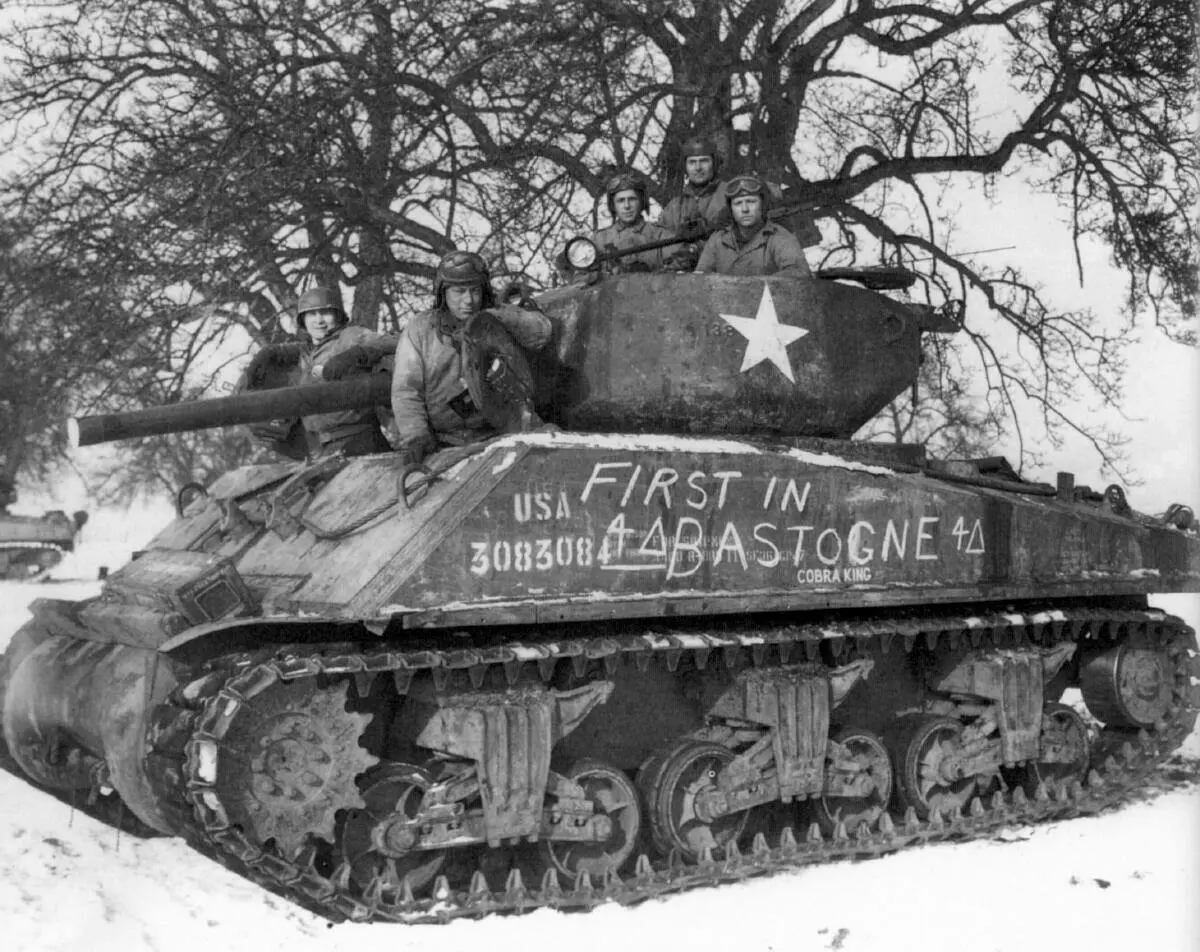
Cobra King, the 37th Tank Battalion Sherman that led the 4th Armored into Bastogne, with Lt. Charles Boggess and his crew. U.S. Army. Abrams to the artillery, 16:35Concentration Number Nine, play it soft and sweet.

The commanders

West Point artilleryman from Washington, D.C. As the 101st’s artillery chief he jumped into Normandy on D-Day and landed by glider in Holland. At Bastogne he led the division in Taylor’s absence, answered the Germans in one word, and retired a four-star general.

West Point class of 1936. Led the 4th Armored’s spearhead across France from Shermans he named Thunderbolt. Earned two Distinguished Service Crosses in 1944, the second for the dash through Assenois. Later Army Chief of Staff. The M1 Abrams tank carries his name.

Cavalryman who led America’s first tank brigade into battle in 1918. At Verdun on 19 December he told Eisenhower he could attack north with three divisions on the 22nd. He jumped off on schedule, and his 4th Armored broke through to Bastogne on the 26th.
By the numbers
In pictures


Watch, listen, see
Films, photographs and first-hand accounts from across the web. Each opens in a new tab.
Recorded 29 December 1944: the general recounts the German surrender demand and his one-word answer.
National Archives · YouTube
Senior historian Rob Citino walks through the German offensive and how the Americans stopped it.
The National WWII Museum
Today’s Screaming Eagles tell the story of the siege as the division marks its 80th anniversary.
101st Airborne Division · YouTube
Vincent Speranza of the 501st Parachute Infantry tells his story of Bastogne, beer run included.
American Veterans Center
McAuliffe’s message to every man in Bastogne, with the German demand and his famous reply.
Foundation for the National Archives
The Army’s 1946 combat history of the siege, written from interviews with the men who held it.
U.S. Army Center of Military History
The Army’s official Battle of the Bulge site: the key numbers, the units and their stories.
U.S. Army
A C-47 drops parachute bundles to the surrounded garrison, 23 December 1944.
National Archives“We have stopped cold everything that has been thrown at us from the North, East, South and West.”
Brig. Gen. Anthony C. McAuliffe, Christmas message to the men of Bastogne, 24 December 1944
After
Patton pinned the Distinguished Service Cross on McAuliffe, and Abrams earned his second for Assenois. Pvt. James R. Hendrix, 19, of Lepanto, Arkansas, had charged two 88 mm guns with his rifle at Assenois and pulled a burning soldier from a half-track. President Truman presented him the Medal of Honor at the White House on 23 August 1945.
On 15 March 1945 at Mourmelon, General Eisenhower presented the Distinguished Unit Citation to the entire 101st Airborne Division. It was the first time in Army history that a whole division had been so cited. Combat Command B of the 10th Armored was cited as well, and Belgium awarded the 101st its Croix de Guerre.
Bastogne never forgot. Its central square is Place Général McAuliffe, with a Sherman tank in one corner. The 101st’s headquarters at Fort Campbell is McAuliffe Hall. In December 2024, eighty years on, the Screaming Eagles went back to Bastogne to honor the men who would not give it up.
Primary sources
- Bastogne: The First Eight Days. Col. S. L. A. Marshall, Infantry Journal Press for the War Department, 1946; reprinted by the U.S. Army Center of Military History.
- The Ardennes: Battle of the Bulge, Chapter XIX, The Battle of Bastogne. Hugh M. Cole, U.S. Army in World War II, Office of the Chief of Military History, 1965.
- Christmas message to the troops, Headquarters 101st Airborne Division, Brig. Gen. Anthony C. McAuliffe, 24 December 1944.