UCLA to SRI, Menlo Park, California · 29 October 1969 · Charley Kline and Bill Duvall
Lo and Behold
Twelve years after Sputnik, a Pentagon research agency bet a million dollars on linking computers across the country. Then a UCLA student typed two letters, and a computer 315 miles away got them.

The moment · 22:30 PST · 29 October 1969
A UCLA student named Charley Kline sits at the keyboard. At SRI, 315 miles away, Bill Duvall listens on a headset. Kline types L. “Got the L.” He types O. “Got the O.” He types G, and the computer at SRI crashes. Two letters have made it.
Talked to SRI Host to HostUCLA IMP log
In October 1957 the Soviet Union put Sputnik in orbit. Four months later the Pentagon created ARPA so America would not be caught short again. ARPA backed the best minds it could find and let them work. One of its bets was a network that would let any computer talk to any other. It began with two letters and grew into the internet.
ARPA is born
Four months after Sputnik, Secretary of Defense Neil McElroy signs Directive 5105.15 and creates the Advanced Research Projects Agency. Its mission is to keep the United States from ever again facing a technical surprise. ARPA runs no labs of its own. It finds the best people at universities and companies, gives them money and room, and lets them build. That model will build the internet.
The Intergalactic Network
J.C.R. Licklider, a psychologist who believes computers should work as partners to people, takes charge of ARPA’s new computer research office. He funds time-sharing machines at MIT, Berkeley, Santa Monica and beyond. In April 1963 he writes a memo addressed to the “Members and Affiliates of the Intergalactic Computer Network” and asks how all their machines might one day talk to each other.
Three terminals
Bob Taylor now runs Licklider’s old office. At the Pentagon he has three terminals: one to SDC in Santa Monica, one to Berkeley, one to MIT. Each needs its own login. “Well this is silly,” he later recalled thinking. “I should be able to access any of these systems from a single terminal.” He pitches one network to ARPA director Charles Herzfeld. Twenty minutes later he has a million dollars.
The plan
Taylor gets Herzfeld to lean on Lincoln Laboratory until it lets go of Larry Roberts, a 29-year-old MIT engineer who had already linked computers in Massachusetts and California over a phone line. At a symposium in Gatlinburg, Roberts lays out the ARPANET. It rests on packet switching: cut messages into blocks and let each find its own way. Paul Baran at RAND had worked it out by 1964. Britain’s Donald Davies reached it independently and named the packet.
IMP No. 1
ARPA’s request for bids went to 140 companies in July 1968. Frank Heart’s small team at Bolt Beranek and Newman in Cambridge, Massachusetts, won it the week before Christmas. Their Interface Message Processor is a ruggedized Honeywell DDP-516 with 12K words of memory, built to do one thing: route packets. On the Saturday before Labor Day, BBN delivers IMP No. 1 to Leonard Kleinrock’s lab in room 3420 of Boelter Hall.
LO
Charley Kline, a UCLA student programmer, sits at the lab’s Sigma 7. At SRI in Menlo Park, 315 miles away, Bill Duvall waits at an SDS 940. They talk by telephone headset. Kline types L. “Got the L.” He types O. “Got the O.” He types G, and the SRI machine runs out of memory and crashes. Two letters have crossed. Later that night the full login goes through. Kleinrock said the message meant “lo and behold.”
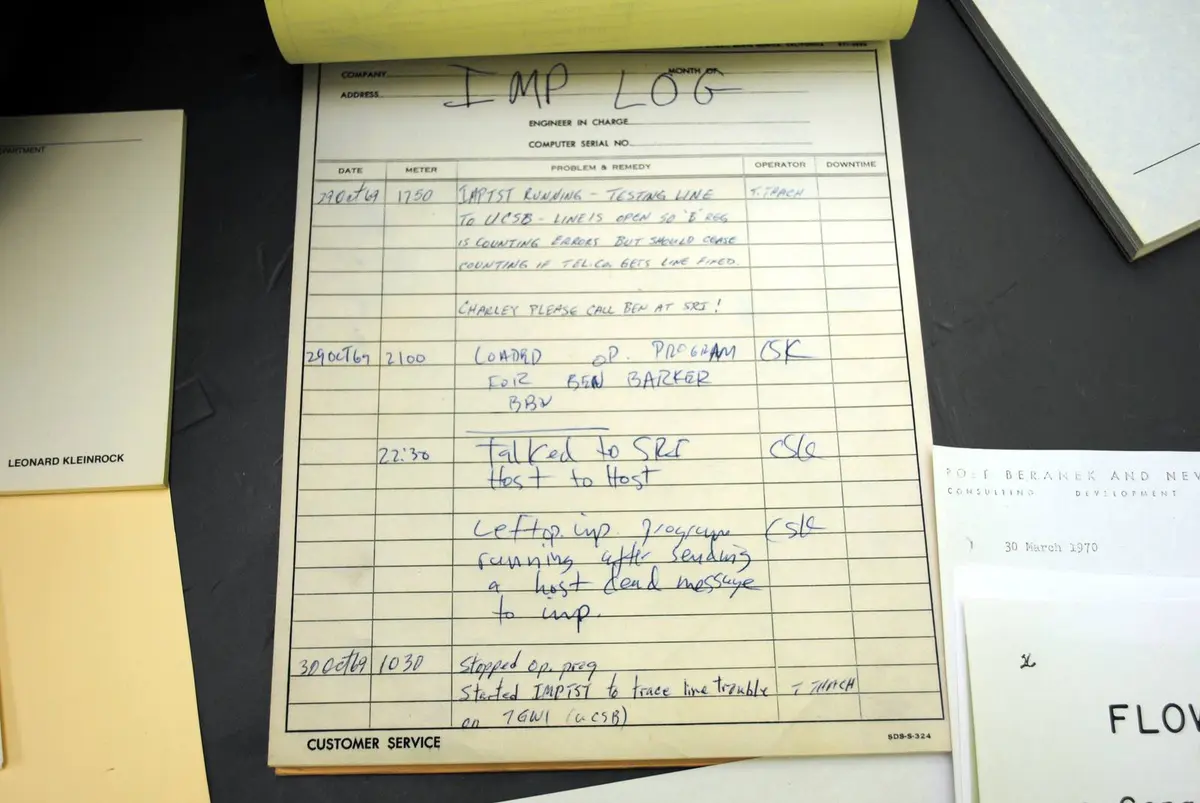
UCLA’s IMP log for 29 October 1969: at 22:30 Charley Kline wrote “Talked to SRI Host to Host”. Andrew “FastLizard4” Adams / Wikimedia Commons. UCLA IMP log, 22:30, initialed CSKTalked to SRI Host to Host
A network
UC Santa Barbara’s IMP is installed on 1 November. The permanent UCLA to SRI link is up on 21 November, and the University of Utah joins in December. Four different computers, a Sigma 7, an SDS 940, an IBM 360 and a PDP-10, now speak one network. Kleinrock’s Network Measurement Center pushes it until it breaks, then fixes each fault it finds. By mid-1970 ten nodes span the country.
The world sees it
Bob Kahn of BBN puts the ARPANET on public show at the International Conference on Computer Communication at the Washington Hilton. A dedicated phone line feeds dozens of terminals on the floor. Visitors play chess against distant machines, run an air traffic control simulation and watch ELIZA at MIT and PARRY at Stanford hold a conversation. By now Ray Tomlinson at BBN has sent network email and picked the @ sign.
The internet switches on
In May 1974 Vint Cerf and Bob Kahn publish their design for TCP, a way for any network to carry packets to any other. On 22 November 1977 a test sends packets from an SRI van in California across three networks, over the Atlantic by satellite and back. On 1 January 1983 every ARPANET host drops the old protocol and switches to TCP/IP. The network of networks is running.
The builders

Born in St. Louis in 1915. A psychologist who studied human hearing, he argued in 1960’s “Man-Computer Symbiosis” that computers should work alongside people. At ARPA he funded the labs and wrote the memo that imagined one network linking them all.

Born in Westport, Connecticut, in 1937. Earned three degrees at MIT and linked computers across the country by phone line in 1965. Designed the ARPANET, wrote its specifications and ran ARPA’s computer office from 1969 to 1973. Shared the 2001 Draper Prize.

Born in New York City in 1934, a Bronx High School of Science graduate. His MIT doctoral work laid out the mathematics of messages flowing through networks. His UCLA lab got IMP No. 1 and sent the first message. National Medal of Science, 2007.

Born in New Haven, Connecticut, in 1943. As a graduate student in Kleinrock’s UCLA lab he worked on the first host-to-host protocols. With Bob Kahn he designed TCP/IP, the language every internet device still speaks. Presidential Medal of Freedom, 2005.
By the numbers
In pictures


Watch, listen, see
Films, photographs and first-hand accounts from across the web. Each opens in a new tab.

Leonard Kleinrock sketches the first two nodes and walks through how UCLA sent the first message.
UCLA
The Franklin Institute honors the two engineers whose TCP/IP joined separate networks into one internet.
The Franklin InstituteA year-by-year timeline of the people, papers and machines that built the ARPANET.
Computer History Museum
The man who started the ARPANET recalls his three terminals and the 1966 meeting that funded it.
Computer History Museum
How a RAND engineer designed a network that could survive attack by breaking messages into blocks.
RAND
Steve Crocker’s April 1969 memo from UCLA, first in the series that still defines internet standards.
RFC Editor
Room 3420 Boelter Hall, IMP No. 1, the IMP log and UCLA’s 1969 press release.
UCLA Samueli School of Engineering
The citation honoring Cerf and Kahn for the protocol “that gave rise to the modern Internet.”
The White House“The world will witness future discoveries even more startling than that of nuclear fission. The question is: Will we be the ones to make them?”
President Dwight D. Eisenhower, address on “Our Future Security,” Oklahoma City, 13 November 1957
After
The ARPANET kept growing, to 213 host computers by 1981. Its military sites later split off into a network of their own, and the National Science Foundation built faster backbones on the same TCP/IP. DARPA retired the original network in 1990. Its job was done.
In 2001 Cerf, Kahn, Kleinrock and Roberts shared the National Academy of Engineering’s Draper Prize. On 9 November 2005 President George W. Bush awarded Cerf and Kahn the Presidential Medal of Freedom for the architecture and protocol “that gave rise to the modern Internet.”
UCLA restored room 3420 of Boelter Hall in 2011, and IMP No. 1 still stands there. The idea it carried, packets finding their own way across a network of networks, now connects about six billion people.