Washington and Sitka · 30 March 1867 · Seward, Sumner, Johnson
Let Us Make the Treaty Tonight
Russia offered to sell. Seward would not wait for morning. For under two cents an acre he bought a territory more than twice the size of Texas.

The moment · Night of 29–30 March 1867 · Washington
Seward is at whist in his parlor when the Russian minister calls. The emperor has agreed to sell. Stoeckl offers to start on the treaty tomorrow. Seward pushes the card table away. By midnight the State Department is lit up. By four in the morning the treaty is signed.
Why wait till tomorrow, Mr. Stoeckl? Let us make the treaty tonight.William H. Seward, as his son Frederick recorded it
In March 1867 the Russian minister in Washington told Secretary of State William H. Seward that his emperor would sell Russian America. Seward did not hesitate. He closed the deal in a single night. For under two cents an acre, the United States added a territory more than twice the size of Texas, with a coast that reaches almost to Asia.
An offer on the table
Eduard de Stoeckl, Russia’s minister to the United States, calls on Seward at the State Department and says he is authorized to take an offer for Russian America. Seward wants it. He asks for secrecy until the cabinet agrees and talks of $5 million, perhaps $5.5 million. By 15 March he has a draft treaty and asks the cabinet for authority to pay $7 million. Nobody objects.
Why wait till tomorrow?
Seward is playing whist with his family when Stoeckl is announced. A cable has come from St. Petersburg: the emperor consents to the sale. Stoeckl offers to come to the department tomorrow and begin. Seward pushes the whist table away. When Stoeckl objects that the department is closed and his secretaries are scattered around town, Seward tells him to muster his legation before midnight. The department will be open and ready.
Seward to StoecklWhy wait till tomorrow, Mr. Stoeckl? Let us make the treaty tonight.
Signed by gaslight
In under two hours the windows of the State Department are blazing, as if it were midday. Clerks compare the English and French texts. In the last haggling Seward adds $200,000, and the price is set at $7.2 million in gold. His son Frederick, the assistant secretary, goes out into the night to find Senator Charles Sumner. By four o’clock on Saturday morning the treaty is engrossed, signed and sealed.
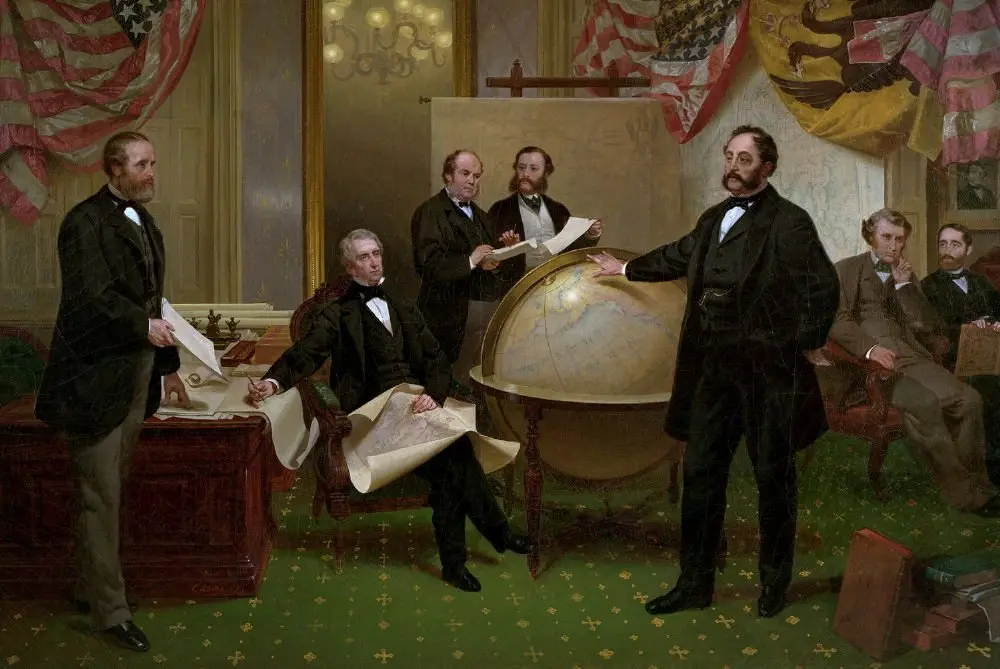
Signing of the Alaska Treaty (Emanuel Leutze, 1867). Seward sits pen in hand as Stoeckl reaches across the globe; Sumner sits at right.. Emanuel Leutze / Seward House Museum, Auburn, N.Y.. Another veto?
The Senate’s session is nearly over, so President Andrew Johnson sends the treaty up that same morning. When a message from the president is announced, senators mutter, “Another veto!” Instead the clerk reads out a treaty for the cession of Russian America. Sumner, chairman of Foreign Relations and no friend of the president, rises to support it. One senator calls it the biggest and most unheard-of thing the administration has done yet.
The great land
Sumner spends days and nights reading everything ever written about the territory. He tells a friend he is living with seals, walruses and black foxes. Then he speaks for three hours, laying out its coasts, harbors, fisheries and furs. He gives the land its name. It should come from the country itself, he says, from the word its first people used for the great land of the continent: Alaska.
Thirty-seven to two
After more debate behind closed doors, the Senate gives its advice and consent, 37 to 2. President Johnson ratifies the treaty on 28 May, and on 20 June ratifications are exchanged and the treaty is proclaimed. Congress has not yet voted the money, but Russia trusts the good faith of the United States. It agrees to hand the territory over before it is paid.
The flag goes up
On Castle Hill at New Archangel, about 250 American soldiers face a company of Russians. At half past three the Russian flag starts down, but it snags in the ropes near the top of a pole about 90 feet tall. A Russian soldier hoisted in a boatswain’s chair frees it, and it drops onto the bayonets below. Then George Lovell Rousseau, 15, runs up the Stars and Stripes as USS Ossipee’s guns thunder.
Capt. Aleksei Peshchurov to Gen. Lovell H. RousseauGeneral Rousseau, by authority from His Majesty, the Emperor of Russia, I transfer to the United States the Territory of Alaska.
Paying for it
The House has to vote the money, and Congress spends the spring on the impeachment trial of President Johnson. On 30 June Nathaniel Banks, chairman of Foreign Affairs, makes the case for paying. On 14 July the House votes 113 to 43. The act becomes law on 27 July. On 1 August the Treasury issues a warrant for $7.2 million, payable to Stoeckl.
Seward sees Alaska
Out of office since March, Seward sails north to see the land he bought. At Sitka he thanks the townspeople and tells them what is coming. First Alaska will be a territory, and in time a state, he says, loyal to the Union and forever true to its republican instincts. Ninety years later, on 3 January 1959, Alaska becomes the 49th state.
The dealmakers

Governor of New York, senator, and secretary of state to Lincoln and Johnson. He survived a knife attack on the night Lincoln was shot. When Russia offered Alaska, he negotiated through the night and signed the treaty at 4 a.m.

Massachusetts senator since 1851 and the Senate’s leading foreign-policy voice. He came back from a near-fatal beating at his Senate desk in 1856. His three-hour speech carried the treaty 37 to 2 and gave Alaska its name.

A tailor from Tennessee who rose to governor and senator. In 1861 he was the only senator from a seceding state to stay loyal to the Union. He authorized the talks, sent the treaty to the Senate and signed the act that paid for it.
By the numbers
In pictures


Watch, listen, see
Films, photographs and first-hand accounts from across the web. Each opens in a new tab.

The first episode of The Heritage of Alaska, a 1968 television series, tells how Seward bought Russian America.
Alaska State Library
The museum in Seward’s own home explains Emanuel Leutze’s painting of the all-night signing.
Seward House Museum
The Heritage of Alaska episode on the flag ceremony at Sitka, 18 October 1867.
Alaska State Library
The Treasury warrant that paid for Alaska, with the story of the treaty and the payment.
National Archives
Sixteen eyewitness accounts of the Sitka transfer, including General Rousseau’s own report to Seward.
Alaska Historical SocietyHow Senator Charles Sumner studied the territory, named it Alaska and carried the treaty 37 to 2.
U.S. Senate
Interviews and wartime film recall May 1943, when American soldiers took back Attu, Alaska’s most distant island.
U.S. Fish & Wildlife Service
The builders’ own 1975 progress report from construction of the 800-mile trans-Alaska pipeline.
Alyeska Pipeline“These, citizens of Sitka, are the guaranties, not only that Alaska has a future, but that that future has already begun.”
William H. Seward, at Sitka, 12 August 1869
After
Critics called it Seward’s Folly, Seward’s Icebox and a polar bear garden. Then came the gold. The Klondike strike of 1896 sent thousands of stampeders north through Skagway and Dyea. In 1899 gold turned up in the beach sand at Nome, and by 1900 more than 20,000 people had landed there. Alaska has produced more than 51 million ounces of gold since 1880.
In June 1942 Japanese troops seized Attu and Kiska in the Aleutians. More than 10,000 Army engineers built the 1,570-mile Alaska Highway in eight months, and in May 1943 American soldiers took Attu back after 18 days of fighting. Today the interceptors that guard the country against long-range missiles stand in silos at Fort Greely, Alaska, and Vandenberg, California.
On 3 January 1959 President Eisenhower proclaimed Alaska the 49th state. In 1968 drillers found oil at Prudhoe Bay, the largest field in North America, and in 1977 the 800-mile trans-Alaska pipeline began carrying it south to Valdez. It has moved some 18 billion barrels since. Alaskans celebrate 18 October, the day the flag went up at Sitka, as Alaska Day.
Primary sources
- Frederick W. Seward, Seward at Washington as Senator and Secretary of State, 1861–1872 (New York, 1891), chapters on the Alaska treaty and the transfer.
- Report of Gen. Lovell H. Rousseau to Secretary of State Seward, 5 December 1867, in As the Old Flag Came Down: Eyewitness Accounts of the October 18, 1867 Transfer Ceremony. Alaska Historical Society.
- Check for the Purchase of Alaska (1868). National Archives, Milestone Documents.