Yorktown, Virginia · 19 October 1781 · Washington’s army and its French allies
Most Happily Effected
In the fall of 1781 George Washington marched his army south on a gamble, trapped Lord Cornwallis against the York River and made his whole army surrender. The war for independence was won.

The moment · Morning · 17 October 1781
A midnight storm has wrecked the breakout. Allied guns are pounding the town from 300 yards. Then, four years to the day after Saratoga, a drummer in red climbs onto the British parapet and beats a parley. Lord Cornwallis is asking for terms.
I propose a cessation of hostilities for twenty four hours.Lord Cornwallis
By the summer of 1781 the war was six years old, and the Continental Army was short of money, food and men. Then Washington got the chance he had waited for. Lord Cornwallis had dug in at Yorktown, Virginia, with his back to the water, and a French fleet was sailing to close the sea behind him. Washington had to get there first.
The march south
On 14 August Washington learns that the Comte de Grasse is sailing for the Chesapeake with 28 ships of the line and 3,200 troops, and can stay only a short time. Washington drops his plan to attack New York. Leaving fewer than 4,000 men to hold the Hudson, he starts south with Rochambeau’s French on 19 August. To fool the British in New York, he builds big camps and bread ovens and lets false orders fall into their hands.
Hat in hand
The army parades through Philadelphia and keeps marching. Few men in either army know where it is going. At Chester a courier rides up with the news Washington has waited all summer for: de Grasse is in the Chesapeake, and his troops are already landing to join Lafayette. When Rochambeau’s boat comes down the Delaware, the French officers see Washington on the riverbank waving his hat and handkerchief. He greets Rochambeau with an embrace.
The Battle of the Capes
That afternoon, 19 British ships of the line under Admiral Thomas Graves find de Grasse’s 24 at the mouth of the bay. They open fire at about 16:00 and fight until dark. The British lose 90 killed and 246 wounded, and the battered Terrible has to be scuttled. Graves cannot get past. A French squadron from Newport slips into the bay with the siege guns, and on 14 September Graves turns for New York. Cornwallis is sealed in.
Within a mile
On the way south Washington stops at Mount Vernon, his first time home in six years. On 14 September he rides into Williamsburg and takes command. His troops come down the bay by ship. By the 27th he has about 5,200 Continentals, 7,500 French and more than 3,000 Virginia militia. At 05:00 on 28 September the army marches on Yorktown. By nightfall it is within a mile of the British works, and the men sleep on their arms.
The first gun
After dark on 6 October, in a gentle rain, 1,500 men dig along a line of pine strips laid out by the engineers. By morning they have a trench about 600 yards from the British works. On 9 October the guns are ready. The French open at 15:00. At 17:00 Henry Knox’s American battery opens, and Washington fires the first American gun. Within two days the British guns barely answer. On the 11th the allies dig a second trench, 300 yards out.
With the bayonet only
Two British forts, Redoubts 9 and 10, block the new trench from the river. Lt. Col. Alexander Hamilton claims the command against No. 10. At a signal of six shells, 400 light infantry move out with unloaded muskets while John Laurens takes 80 men around the rear. They do not wait for the axemen. They climb over the abatis and into the fort without firing a shot. In under ten minutes Redoubt 10 is American. The French take No. 9 alongside them.
The breakout fails
Before dawn on the 16th, 350 British troops raid the new trench and spike six guns with snapped-off bayonet points. They are driven out, and the guns fire again within hours. That night Cornwallis starts ferrying his army across the river to Gloucester Point to break out north. At midnight a violent storm scatters the boats. On the morning of the 17th, four years to the day after Saratoga, a drummer in red climbs the British parapet and beats a parley.
Cornwallis to Washington, 17 OctoberI propose a cessation of hostilities for twenty four hours, and that two officers may be appointed by each side, to meet at Mr. Moore’s house, to settle terms for the surrender of the posts of York and Gloucester.
Colors cased
The surrender is signed that morning. At 14:00 the garrison marches out between allied lines more than a mile long, Americans on one side and French on the other, colors cased and drums beating a British march. These are the terms the British gave the Americans at Charleston. Cornwallis stays in his quarters, pleading illness. General O’Hara tries to surrender to Rochambeau, who sends him to Washington. Washington points him to Benjamin Lincoln, who takes the sword and hands it back.
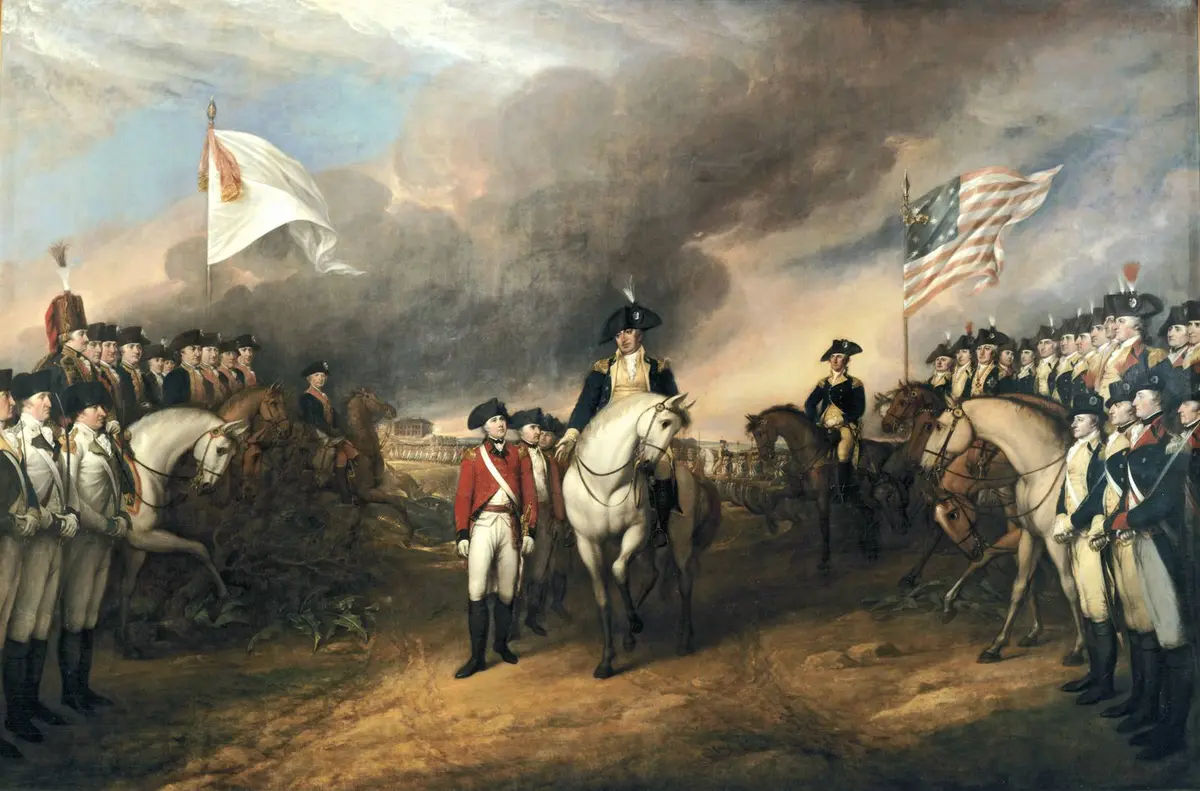
Surrender of Lord Cornwallis (John Trumbull, 1820), 12 by 18 feet, in the Capitol Rotunda. General Lincoln, on the white horse, receives the British column.. John Trumbull / Architect of the Capitol. The news reaches Congress
Washington picks his longest-serving aide, Lt. Col. Tench Tilghman, to carry his report. Tilghman leaves on 20 October, sick with fever. He crosses the Chesapeake by boat, lands in Maryland and rides north through the night. Before dawn on 24 October he reaches Philadelphia and wakes Thomas McKean, the President of Congress. At 14:00 that day the members of Congress walk in procession to the Dutch Lutheran church to give thanks.
Washington to Congress, 19 OctoberI have the Honor to inform Congress, that a Reduction of the British Army under the Command of Lord Cornwallis, is most happily effected.
The men

Virginia planter and veteran of the French and Indian War, commander in chief since June 1775. At 49 he marched two armies south from the Hudson, betting the French fleet would be there. It was. He ran the siege and fired the first American gun.

Born in the West Indies. Captain of artillery at Trenton, then Washington’s aide for four years. He left the staff to get a field command, and at Yorktown he got one: a light infantry battalion and the storm of Redoubt 10. First Secretary of the Treasury.

Boston bookseller who taught himself gunnery. At Yorktown he brought up the siege guns and ran the American batteries, and Washington thanked him by name in general orders. At 31 he became the army’s youngest major general. First Secretary of War.

Philadelphia merchant from Maryland’s Eastern Shore who joined Washington’s staff in August 1776 and served for years without pay. Washington chose him to carry the surrender news to Congress, which voted him a horse and an elegant sword. He died in 1786, aged 41.
By the numbers
In pictures


Watch, listen, see
Films, photographs and first-hand accounts from across the web. Each opens in a new tab.

Mount Vernon’s film on the 1781 campaign, from the march south to the surrender at Yorktown.
George Washington’s Mount Vernon · YouTube
How the allied armies and the French fleet trapped Cornwallis and ended the war.
American Battlefield Trust · YouTube
A historian’s guided tour of the siege lines, Redoubts 9 and 10, the Moore House and Surrender Field.
American Battlefield Trust · YouTubeA short Yorktown Battlefield film on Henry Knox, Washington’s chief of artillery.
National Park Service
The original letter Tilghman carried to Congress announcing Cornwallis’s surrender, from the National Archives.
U.S. Capitol Visitor Center
The night attacks on Redoubts 9 and 10 on 14 October 1781, mapped.
American Battlefield Trust
The 12-by-18-foot painting of the surrender that has hung in the Capitol Rotunda since 1826.
Architect of the CapitolThe sword Congress voted Tilghman on 29 October 1781, inscribed on the grip, shown in detail.
American Revolution Institute“This is to us a most glorious day, but to the English, one of bitter chagrin and disappointment.”
Dr. James Thacher, Continental Army surgeon, journal entry for 19 October 1781
After
On 29 October Congress thanked the army and its allies, voted Tench Tilghman a horse and an elegant sword, and resolved to raise a marble column at Yorktown. The sword is in the American Revolution Institute’s collection in Washington. The column went up a century later and was finished in 1884.
The news reached London on 25 November. Lord North, the prime minister, is reported to have said, “Oh God! It is all over.” It was. In 1782 Parliament turned against the war, and on 3 September 1783 the Treaty of Paris recognized the United States as free and independent. Yorktown was the last major land battle of the Revolution.
The siege lines, the rebuilt Redoubts 9 and 10, the Moore House and Surrender Field are preserved at Yorktown Battlefield, part of Colonial National Historical Park. Hamilton became the first Secretary of the Treasury, Knox the first Secretary of War, and Washington the first President.
Primary sources
- George Washington to the President of Congress, 12, 16 and 19 October 1781, and Lt. Col. Alexander Hamilton to Lafayette, 15 October 1781. Printed in the Pennsylvania Packet, 27 October 1781. Library of Congress.
- Charles E. Hatch Jr., Yorktown. National Park Service Historical Handbook No. 14.
- Chronology of the Siege of Yorktown. Yorktown Battlefield, Colonial National Historical Park, National Park Service.