Bethesda to Queens · 14 December 2020 · NIH, American industry and the U.S. Army
Distribution Has Begun
The old record for a new vaccine was four years. NIH scientists designed one in days, industry built the doses before the trials ended, and an Army general got them to every state in a week.

The moment · About 09:25 EST · 14 December 2020
Long Island Jewish Medical Center, Queens. A day after the first trucks left Michigan, ICU nurse Sandra Lindsay rolls up her sleeve. Dr. Michelle Chester gives the shot on live television. Eleven months after the virus’s genetic code went online, America’s vaccination campaign begins.
I feel like healing is coming.Sandra Lindsay
In January 2020 a new coronavirus was spreading and no vaccine for it existed. The fastest vaccine ever made, for mumps, had taken four years. America ran every step at once. Government scientists designed the shot, companies built doses before anyone knew they would work, and the Army planned delivery to every state. Eleven months later, the first trucks rolled.
The code arrives
Chinese scientists post the genetic sequence of the new coronavirus online. At the NIH Vaccine Research Center, Barney Graham’s team has spent years studying coronavirus spikes for a day like this. Within 24 hours, Kizzmekia Corbett’s group writes two stabilizing mutations into the new spike. On 13 January the team and Moderna lock the sequence for the vaccine, mRNA-1273. Within five days of the genome’s release, production begins.
Mapping the spike
Jason McLellan’s lab at the University of Texas, working with the VRC, publishes the first atomic map of the new virus’s spike, sharp to 3.5 angstroms. The journal Science accepts it seven days after it arrives. Behind it is the 2P design: two prolines, the most rigid amino acid, swapped into a hinge to hold the spike in the shape the immune system must learn. McLellan’s and Graham’s labs found it on MERS in 2017.
First in human
At Kaiser Permanente Washington Health Research Institute, the first volunteer gets a dose of mRNA-1273. It has been 63 days since the sequence was chosen. Moderna finished the first clinical batch on 7 February and shipped it to the NIH on 24 February. Forty-five healthy adults, ages 18 to 55, will test it. NIAID director Anthony Fauci says the study was launched in record speed.
Operation Warp Speed
In the Rose Garden, President Donald Trump announces Operation Warp Speed, a partnership of the Department of Health and Human Services and the Department of Defense. The goal is 300 million doses, with the first ready by January 2021. Moncef Slaoui, who led development of five major vaccines at GlaxoSmithKline, is named chief advisor. Gen. Gustave Perna, whose Army Materiel Command runs a global supply chain of more than 190,000 people, is chief operating officer.
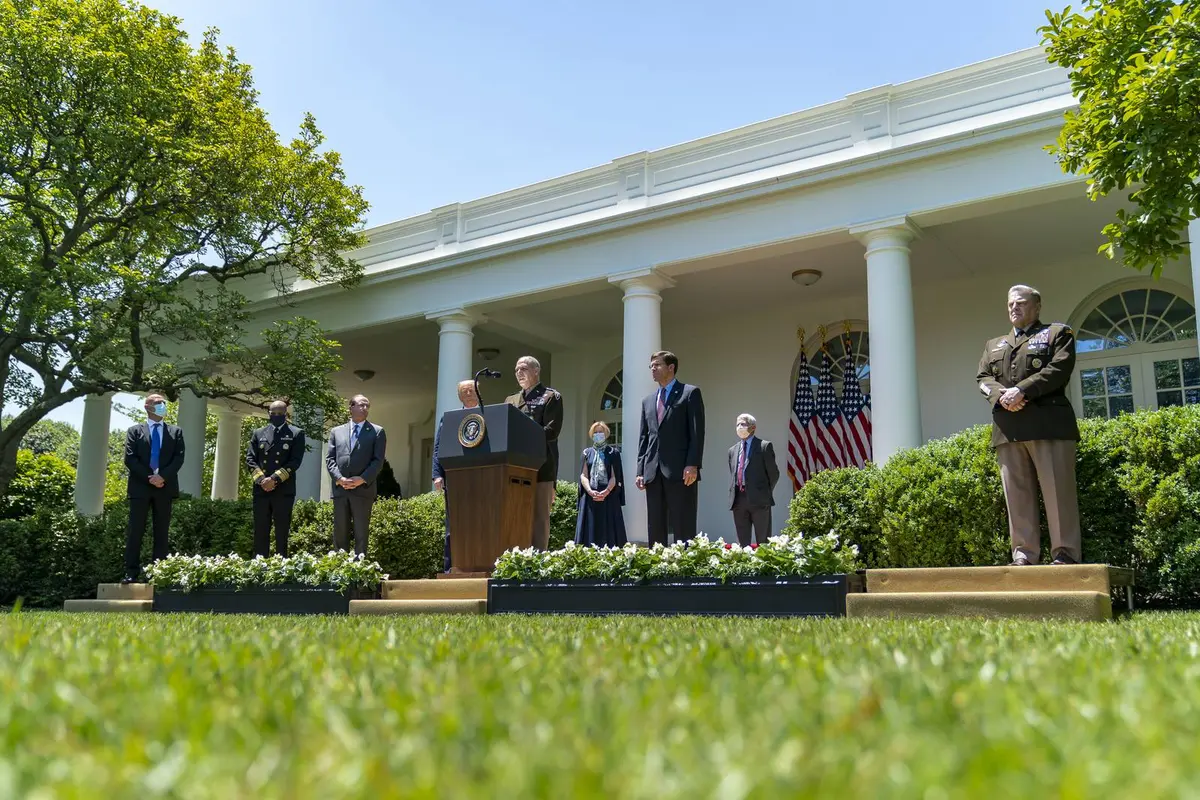
Gen. Gustave Perna, in uniform at right, stands in the Rose Garden as Operation Warp Speed is launched, 15 May 2020.. Shealah Craighead / The White House. Build it before it is proven
Moderna and the NIH start their Phase 3 trial. It grows to more than 30,000 volunteers at 100 sites across the country. Pfizer and its German partner BioNTech start theirs the same day. Warp Speed buys before the answers are in: $1.95 billion to Pfizer for 100 million doses delivered after authorization, and up to about $1.5 billion to Moderna to make 100 million while its trial is still running.
Ninety-five percent
An independent safety board reads the first Moderna results. Of 95 volunteers who caught COVID-19, 90 had the placebo and 5 had the vaccine: 94.5 percent effective. All 11 severe cases are in the placebo group. Two days later Pfizer and BioNTech report their final count from more than 43,000 volunteers: 162 cases on placebo, 8 on vaccine, 95 percent. Both companies have been mass-producing doses during the trials.
Distribution has begun
On 11 December the FDA authorizes the Pfizer-BioNTech vaccine for emergency use in people 16 and older. The next day General Perna briefs the press. Boxes are being packed, with the emphasis on quality control. Shipments will reach 145 sites on Monday, 425 on Tuesday and the last 66 on Wednesday: 636 locations named in advance by the states and territories.
Gen. Gustave Perna, 12 December 2020Make no mistake, distribution has begun.
The trucks roll
Early Sunday at Pfizer’s Kalamazoo plant, workers in fluorescent yellow, hard hats and gloves pack vials into freezer cases with dry ice. UPS and FedEx trucks pull out under U.S. Marshals protection, some bound for the airport in Grand Rapids, where the first cargo plane lifts off. In one week Warp Speed delivers 2.9 million doses to every state and territory, through snowstorms and the holiday rush.
Healing is coming
At Long Island Jewish Medical Center, ICU nurse Sandra Lindsay, the first to raise her hand when volunteers were asked for, rolls up her sleeve. Dr. Michelle Chester gives the shot shortly before 9:30 a.m., live on television. It is the first COVID-19 vaccination in the United States outside a clinical trial. The same day, Walter Reed starts vaccinating its medical staff.
Sandra Lindsay, after her shotI feel like healing is coming.
The architects

Kansas-raised physician and Vanderbilt-trained virologist who helped found the Vaccine Research Center in 2000. He spent years learning to lock viral spikes in shape, starting with RSV. When the new virus came, his team designed the vaccine within 48 hours.

North Carolina native with a doctorate from UNC Chapel Hill, at the VRC since 2014. She led the coronavirus team that turned the new spike sequence into mRNA-1273 with Moderna and helped drive the preclinical work that cleared it for human trials.

Former VRC postdoctoral fellow who maps viral proteins atom by atom. His lab co-discovered the 2P spike in 2017 and published the first atomic map of the new virus’s spike in February 2020. Moderna, Pfizer-BioNTech, Johnson & Johnson and Novavax all use 2P.

New Jersey native commissioned in 1981 who rose to four stars and command of Army Materiel Command. He ran Warp Speed’s production and distribution and delivered the first 2.9 million doses to every state and territory in one week.
By the numbers
In pictures


Watch, listen, see
Films, photographs and first-hand accounts from across the web. Each opens in a new tab.

Northwell Health’s broadcast on 14 December 2020, as its first frontline workers rolled up their sleeves.
Northwell Health
Gen. Gus Perna briefs the press on vaccine distribution on 14 December 2020, the day shots began.
DVIDS / Department of Defense
The Defense Department’s photos and video of Warp Speed, from headquarters drills to the first shipments.
DVIDSRecorded in May 2020, the VRC’s coronavirus lead explains how her team built mRNA-1273 in record time.
NIH Intramural Research ProgramMcLellan, Corbett, Graham and colleagues publish the spike’s atomic structure in February 2020. Free full text.
Science, via PubMed CentralHow McLellan’s lab and the NIH designed the stabilized spike behind the vaccines within about a day.
University of Texas at Austin
The NIH’s own account of the decades of spike research that let its scientists design a vaccine in days.
The NIH Catalyst
Congress’s auditors on how Warp Speed ran trials and manufacturing in parallel, faster than any vaccine before.
U.S. Government Accountability Office“They were the true first recipients of the vaccine. They deserve our utmost respect and appreciation. Without them, we could not be here today. They’re true American heroes.”
Gen. Gustave F. Perna, on the vaccine trial volunteers, 12 December 2020
After
On 18 December the FDA authorized Moderna’s vaccine, the one designed at the NIH, for adults 18 and older. It kept in a standard freezer and shipped in 100-dose cartons, small enough for rural clinics. The next week Warp Speed allocated 7.9 million doses of the two vaccines to more than 3,700 locations.
The Government Accountability Office found both vaccines were authorized less than a year after the virus was sequenced, considerably faster than any vaccine before them in the United States. The old record belonged to another American, Maurice Hilleman of Merck, whose mumps vaccine took four years, from 1963 to 1967.
The 2P spike that Graham, McLellan and their colleagues designed is in the Moderna, Pfizer-BioNTech, Johnson & Johnson and Novavax vaccines. By the end of January 2021, companies had released 63.7 million doses. General Perna retired in July 2021 after more than 40 years in uniform.
Primary sources
- Operation Warp Speed: Accelerated COVID-19 Vaccine Development Status and Efforts to Address Manufacturing Challenges (GAO-21-319). U.S. Government Accountability Office, February 2021.
- Corbett, K. S., et al. SARS-CoV-2 mRNA vaccine design enabled by prototype pathogen preparedness. Nature 586 (2020).
- Operation Warp Speed Official: First COVID-19 Vaccines to Arrive Monday. DOD News, U.S. Department of Defense, 12 December 2020.