Bell Labs, Murray Hill, New Jersey · 16 December 1947 · Bardeen, Brattain and Shockley
A Magnificent Christmas Present
Two physicists at Bell Labs pressed two gold points onto a sliver of germanium, and a signal came out a hundred times stronger. Every phone, computer and chip since starts there.

The moment · 16 December 1947 · Murray Hill, New Jersey
Five weeks of trying. Walter Brattain wraps gold foil over a plastic wedge, slits it at the tip with a razor and presses it onto germanium with a spring. Two contacts, two thousandths of an inch apart. A small signal goes in. It comes out a hundred times stronger.
We discovered something today.John Bardeen
After the war, the American telephone network ran on vacuum tubes that ran hot and burned out, and on metal relays that wore out with use. Mervin Kelly, who ran research at Bell Telephone Laboratories, wanted something small, solid and cool to replace them. He put a team of physicists, chemists and engineers on it. Two years later, two of them built it on a lab bench in New Jersey.
A tube man wants something better
Mervin Kelly, a Missouri physicist who made his name building vacuum tubes for the phone system, becomes director of research at Bell Telephone Laboratories. Tubes run hot, eat power and burn out. The switches in telephone exchanges are metal relays. Kelly starts hiring solid-state physicists. One of the first is William Shockley, fresh from MIT. Kelly tells him the day is coming when telephone switching will be done electronically.
The solid-state group
As the war ends, Kelly sets up a new group for basic research in solid-state physics, led by Shockley and chemist Stanley Morgan. Experimenter Walter Brattain, at Bell since 1929, joins. In October theorist John Bardeen arrives from the Naval Ordnance Laboratory. Chemist Robert Gibney and physicist Gerald Pearson round it out. Shockley’s first design for a semiconductor amplifier fails to work. In March 1946 Bardeen works out why: electrons trapped at the surface block the effect.
The miracle month
Gibney suggests putting a voltage across an electrolyte to break through the surface barrier. It works. For five weeks Brattain and Bardeen try one setup after another, on silicon and then on germanium, in water, in electrolyte, with metal points coated in wax. On 8 December a germanium version amplifies 330 times. On 12 December Brattain accidentally washes off an oxide layer and finds the effect works at every frequency he tries.
Gold, germanium and a plastic wedge
Bardeen works out that the two contacts must sit about two thousandths of an inch apart. Brattain wraps a strip of gold foil over the point of a plastic triangle, slices it at the tip with a razor blade and presses the two gold edges onto a slab of germanium with a spring. A small signal on one contact controls a larger current through the other. The output is about 100 times the input. It is the first transistor.
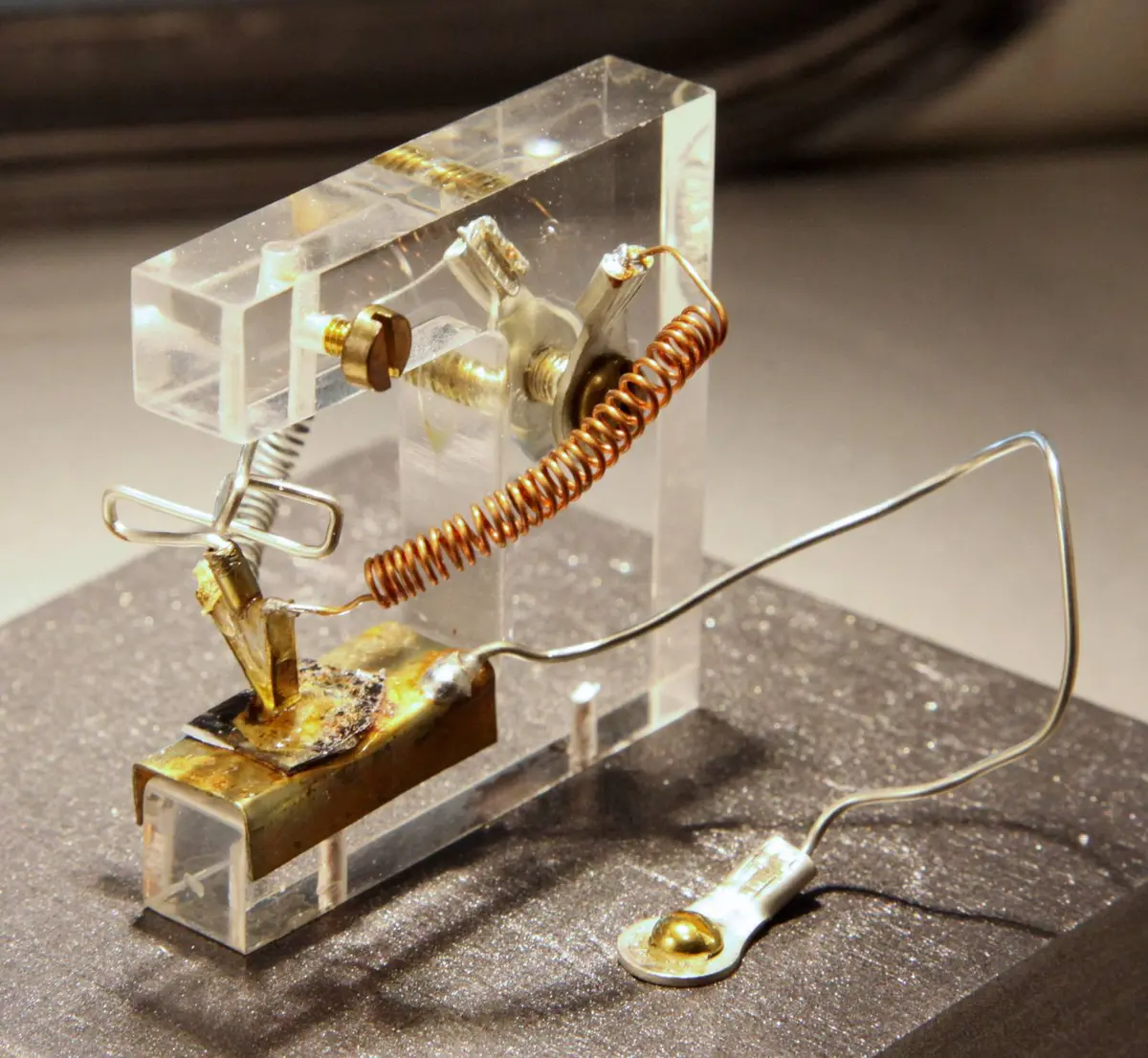
A replica of the first point-contact transistor: gold foil on a plastic wedge, pressed onto germanium by a spring. Florian Schäffer / Heinz Nixdorf MuseumsForum. Bardeen to his wife, Jane, that eveningWe discovered something today.
The Christmas present
The day before Christmas Eve, Shockley brings Bell Labs’ research leadership to see it. Speech goes into a microphone, through the transistor and out to headphones. Switch the device in and out and the voice jumps in volume with no loss of quality. Measured at a fixed frequency, the power gain is 18 or better. Shockley calls it a magnificent Christmas present. Bell Labs keeps it secret while the patents are prepared.
Brattain’s lab notebook, 24 December 1947This circuit was actually spoken over and by switching the device in and out a distinct gain in speech level could be heard and seen on the scope presentation with no noticeable change in quality.
The junction transistor
Shockley spends the weeks after the demonstration on a design of his own. On 23 January he writes down the idea of the junction transistor: a sandwich of differently treated layers of semiconductor, with no delicate points at all. It is sturdier and easier to make in quantity. Morgan Sparks and Gordon Teal build the first working ones at Bell Labs in 1951. It becomes the workhorse transistor of the 1950s.
The transistor goes public
The military gets a private look first. Then, at Bell Labs’ headquarters on West Street, research director Ralph Bown shows the press the new device. Its name, transistor, came from engineer John Pierce and won a staff ballot in May. Bown tells reporters it can do just about everything a vacuum tube can do, and some things a tube cannot. The New York Times gives it a short item the next morning.
Silicon and the pocket radio
Bell Labs licenses the transistor to other companies for a $25,000 advance. At Texas Instruments in Dallas, Gordon Teal builds the first commercial silicon transistors, which keep working in heat that stops germanium. On 10 May he tells an engineering conference in Dayton he happens to have a few in his pocket. On 18 October TI and Regency of Indianapolis announce the TR-1, the first transistor radio sold. It has four transistors and costs $49.95.
The Nobel Prize
Shockley, Bardeen and Brattain share the Nobel Prize in Physics “for their researches on semiconductors and their discovery of the transistor effect.” Bardeen’s Nobel lecture the next day is titled “Semiconductor Research Leading to the Point Contact Transistor.” By now transistors are in hearing aids, pocket radios and the Bell System equipment that routes long-distance calls.
The team

Born in Madison, Wisconsin, in 1908 and in college at 15. Led mine and torpedo countermeasures at the Naval Ordnance Laboratory in the war. Explained the surface barrier and guided the experiments. In 1972 he became the only person to win the physics Nobel twice.

Born in China in 1902 and raised on a cattle ranch in eastern Washington. Joined Bell Labs in 1929 and built magnetometers to find submarines in the war. Made the gold-foil wedge with his own hands. Later taught at Whitman College, his alma mater.

Born in London to American parents in 1910 and raised in California. Led antisubmarine operations research for the Navy in the war and won the Medal for Merit. Invented the junction transistor, the sturdy design that made transistors practical to mass-produce.

Born in Princeton, Missouri, in 1894. Earned his doctorate in Chicago as an assistant to Robert Millikan. Built vacuum tubes for the phone network, then set out to replace them. Formed the solid-state group in 1945 and was president of Bell Labs from 1951 to 1959.
By the numbers
In pictures


Watch, listen, see
Films, photographs and first-hand accounts from across the web. Each opens in a new tab.

A 1965 Bell Labs film reunites Bardeen, Brattain and Shockley to show how they built the first transistor.
AT&T Archives
Bell Labs explains its new invention to the public and predicts wrist radios and portable TVs.
AT&T Archives
A 1980s Bell Labs film in which the inventors of the transistor recall how they did it.
AT&T Archives
The handwritten notebook page recording the first demonstration of the transistor, December 1947.
PBS Transistorized!
The full story of the invention, with biographies, notebook pages, a timeline and interactive science lessons.
PBS / American Institute of Physics
Bardeen and Brattain’s patent for the point-contact transistor, filed June 1948 and granted October 1950.
Google PatentsBardeen’s own account, given in Stockholm in December 1956, of the research that led to the transistor.
NobelPrize.org
The museum’s semiconductor timeline, from the point-contact transistor to the integrated circuit and beyond.
Computer History Museum“What we have to show you today represents a fine example of teamwork, of brilliant individual contributions and of the value of basic research in an industrial framework.”
Ralph Bown, director of research, Bell Telephone Laboratories, announcing the transistor, New York, 30 June 1948
After
Bell Labs shared what it had made. It licensed the transistor to any company that would pay the advance and held symposiums to teach licensees how to build it. On 12 September 1958 Jack Kilby of Texas Instruments showed his managers the first integrated circuit, a whole circuit on one sliver of germanium. In July 1959 Robert Noyce of Fairchild Semiconductor filed a patent on a silicon version built for mass production. Kilby won the Nobel Prize in Physics in 2000.
From there the count climbed without stopping. Intel’s 4004 of 1971 held 2,300 transistors. Apple’s M3 Max of 2023 holds 92 billion. By 2018 the industry had built an estimated 13 sextillion of them, and the Computer History Museum calls the transistor the most frequently manufactured human artifact in history.
In 2009 the IEEE dedicated a Milestone plaque at Bell Labs in Murray Hill. It records that from 17 November to 23 December 1947, Brattain and Bardeen, under the direction of Shockley, discovered the transistor effect there and built and demonstrated the point-contact germanium transistor.
Primary sources
- Walter H. Brattain, laboratory notebook, entry of 24 December 1947. Bell Telephone Laboratories. Reproduced in Transistorized!, PBS.
- J. Bardeen and W. H. Brattain, Three-Electrode Circuit Element Utilizing Semiconductive Materials, U.S. Patent 2,524,035, 3 October 1950.
- The Nobel Prize in Physics 1956: William B. Shockley, John Bardeen, Walter H. Brattain. Nobel Foundation.