Boston, Massachusetts · 10 March 1876 · Alexander Graham Bell and Thomas A. Watson
Mr. Watson, Come Here
Three days after his patent came through, Alexander Graham Bell shouted nine words into a wire and his assistant heard every one. Within Bell’s lifetime, more than ten million American telephones were ringing.

The moment · 10 March 1876 · 5 Exeter Place, Boston
Two rooms on the top floor of a boarding house. Both doors shut. Watson presses the receiver to one ear and covers the other. In the next room Bell leans over his new transmitter and shouts. Moments later Watson is at his side. He heard every word.
Mr. Watson, come here, I want to see you.Alexander Graham Bell, as written in his notebook that day
In 1875 a telegraph wire could carry only clicks. Alexander Graham Bell, a young teacher of the deaf in Boston, believed it could carry the human voice itself. Backed by the fathers of two of his deaf students and helped by a machinist named Thomas Watson, he set out to prove it. Nobody had ever sent a spoken sentence over a wire.
A teacher with an idea
Bell comes to Boston in 1871 to teach at the Boston School for Deaf Mutes and is soon a professor of vocal physiology at Boston University. At night he works on a harmonic telegraph to send many messages down one wire. Two fathers of his deaf pupils, Gardiner Greene Hubbard and Thomas Sanders, pay for the work. On 27 February 1875 the three sign an agreement forming the Bell Patent Association.
The twanging reed
In the hot attic of Charles Williams Jr.’s electrical shop, Watson tends the transmitter springs while Bell tunes the receivers in the next room. One spring sticks. Watson plucks it. Bell bursts in. The stuck spring had sent a current that rose and fell exactly like the sound, and Bell heard its tone. He knows a wire can carry speech. Watson builds the first telephone the next day.
Bell to Watson, as Watson remembered itWhat did you do then? Don’t change anything. Let me see!
Patent 174,465
Bell’s lawyer files his application at the Patent Office in Washington on 14 February 1876. On 7 March the government grants U.S. Patent 174,465, “Improvement in Telegraphy.” It covers a method of transmitting vocal or other sounds telegraphically by electrical undulations shaped like the vibrations of the air. Bell has the patent. Now he has to make the machine talk.
Come here
Bell now lives and works in two attic rooms at 5 Exeter Place. He has built a new transmitter: a mouthpiece over a fine platinum wire dipping into acidified water. Watson sits in the far room with the receiver against his ear, both doors closed. Bell shouts into the mouthpiece. Watson appears at his door and repeats the sentence back. Then they trade places, and Bell hears Watson ask, “Mr. Bell, do you understand what I say?”
Bell, into the transmitterMr. Watson, come here, I want to see you.
It speaks
At the Centennial Exhibition, the nation’s hundredth-birthday fair, Bell shows his telephones to the judges. Watson has built them polished to a mirror shine. The emperor of Brazil, Dom Pedro II, holds the receiver to his ear while Bell talks from across the room. By the Bell company’s account, he cried out, “My God, it speaks!” The British physicist Sir William Thomson tries it too. Bell wins the Exhibition’s medal.
Talking between towns
Bell and Watson borrow the Walworth Manufacturing Company’s private telegraph wire, about two miles from its Boston office to its Cambridgeport factory. At first the line is dead. Watson finds a relay left in the circuit, cuts it out, and hears Bell’s voice call “Ahoy!” They talk until long after midnight, each writing down what he hears. The Boston Advertiser prints both records side by side the next morning.
The Bell Telephone Company
Western Union has already turned down Hubbard’s offer to sell every Bell patent for $100,000. So Hubbard organizes the Bell Telephone Company himself, as trustee, and decides to lease telephones instead of selling them, so the company keeps control. Two days later Bell marries Hubbard’s daughter Mabel. In January 1878 the first commercial exchange opens in New Haven, Connecticut, with 21 telephones.
Building the system
In May 1878 Hubbard hires Theodore Vail, head of the Railway Mail Service, as general manager. Bell’s patents survive some 600 lawsuits, and the Supreme Court upholds them in 1888. In 1885 the company forms American Telephone and Telegraph to build long-distance lines between cities. On 18 October 1892 Bell opens the line from New York to Chicago.
Across the continent
Bell sits at AT&T’s offices at 15 Dey Street in New York. Watson waits at 333 Grant Avenue in San Francisco. Between them run 3,400 miles of copper on 130,000 poles through thirteen states. Vail listens in from Jekyll Island, Georgia, and President Wilson joins from the White House. Thirty-eight years after Exeter Place, Bell repeats his summons to Watson, now a continent away.
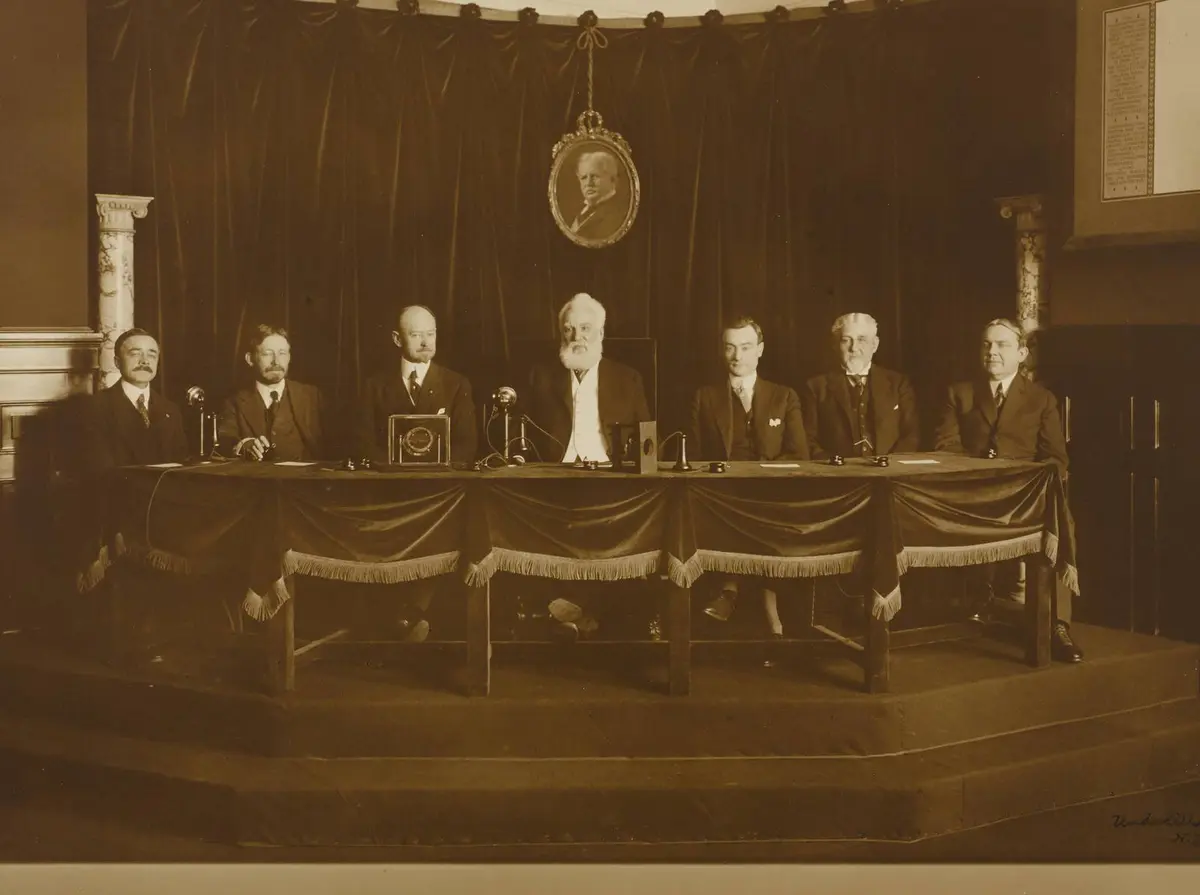
Bell, center, at AT&T’s New York offices on 25 January 1915, opening the first transcontinental telephone line with a call to Watson in San Francisco.. Irving Underhill / via Wikimedia Commons.
The inventors and the builders

Edinburgh-born teacher of the deaf who came to Boston in 1871 and taught vocal physiology at Boston University. He worked out how a current could carry the shape of a voice, won the patent and spoke the first sentence. U.S. citizen from 1882.

Salem-born machinist from Charles Williams Jr.’s Boston shop. He built every one of Bell’s early instruments, heard the first sentence ever spoken over a wire and ran the young company’s engineering. Later he founded the Fore River shipyard in Massachusetts.

Boston lawyer and president of the Clarke School for the Deaf. With Thomas Sanders he paid for Bell’s experiments, then organized the Bell Telephone Company in 1877 and chose to lease telephones, not sell them. First president of the National Geographic Society.

Ohio-born telegrapher who rose to run the federal Railway Mail Service. Hubbard hired him in 1878 to manage the Bell company. He defended the patents, became AT&T’s first president in 1885, returned to lead it in 1907 and drove the line coast to coast.
By the numbers
In pictures


Watch, listen, see
Films, photographs and first-hand accounts from across the web. Each opens in a new tab.

A 1930 film of the invention, introduced and narrated in part by Thomas A. Watson himself.
AT&T Archives
The Bell System’s 1947 centennial film of Bell’s life in Boston as he invented the telephone.
AT&T Archives
The only confirmed recording of Bell’s voice, made in 1885 and recovered by the Smithsonian with light.
Smithsonian National Museum of American History
Bell’s 1875–1876 notebook, including the 10 March 1876 entry recording the first sentence by telephone.
Library of CongressBell’s letter to his father the same day: speech sent intelligibly, and telephones in every home to come.
Library of CongressBell’s signed patent drawing for No. 174,465, approved 7 March 1876, from the Patent Office records.
National ArchivesWatson’s 1913 account of the twanging reed, the first sentence and the first conversation, in his words.
Project Gutenberg
AT&T’s 1915 booklet on the transcontinental line: the call, the route, the poles and the copper.
Internet Archive“The day is coming when telegraph wires will be laid on to houses just like water or gas and friends converse with each other without leaving home.”
Alexander Graham Bell, letter to his father, 10 March 1876
After
Bell became a United States citizen in 1882. France awarded him the Volta Prize, and he used the money to found the Volta Laboratory in Washington, D.C., where he and his associates improved the phonograph and invented the photophone. He later served as the second president of the National Geographic Society, which Gardiner Hubbard had helped found, and as a regent of the Smithsonian Institution.
The company Hubbard organized and Vail built became the Bell System. America had 3,000 telephones in 1876, 1.36 million in 1900 and 10.5 million in 1915, the year Bell called Watson across the continent.
Bell died on 2 August 1922. By 1970 Americans had 120 million telephones, and 90.5 percent of households had one. Every one of them traced back to nine words shouted down a wire in a Boston attic.
Primary sources
- Alexander Graham Bell, laboratory notebook, 1875–1876, entry of 10 March 1876. Alexander Graham Bell Family Papers, Manuscript Division, Library of Congress.
- Thomas A. Watson, The Birth and Babyhood of the Telephone. Address to the Telephone Pioneers of America, Chicago, 17 October 1913.
- Historical Statistics of the United States, Colonial Times to 1970, Series R 1–12: Telephones. U.S. Census Bureau, 1975.