Argonne Forest, France · 8 October 1918 · Company G, 328th Infantry, 82nd Division
I Got a Plenty
A German officer asked a Tennessee corporal how many men he had. York had seven. He marched 132 prisoners back to the American line anyway.

The moment · Morning · 8 October 1918
Six of the patrol are dead. The survivors lie pinned among their prisoners. Corporal York is in the open below the ridge. Each time a German head rises over a gun pit, he fires. A bayonet party charges. He drops the empty rifle, draws his .45 and keeps shooting.
By this time the Germans from on the hill was shooting at me. Well I was giving them the best I had.Alvin C. York, diary
In October 1918 the 82nd Division pushed into the Argonne Forest in the largest battle the U.S. Army had ever fought. Its job on the morning of 8 October was to cross a narrow valley and cut the Decauville Railroad, a German supply line. German machine guns on the ridges stopped the attack cold. A patrol of seventeen men went around the flank to find them.
The valley of the Three Forks
Alvin Cullum York is born on 13 December 1887 in a log cabin in Fentress County, the third of eleven children. He gets about nine months of schooling. He works as a blacksmith, farmer and laborer, and he hunts. At mountain turkey shoots the target is a bird's head bobbing behind a log, and York is one of the best shots in the hills.
A man of faith goes to war
York joined a strict church in 1915 and believes the Bible forbids killing. He registers for the draft, his conscientious objector claim is denied, and in November 1917 he reports to Camp Gordon, Georgia. His company commander, Capt. Edward Danforth, and battalion commander, Maj. G. Edward Buxton, talk Scripture with him for hours. After ten days of leave and prayer at home, York comes back ready to fight.
The All-Americans
The 82nd Division drew men from all 48 states, so it called itself the All-American Division. It crossed to France in the spring of 1918 and fought at Saint-Mihiel in September. In the first week of October it entered the Argonne, and on the 7th the 328th took Hill 223 near the village of Châtel-Chéhéry. York, now a corporal in Company G, writes the next order in his diary: take Hills 223 and 240 on the 8th.
No barrage
The 2nd Battalion goes over the top from Hill 223 at 06:10. The promised artillery barrage never comes. German machine guns on the ridges ahead and on the left flank sweep the valley, and the attack stalls in the open. York is with the support platoon and watches the men in front of him go down. Somebody has to get at those guns.
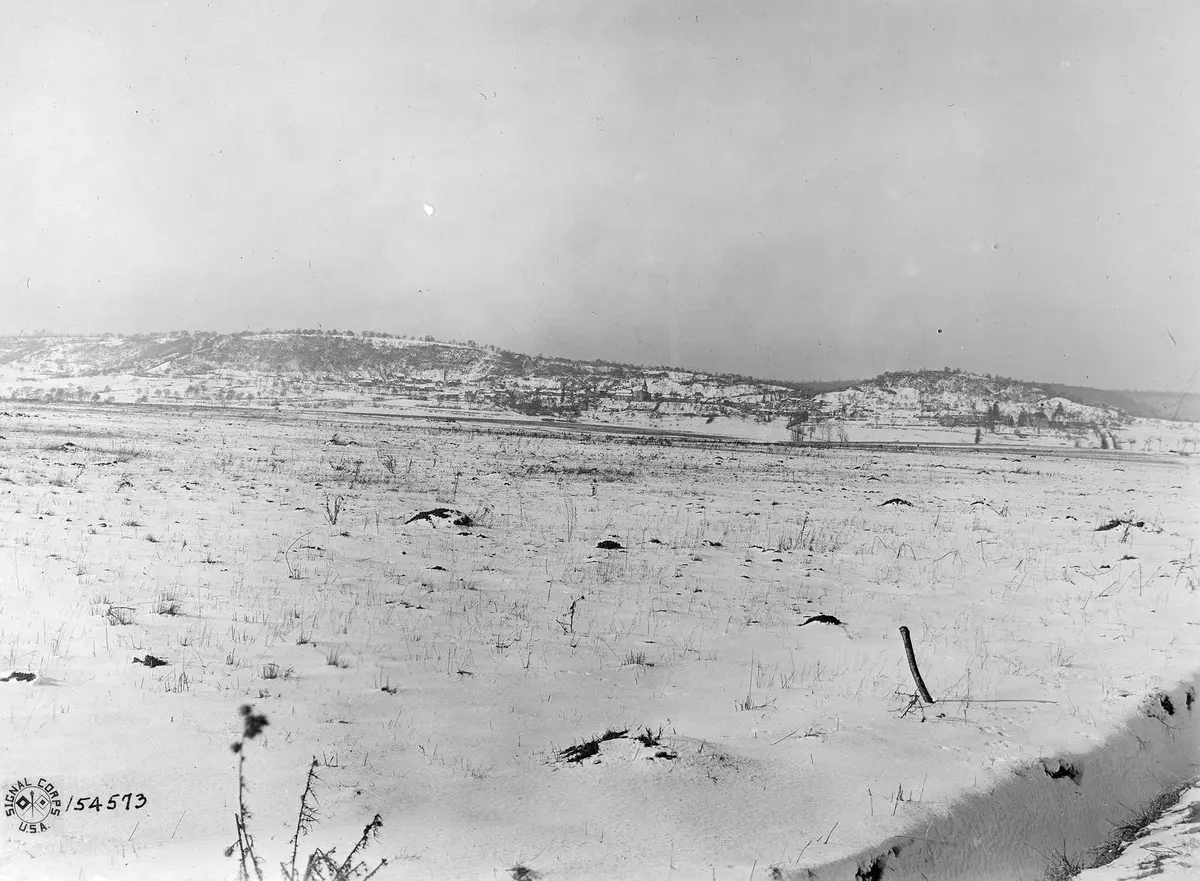
Hill 223, Argonne Forest, marked with the 328th Infantry's line of advance in its capture on 7 October 1918 (111-SC-154573). U.S. Army Signal Corps / U.S. Army Military History Institute. Behind the German line
Acting Sgt. Bernard Early leads seventeen men around the left flank: four NCOs, York among them, and thirteen privates. They slip through the brush into the German rear and stumble on two stretcher-bearers. Chasing them across a small stream, they land in a German battalion headquarters at breakfast. About twenty Germans, officers among them, throw up their hands without a fight.
The guns turn around
On the ridge above, German machine gunners swing their guns around and open fire into the clearing. The prisoners drop flat. The burst kills six Americans, among them Cpl. Murray Savage, and wounds three, including Sergeant Early. Eight men are left standing. The surviving Americans are pinned among the prisoners. Corporal York is on the left edge of the thicket, in the open, with a clear view up the slope.
One rifle against the ridge
York shoots the way he did at home, one round each time a German head comes up over a gun pit. Between shots he calls on them to come down and surrender. A small party charges him with bayonets. He drops his empty rifle, draws his .45 pistol and shoots the men at the back first so the rest keep coming. Then the German battalion commander offers to make his men quit.
York's diaryBy this time the Germans from on the hill was shooting at me. Well I was giving them the best I had.
Only 132
The officer blows a whistle and the gunners come down with their hands up. York lines the prisoners up in twos, puts the officers in front with his pistol at their backs, and marches them straight through more German positions, collecting those crews too. Back at battalion, the count is 132. Brig. Gen. Julian Lindsey tells him he hears York captured the whole German army. York says he only got 132.
York, to the German officerHow many have you got? I got a plenty.
The railroad is cut
With the guns on the left ridge silent, the 328th Infantry renews its attack and cuts the Decauville Railroad before the day is out. York reports for duty and is sent back to guard his prisoners. Officers of his regiment later walk the hillside and count 25 dead Germans and 35 machine guns. The division's report says the story was checked in every possible detail.

The men

Tennessee blacksmith, farmer and church elder who tried to stay out of the war on grounds of faith. At 30, he took command of what was left of his patrol and broke a German machine-gun position with a rifle and a pistol.

Rhode Island businessman who led York's battalion. He sat up with York debating the Bible until York was ready to fight. As the 82nd's official historian he gathered the patrol's sworn affidavits. In World War II he was assistant director of the OSS.

Kentuckian, West Point class of 1886, veteran of Cuba and the Philippines. He took the 82nd in October 1918 and led it through the Argonne. His headquarters checked York's story in every detail and sent it up for the Medal of Honor.

Missouri-born cavalryman, West Point class of 1886. He built the American army in France from almost nothing and sent more than 1.2 million Americans into the Meuse-Argonne. In 1919 Congress made him General of the Armies.
By the numbers
In pictures


Watch, listen, see
Films, photographs and first-hand accounts from across the web. Each opens in a new tab.

Army Col. Douglas Mastriano tells York's story from his award-winning biography, at Norwich University in 2015.
C-SPAN Book TV
ABMC's film of the doughboy's war in the offensive where York fought, made for the cemetery visitor center.
American Battle Monuments Commission
Military historian Brad Posey on the search to pin down exactly where York fought.
C-SPAN3 · Internet Archive
Sergeant York, back in the Argonne in 1919, shows the hill where the patrol took 132 prisoners.
National Archives
The Army's own biography of the Tennessee farmer who became one of its most celebrated soldiers.
National Museum of the U.S. ArmySam Cowan's 1922 book, with York's diary account of the fight and his comrades' sworn affidavits.
Project Gutenberg
The 82nd Division's official 1919 history of its campaigns in France.
Internet Archive
Photographs, a scrapbook, papers and an Argonne trench map from York's home state archives.
Tennessee State Library and Archives“Fearlessly leading seven men, he charged with great daring a machinegun nest which was pouring deadly and incessant fire upon his platoon.”
Medal of Honor citation, Corporal Alvin C. York, 328th Infantry, 82nd Division
After
York was promoted to sergeant and awarded the Distinguished Service Cross. After the 82nd gathered sworn statements from the survivors, it was upgraded to the Medal of Honor in April 1919. France added the Croix de Guerre with Palm and the Legion of Honor. His first biographer recorded Marshal Foch's verdict: “What you did was the greatest thing accomplished by any private soldier of all of the armies of Europe.”
A Saturday Evening Post story that April made him famous overnight. He came home aboard the Ohioan on 22 May 1919, and the House of Representatives stopped its debate to cheer him. He turned down fortunes in endorsements and stage offers, went home to Pall Mall, and on 7 June married Gracie Williams, with the governor of Tennessee performing the ceremony.
He spent his fame on his mountains. The York Agricultural Institute opened in 1929 to give Fentress County children a high school. In 1941 Gary Cooper won an Oscar playing him. York died on 2 September 1964 and is buried in the Wolf River Cemetery in Pall Mall.
Primary sources
- Sergeant York and His People. Sam K. Cowan, 1922. Includes York's diary account and the patrol's affidavits.
- Medal of Honor citation, Corporal Alvin C. York, Company G, 328th Infantry, 82nd Division. War Department, 1919.
- Official History of the 82nd Division, American Expeditionary Forces. 82nd Division, 1919.