Abbottabad, Pakistan · 2 May 2011 · Navy SEALs, the Night Stalkers and the CIA
Justice Has Been Done
Nearly ten years after 9/11, the CIA tracked Osama bin Laden to a walled compound in Pakistan. Navy SEALs flew in by night, got him, and came home without losing a man.

The moment · 23:35 EDT · 1 May 2011
The President walks to the lectern in the East Room. Outside the gates, the crowd is growing. Some 56.5 million Americans are watching. He tells them a small team has found bin Laden in Pakistan, and that no Americans were harmed.
Justice has been done.President Barack Obama
On 11 September 2001, al Qaeda killed 2,977 people in New York, at the Pentagon and in a Pennsylvania field. Its leader, Osama bin Laden, escaped into Pakistan. For nearly ten years, CIA officers and analysts worked every lead. One courier led them to a walled compound in Abbottabad. On 1 May 2011, the President sent in the SEALs.
The worst day
Nineteen al Qaeda hijackers seize four airliners. They bring down the Twin Towers, hit the Pentagon and crash in a Pennsylvania field, where the passengers fought back. 2,977 people are killed. Within days the President authorizes the CIA to go after al Qaeda, and its officers are in Afghanistan before the month is out. By December bin Laden is cornered at Tora Bora. He escapes across the border into Pakistan.
One courier
Detainees name a courier by his nickname. He is a protégé of Khalid Sheikh Mohammed, the 9/11 mastermind, and one of the few men bin Laden trusts. They say he may be living with bin Laden. For years no one knows his real name. Around 2007 the CIA finds it. Two years later analysts narrow his movements to parts of Pakistan, but he and his brother are careful. That only makes the hunters surer.
The compound
Analysts follow the brothers home to Abbottabad, a quiet town 35 miles north of Islamabad. Their compound is eight times larger than the houses around it, with walls 12 to 18 feet high topped with barbed wire. It has no phone or internet line, though it is worth about $1 million. The residents burn their trash. A third family lives there, matching bin Laden’s. A man paces the courtyard, but no one can see his face.
Five meetings
The President chairs five National Security Council meetings on the compound. The CIA red-teams its own case and finds no one who fits better than bin Laden, but it cannot prove he is there. A B-2 strike would cause heavy damage around the compound, so the President rules it out. He chooses a raid by Navy SEALs, who rehearse on a full-size replica with movable inside walls. He calls the odds 55/45.
The order
On Friday morning the President gives the final order. It goes to the CIA Director as a covert action, and Leon Panetta hands it to Vice Adm. William McRaven, head of Joint Special Operations Command, who will command the raid from Afghanistan. Panetta keeps his instructions short. At 13:25 Washington time on Sunday, 1 May, the President, Panetta and McRaven approve the launch.
Panetta’s orders to McRaven, as he recalled themGo in, get bin Laden. And if he’s not there, get the hell out.
Into Pakistan
Two Black Hawk helicopters lift off from Jalalabad, Afghanistan, into the dark with about two dozen SEALs aboard. Army pilots of the 160th Special Operations Aviation Regiment, the Night Stalkers, have a flight of about 162 miles ahead of them. Panetta runs the operation from CIA headquarters in Langley, in direct contact with McRaven. At the White House, the President and his national security team gather in the Situation Room.
One helicopter down
It is 00:30 on 2 May in Abbottabad when the helicopters reach the compound. The first one runs into trouble over the courtyard and comes down hard inside the walls. No one is hurt. The second sets down too, and both teams go straight in. The plan has changed in seconds, and the SEALs keep going. They blast through walls, push into the house and fight their way up the stairs.
Geronimo
Nine minutes after the helicopters arrive, the SEALs find bin Laden on the third floor. In Washington there are long minutes of silence. Then McRaven passes the code word to Panetta and the White House. At 15:53 the President has tentative confirmation. The team gathers up documents and computers, destroys the damaged helicopter and is gone by 16:10. The President later calls it the longest 40 minutes of his life.
The code word, relayed by McRavenGeronimo EKIA.
The announcement
The helicopters land in Afghanistan at 17:53, and McRaven meets the team. By 19:01 the identification is highly probable. The President calls Presidents Bush and Clinton. As word spreads, crowds gather outside the White House, at Ground Zero and in Times Square, chanting “U-S-A” and singing the national anthem. At 23:35 the President speaks from the East Room. Some 56.5 million Americans watch.
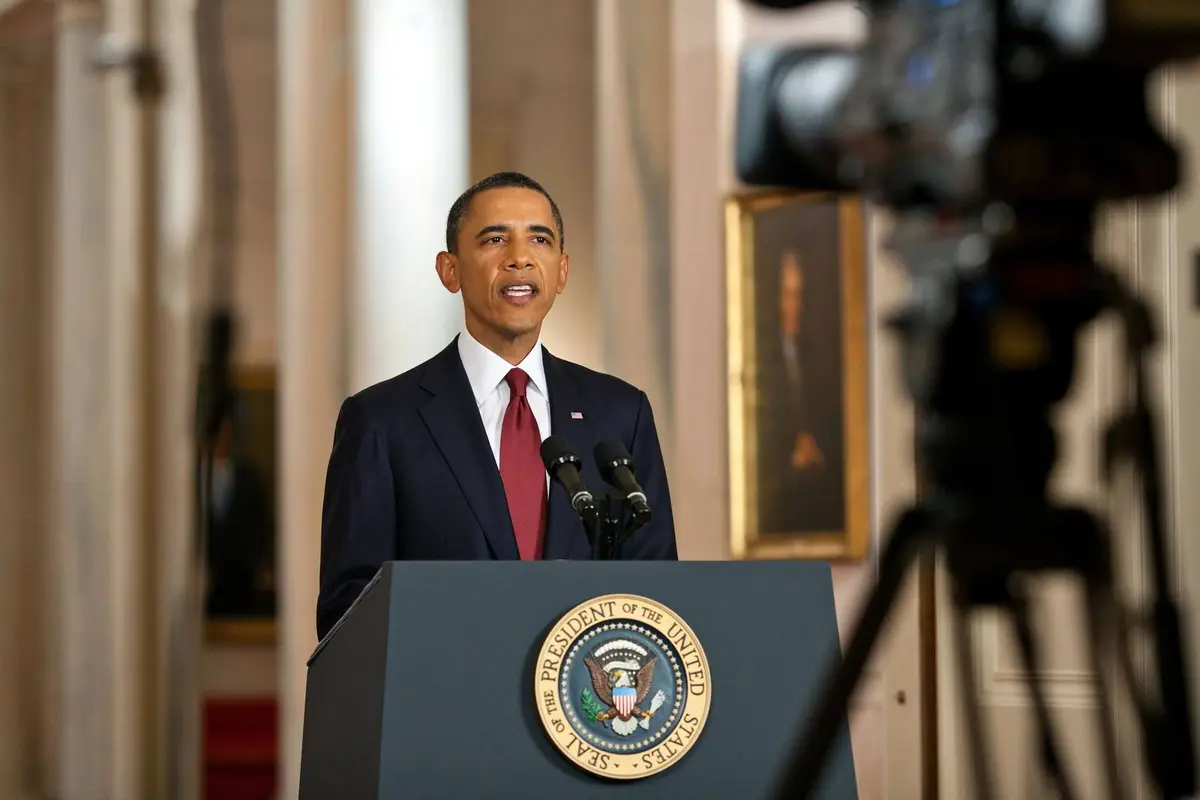
President Obama announces the mission’s success to the nation from the East Room of the White House, 11:35 p.m., 1 May 2011. Pete Souza / The White House.
The chain of command

The 44th President and a former U.S. senator from Illinois. In 2009 he made bin Laden the CIA’s top priority. He chaired five National Security Council meetings on Abbottabad, weighed odds he called 55/45, chose the raid over a bombing and gave the order.

Son of Italian immigrants in Monterey, California. Army officer, 16 years in Congress, then budget director and White House chief of staff. As CIA Director he drove the hunt, ran the raid under the President’s covert-action order and watched it from Langley.

Commissioned through the University of Texas in 1977, then a Navy SEAL. Commanded SEAL Team Three and wrote Spec Ops, a study of eight classic commando raids. He planned this one, briefed the President on it and commanded it from Afghanistan.
By the numbers
In pictures


Watch, listen, see
Films, photographs and first-hand accounts from across the web. Each opens in a new tab.

President Obama’s address from the East Room at 11:35 p.m. on 1 May 2011.
The Obama White House
Days later, the President tells Steve Kroft about the intelligence, the odds and the decision.
60 Minutes
The museum’s online exhibition traces the hunt from the 1990s through Tora Bora to Abbottabad.
9/11 Memorial & Museum
The CIA’s account of the operation, with its minute-by-minute timeline of the raid.
Central Intelligence Agency
How the CIA and NGA built the scale model of the compound used to brief the President.
Central Intelligence Agency
Pete Souza’s official photographs of 1 May 2011, from the Situation Room to the East Room.
The Obama White HouseThe day after, the CIA Director describes the tense minutes and the code word Geronimo.
PBS NewsHour
The President thanks the troops at Fort Campbell after meeting the team that flew the mission.
The Obama White House“Tonight, we are once again reminded that America can do whatever we set our mind to.”
President Barack Obama, address to the nation, 1 May 2011
After
On 5 May the President laid a wreath at Ground Zero with 9/11 families and visited the “Pride of Midtown,” the Manhattan firehouse that lost 15 men on 9/11. The next day at Fort Campbell, Kentucky, he met the assault team and its Night Stalker pilots in private, awarded them the Presidential Unit Citation and told them, “Job well done.”
The team brought out a trove of documents and computer files. They showed bin Laden still running al Qaeda from hiding. In 2017 the CIA released nearly 470,000 of the files to the public. Panetta became Secretary of Defense on 1 July 2011. McRaven earned a fourth star and took command of U.S. Special Operations Command that August.
The scale model built to brief the President now sits in the CIA Museum. In November 2019, the 9/11 Memorial & Museum, on the ground where the towers stood, opened Revealed: The Hunt for Bin Laden, with artifacts from the raid shown to the public for the first time.