Lake Placid, New York · 22 February 1980 · Herb Brooks and the U.S. Olympic hockey team
Do You Believe in Miracles?
Twenty young Americans, most of them college players, beat the greatest hockey team in the world at Lake Placid. Two days later they won the gold.

The moment · Final seconds · 22 February 1980
The Americans lead 4–3, and the Soviets throw everything at Jim Craig. He kicks away a slap shot with 33 seconds left. The Soviets never pull their goalie. The whole Field House starts counting down. Five. Four. Three.
Do you believe in miracles? Yes!Al Michaels
In 1980 the Soviet Union owned Olympic hockey. Its players were full-time veterans who had won four straight gold medals and had not lost an Olympic game since 1968. The United States sent the youngest team in the tournament, college players picked and driven by Herb Brooks. On a Friday afternoon in Lake Placid, they beat the Soviets 4–3.
Brooks picks his team
Herb Brooks, the last man cut from the 1960 gold-medal team, holds tryouts with 68 players. He wants skaters who will learn a faster European game and buy into the team. Nine of the 20 he keeps played for him at Minnesota. Four come from Boston University, Minnesota’s bitter rival. Twelve are Minnesotans. Only Buzz Schneider is back from the 1976 Olympic team.
Herbies
The team plays 61 exhibition games in five months, against college, pro and European teams. Brooks believes the Soviets win because their opponents are spent by the third period, so he builds a team that will not tire. After a sloppy 3–3 tie in Norway that September, he keeps the players on the ice for more than an hour, skating sprints. Arena workers turn off the lights. The players keep skating. They name the sprints Herbies.
Ten to three
In the last tune-up, at Madison Square Garden, the Soviets beat the Americans 10–3. Defenseman Jack O’Callahan hurts his knee, and Brooks keeps him on the roster anyway. The Soviets leave New York sure the Americans are no threat. Their coach, Viktor Tikhonov, later said that lopsided win turned into a very big problem for his team. Three days later, the Olympic tournament opens.
Unbeaten
Against favored Sweden, Brooks pulls goalie Jim Craig for an extra skater, and Bill Baker ties the game 2–2 with 27 seconds left. Two days later the Americans crush Czechoslovakia, the silver-medal favorite, 7–3. Then they beat Norway 5–1, Romania 7–2 and West Germany 4–2, coming from behind in game after game. They finish group play 4–0–1. The Soviets win their group by scores like 16–0 and 17–4.
One second left
About 8,500 fans pack the Field House. Vladimir Krutov puts the Soviets ahead at 9:12. Buzz Schneider ties it from 50 feet. Sergei Makarov makes it 2–1. With seconds left, Dave Christian fires from long range, and Vladislav Tretiak, widely called the best goalie in the world, lets the rebound get away. Mark Johnson splits two defenders and scores with one second on the clock. Tikhonov pulls Tretiak for Vladimir Myshkin.
Herb Brooks, from the note he read to his players before the gameYou were born to be a player. You were meant to be here.
Exactly ten minutes
The Soviets outshoot the Americans 12–2 in the second period and lead 3–2. Craig keeps it close. At 6:47 of the third, Krutov goes off for high-sticking. Johnson scores at 8:39 to tie it. Moments later Mark Pavelich finds captain Mike Eruzione alone in the slot. Eruzione, just off the bench, snaps a wrist shot past a screened Myshkin. With exactly ten minutes to play, the United States leads 4–3.
The countdown
The Soviets throw everything at Craig, who stops 36 of their 39 shots. Brooks keeps telling his players to play their game, and they keep attacking. Craig kicks away a slap shot with 33 seconds left. The Soviets never pull their goalie. The crowd counts down the last ten seconds, and ABC’s Al Michaels counts with them. In the locker room, the players sing “God Bless America.”
Al Michaels, ABC, as time runs outDo you believe in miracles? Yes!
Twenty minutes from gold
The win over the Soviets earns no medal on its own. The Americans still have to beat Finland, and after two periods Finland leads 2–1. Brooks, as Eruzione remembers it, tells his players that if they lose, they will take it to their graves. Phil Verchota ties it early in the third. Rob McClanahan puts them ahead. Mark Johnson adds a fourth. The United States wins 4–2, its first hockey gold since 1960. Craig wraps himself in an American flag.
Two planes to Washington
Right after the Soviet game, President Carter called Brooks to invite the team to the White House. Brooks said they had a game Sunday and would come by bus afterward. Carter sent a couple of planes instead. On the Truman Balcony, surrounded by Olympians in cowboy hats, Carter called it one of the proudest moments he had ever experienced.
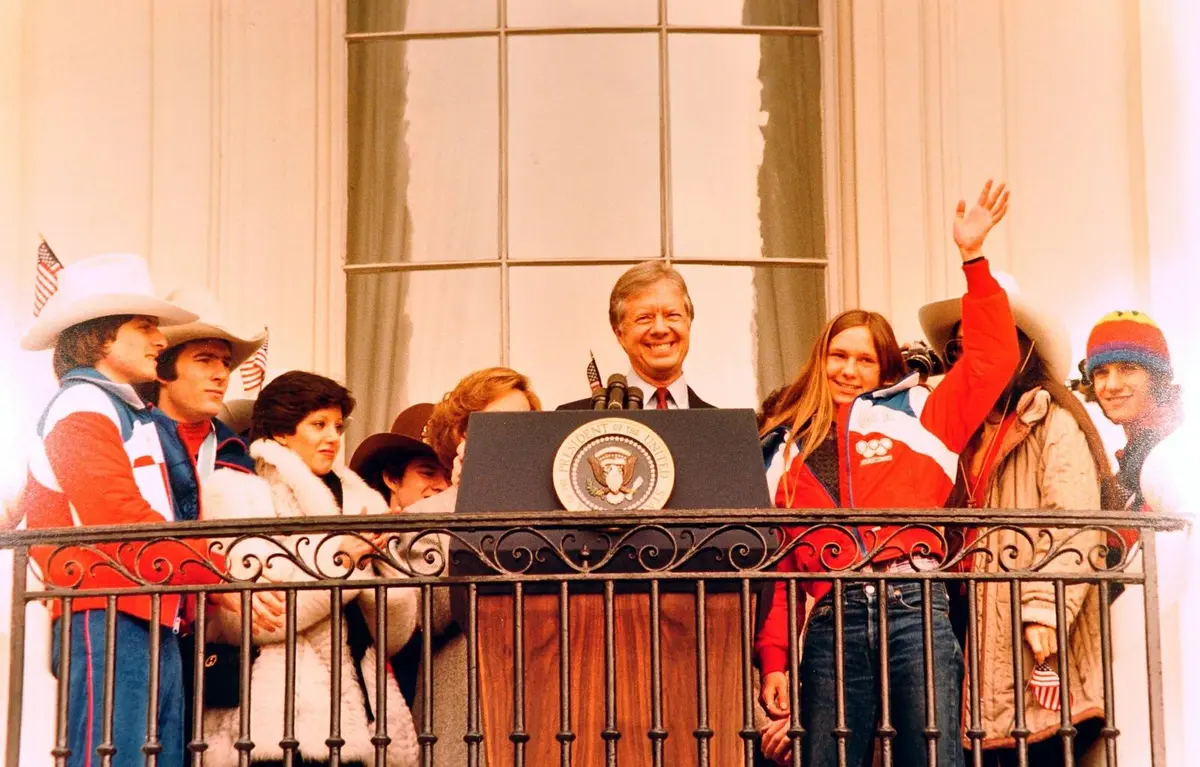
President Carter welcomes the U.S. Winter Olympians, hockey players among them, from the Truman Balcony of the White House, 25 February 1980. White House Staff Photographers / Jimmy Carter Presidential Library (NARA), via White House Historical Association.
The team

St. Paul native and the last man cut from the 1960 gold-medal team. Played in the 1964 and 1968 Olympics, then coached Minnesota to three NCAA titles. He hand-picked the 1980 roster, drove it hard for months and believed in it first.

Winthrop, Massachusetts, native who averaged more than 20 goals a season at Boston University. Scored the winning goal against the Soviets with ten minutes left, then waved his teammates onto the gold-medal podium. Retired from playing at 25.

North Easton, Massachusetts, goalie who won the 1978 NCAA title with Boston University. Played every minute of the Olympic tournament. Stopped 36 of 39 Soviet shots in the Miracle game and all ten Finnish shots in the third period of the final.

Son of Wisconsin coach Bob Johnson and an NCAA champion with the Badgers in 1977. Led the 1980 team with 11 points. Scored both tying goals against the Soviets, the first with one second left in the period, then played 669 NHL games.
By the numbers
In pictures


Watch, listen, see
Films, photographs and first-hand accounts from across the web. Each opens in a new tab.

The last minute of the game as America saw it, ending with Al Michaels’ famous call.
ESPN
The IOC’s official film of Team USA’s upset of the Soviet Union and its run to gold.
Olympic Games
The broadcaster looks back on calling the game and the five words America remembers.
NBC SportsMike Eruzione tells the story of the team, the Soviets and the goal that won it.
NHL on ESPN
President Carter’s full remarks to the Winter Olympians at the White House, 25 February 1980.
The American Presidency Project
Carter Library photographs of the hockey team’s White House reception two days after the gold.
White House Historical Association
The museum’s curator on the 1980 team and the jersey, skates and stick in its collection.
Smithsonian National Museum of American History
Public Law 119–53, which awards the 1980 team the Congressional Gold Medal, with its findings.
U.S. Congress“Their victory was one of the most breathtaking upsets not only in Olympic history but in the entire history of sport.”
President Jimmy Carter, of the U.S. hockey team, at the White House, 25 February 1980
After
Sports Illustrated named the team its Sportsmen of the Year for 1980, and in 1999 named the win over the Soviets the greatest sports moment of the century. In 2002, the 1980 team lit the Olympic cauldron to open the Winter Games in Salt Lake City.
Thirteen of the twenty played in the NHL. Ken Morrow won the Stanley Cup with the New York Islanders that same spring. Neal Broten, Mike Ramsey and Dave Christian each played more than 1,000 NHL games. Brooks coached Team USA to silver in 2002 and died in 2003. Two years later, Lake Placid renamed its Olympic rink the Herb Brooks Arena.
On 12 December 2025, the Miracle on Ice Congressional Gold Medal Act became law, with team members at the White House. One medal goes to Lake Placid, one to the U.S. Hockey Hall of Fame in Eveleth, Minnesota, and one to the U.S. Olympic and Paralympic Museum in Colorado Springs.
Primary sources
- Miracle on Ice Congressional Gold Medal Act, Public Law 119–53, 12 December 2025.
- Remarks at the Welcoming Ceremony for United States Olympic Team Participants in the 1980 Winter Games, President Jimmy Carter, 25 February 1980.
- Jane Rogers, “Do you believe in miracles (on ice)?” Smithsonian National Museum of American History, 21 February 2014.