Washington and Western Europe · 3 April 1948 · The European Recovery Program
Against Hunger, Poverty, Desperation and Chaos
Two years after the war, Europe was running out of bread and coal. America sent $13.3 billion in food, fuel and machines to its allies and to the nations it had just defeated, and put a continent back to work.

The moment · Afternoon · 5 June 1947
Harvard Yard. About 15,000 people fill the lawn. The Secretary of State, a five-star general, steps to the microphone and speaks for about ten minutes. He names no dollar figure. He promises that any government willing to help with recovery will find full cooperation from the United States.
With foresight, and a willingness on the part of our people to face up to the vast responsibility which history has clearly placed upon our country, the difficulties I have outlined can and will be overcome.Secretary of State George C. Marshall
In the spring of 1947 Europe was two years past the war and sliding backward. Cities were short of bread and coal, and the money to buy them was running out. Secretary of State George C. Marshall asked Americans to help rebuild the whole continent, allies and former enemies alike. Congress said yes. Within four years Europe was out-producing its prewar self.
Millions are slowly starving
Under Secretary of State Will Clayton, back from Europe, puts it bluntly in a memo. Europe is steadily deteriorating. Millions of people in the cities are slowly starving. Without prompt and substantial aid from the United States, he writes, disintegration will overwhelm Europe. His prescription: a grant of $6 to $7 billion worth of goods a year for three years, chiefly coal, food, cotton and shipping.
The speech
Marshall receives an honorary degree at Harvard’s commencement in the morning. That afternoon he speaks to about 15,000 people. In roughly ten minutes he lays out the crisis: farmers keeping their grain, cities short of food and fuel, governments spending their foreign money just to eat. He names no figure. He asks Europe to draw up its own program and promises American support for it.
Marshall, departing from his textThe whole world of the future hangs on a proper judgment.
Europe answers
The Soviet Union walks out of the preliminary talks on 2 July, and its satellites stay away. Sixteen nations come anyway. In Paris they form the Committee of European Economic Co-operation to count what Europe needs and what it can do for itself. In September the committee delivers its report: a four-year program to raise production, steady currencies and work together.
The bill goes to Congress
Truman sends Congress a message asking for a four-and-a-quarter-year program of aid to 16 nations. The Republican majority was elected on tax cuts and has to be won over. The Senate holds 30 days of hearings with nearly 100 government witnesses. To carry Europe through the winter, Congress first passes $522 million in interim aid for France, Italy and Austria.
Vandenberg takes the floor
Senator Arthur Vandenberg of Michigan, the Republican chairman of Foreign Relations, opens the debate. He calls the bill the product of more intensive study by more devoted minds than he has seen in twenty years in Congress. Marshall had spent so many hours with him that he joked they could not have gotten closer unless one sat in the other’s lap. On 13 March the Senate passes it, 69 to 17.
Vandenberg to the SenateIn the name of peace, stability, and freedom it deserves prompt passage.
Truman signs
The House has passed it 329 to 74. With Vandenberg standing behind him, Truman signs the Economic Cooperation Act, which authorizes $5.3 billion for the first year of European recovery. He calls the program perhaps the greatest venture in constructive statesmanship that any nation has undertaken. It has been ten months since Harvard.
Truman, on signingFew Presidents have had the opportunity to sign legislation of such importance.
A businessman takes charge
Congress wanted a Republican and a businessman to run the money. Truman picks Paul G. Hoffman, president of the Studebaker Corporation, and Chief Justice Fred Vinson swears him in six days after the signing. Averell Harriman goes to Paris as the special representative in Europe, with a staff of 600. Historians judge Hoffman a particularly talented administrator and promoter of the program.
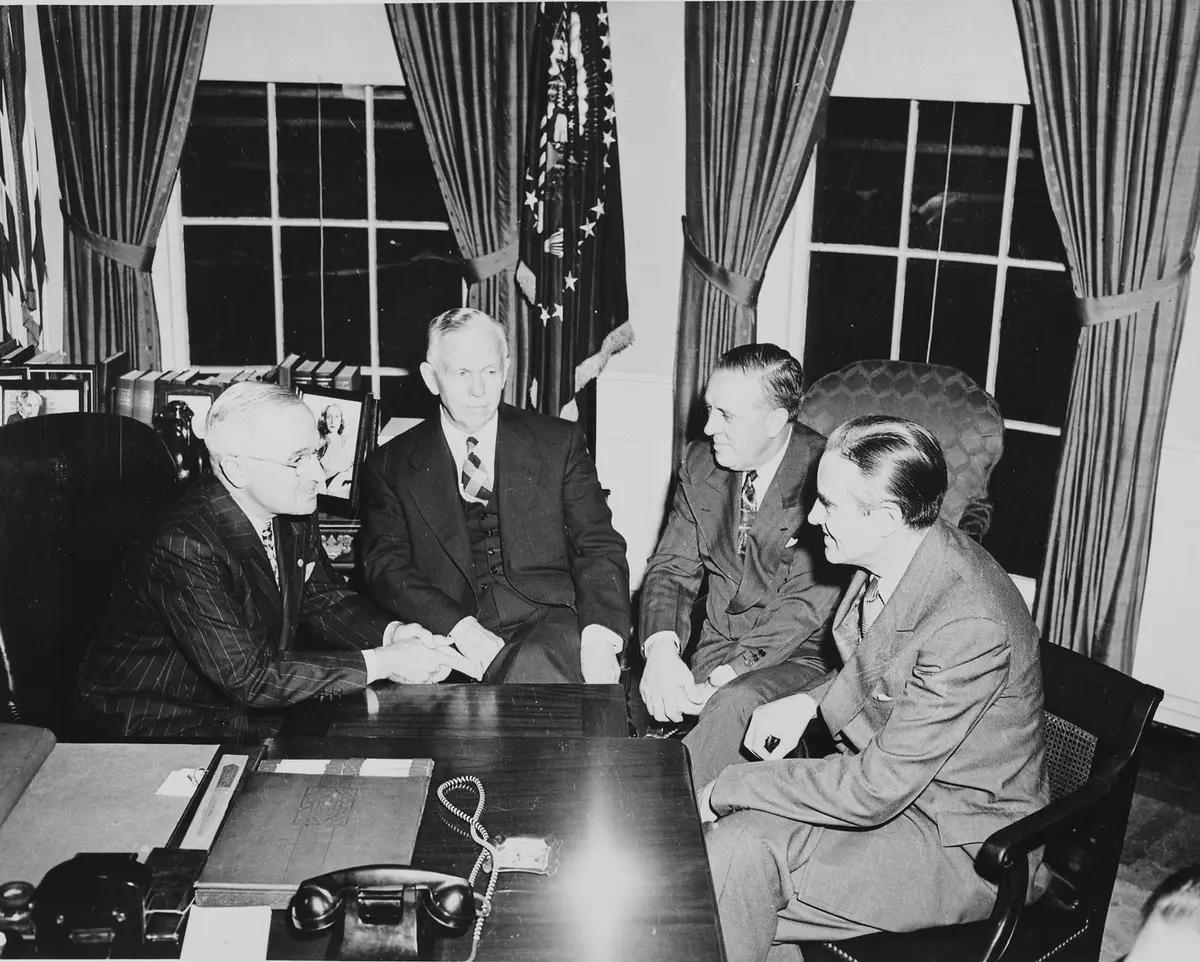
President Truman, George C. Marshall, Paul Hoffman and Averell Harriman discuss the Marshall Plan in the Oval Office, 29 November 1948.. Abbie Rowe, National Park Service / Harry S. Truman Library, National Archives. The first ship reaches France
The freighter John H. Quick ties up at Bordeaux. She sailed from Galveston on 17 April loaded with American wheat, the first ship to bring Marshall Plan supplies to France. Ambassador Jefferson Caffery speaks at a ceremony on the dock. Premier Robert Schuman goes on the radio to tell France that American aid has largely saved the bread ration for the rest of the year.
Europe goes back to work
Ships leave American ports with wheat, coal, cotton, tractors and machine tools. Europe set itself a goal of raising industrial output 30 percent above prewar. By the end of 1951 it is 35 percent above. Steel reaches 60 million tons a year, beating a goal of 55 million. In West Germany, one new home in five built since 1948 was built with Marshall Plan help.
The builders

VMI graduate and Army Chief of Staff through World War II, when he built the Army from fewer than 200,000 soldiers to 8 million. As Secretary of State he proposed the plan at Harvard and sold it to Congress.

Sent the recovery program to a Republican Congress in December 1947 and signed it into law on 3 April 1948. He chose a Republican businessman to run it and kept the aid flowing for four years.

Grand Rapids newspaper editor turned senator, and once a leading isolationist. In January 1945 he told the Senate isolationism had been the wrong course. As chairman he shaped the bill, opened the debate and carried the Senate 69 to 17.

Left the University of Chicago to sell Studebakers in Los Angeles and rose to president of the company in 1935. Sworn in as the Marshall Plan’s first administrator six days after the act became law, he ran it until 1950.
By the numbers
In pictures


Watch, listen, see
Films, photographs and first-hand accounts from across the web. Each opens in a new tab.

Marshall’s own voice delivering the 1947 Harvard address, set to archival film and photographs.
George C. Marshall Foundation
How American aid made Europe and the United States stronger than they were before.
U.S. Department of State
A Truman Library program for the 75th anniversary of the signing, built from its archives.
Harry S. Truman LibraryThe Marshall Plan’s first administrator recalls running the program, in a 1964 interview.
Harry S. Truman Library
The signed Economic Cooperation Act of 3 April 1948, with full transcript and page scans.
National Archives
An online exhibition of photographs, cartoons and Averell Harriman’s papers from the plan’s first years.
Library of Congress
The May 1947 memo that told Washington millions of Europeans were slowly starving.
Office of the Historian, State Department“Essentials to Peace,” delivered in Oslo on 11 December 1953 by the soldier who rebuilt Europe.
NobelPrize.org“Our policy is directed not against any country or doctrine but against hunger, poverty, desperation and chaos.”
Secretary of State George C. Marshall, Harvard University, 5 June 1947
After
Weeks after the first ship reached Bordeaux, the Soviets blockaded West Berlin and American fliers kept the city alive by air. The recovery never slowed. By 1951 Europeans were eating as well as they had before the war, and Western Europe’s factories were turning out far more than before the war.
On 10 December 1953 George Marshall received the Nobel Peace Prize for proposing and supervising the plan for the economic recovery of Europe. He is the only general ever to receive it.
The committee of sixteen became the OEEC and, in 1961, the OECD, with the United States as a full member. Germany and Austria still run recovery funds built from Marshall Plan money. Paul Hoffman later called the plan one of the most truly generous impulses that has ever motivated any nation anywhere at any time.
Primary sources
- Economic Cooperation Act of 1948 (Title I, Foreign Assistance Act of 1948, Public Law 80-472), 3 April 1948. National Archives.
- Remarks by the Secretary of State at Harvard University, 5 June 1947. George C. Marshall Foundation.
- Curt Tarnoff, The Marshall Plan: Design, Accomplishments, and Significance. Congressional Research Service, R45079, 18 January 2018.