Roosevelt Field, New York, to Le Bourget, Paris · 20–21 May 1927 · Charles A. Lindbergh
The Lone Eagle
A 25-year-old airmail pilot climbed into a plane with no front window, flew alone for 33 and a half hours, and landed in Paris.

The moment · 21 May 1927 · Off the coast of Ireland
He has not slept in two days. All night he has dodged sleet and flown blind through fog. Now fishing boats appear below. He throttles back, passes a few feet from one and shouts down at a face in the window. Less than an hour later, Ireland.
Which way is Ireland?Charles Lindbergh
By May 1927, six men had been killed or lost chasing a $25,000 prize for the first nonstop flight between New York and Paris. The favorites had big planes, three engines and full crews. Charles Lindbergh, a 25-year-old airmail pilot, had backers in St. Louis, a small plane built in San Diego in 60 days, and a plan to fly it alone.
$25,000 for Paris
Raymond Orteig came to New York from France at 12 and grew up to run two Manhattan hotels. Now he offers $25,000 to the first aviator to fly nonstop between New York and Paris, in either direction. For five years no one claims it. In 1926 he renews the offer for five more. Now the race is on, and it is deadly. By the spring of 1927, six men have been killed or lost trying.
One engine, one pilot
Charles Lindbergh, 24, flies the night air mail between St. Louis and Chicago. On one of those runs he starts working out the Paris flight. His rivals are building big planes with three engines and crews. He wants one engine, one seat, and every spare pound in fuel. A group of St. Louis businessmen led by banker Harold Bixby puts up $15,000. Bixby suggests the name.
Sixty days
Lindbergh asks Ryan Airlines, a small San Diego company, for a plane that can reach Paris. Ryan quotes three months. Too slow. Company president B. F. Mahoney wires back that they can do it in two. Chief engineer Donald Hall adds 10 feet to the wing, stretches the fuselage two feet and moves the cockpit behind the fuel tanks. The crews work day and night, seven days a week.
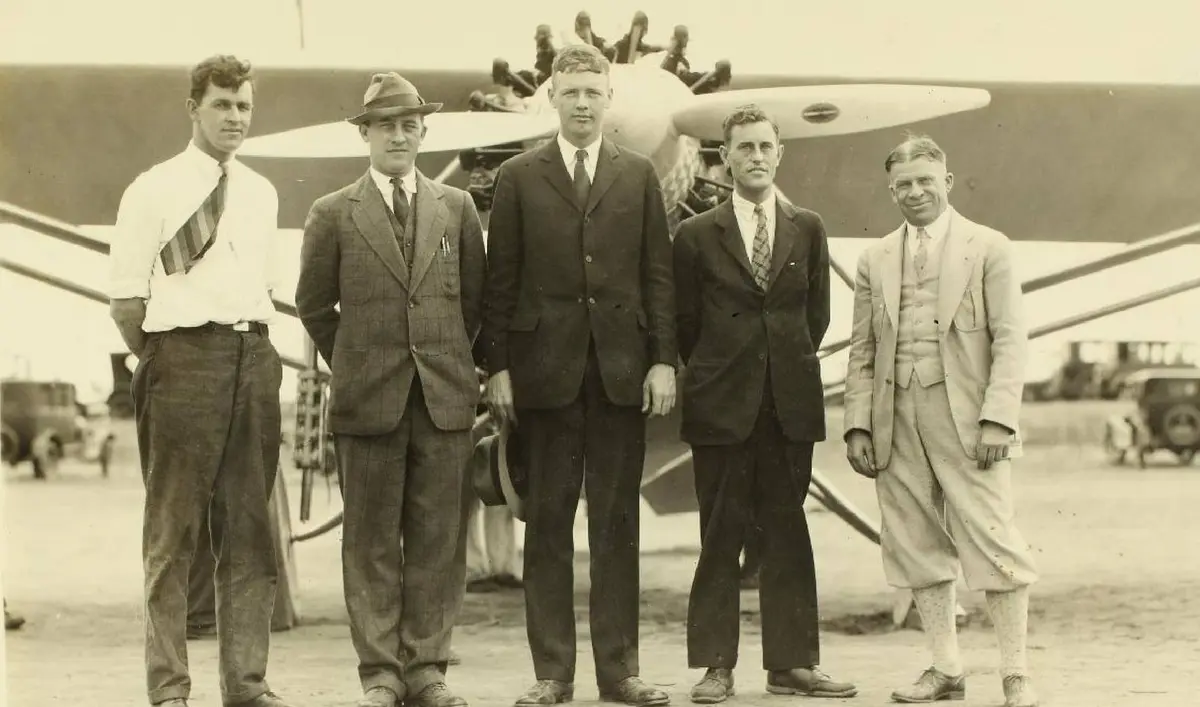
The men who built the Spirit in San Diego: Hawley Bowlus, B. F. Mahoney, Charles Lindbergh, Donald Hall and A. J. Edwards of Ryan Airlines, 1927.. Erickson, San Diego / San Diego Air & Space Museum Archives. Mahoney to Lindbergh, February 1927Can complete in two months.
Coast to coast
Sixty days after the order, the Spirit of St. Louis flies. It leaves the ground in six seconds with 400 pounds of extra tanks aboard. On 10 May Lindbergh takes off from San Diego, flies all night over the mountains and lands in St. Louis 14 hours and 25 minutes later. He reaches Long Island on 12 May, a coast-to-coast record. Two rival crews, Richard Byrd’s and Clarence Chamberlin’s, are already there.
The weather breaks
Rain and fog have held everyone on the ground for a week. Lindbergh has plans to see a show in the city. At about six o’clock the Weather Bureau reports high pressure over the North Atlantic and the storm off Newfoundland moving away. He heads for the field instead. Mechanics fuel and check the plane through the night. He goes to his hotel to rest and never gets to sleep.
Off the mud
The Spirit is towed to the west end of Roosevelt Field and filled to 450 gallons. It weighs 5,135 pounds, more than twice its empty weight. Rain has softened the runway, and the plane gathers speed slowly. Past the halfway mark he knows he will clear the obstacles at the end. There is no radio on board, no parachute and no fuel gauge. Lindbergh takes up his compass course for Cape Cod.
Lindbergh, writing in 1927I passed over a tractor by about fifteen feet and a telephone line by about twenty, with a fair reserve of flying speed.
Sleet and fog
He passes St. John’s, Newfoundland, and heads out over open ocean. Night falls. There is no moon. Fog builds until he is skimming storm clouds at 10,000 feet. Inside one cloud, sleet starts to coat the plane, so he turns back into clear air and goes around. After dawn he flies blind through fog for nearly two hours. He fights to keep his eyes open and drops low, sometimes ten feet above the waves.
Which way is Ireland?
Fishing boats appear below, the first sign of Europe. Lindbergh throttles back, passes a few feet from one and shouts a question down to a face in the cabin window. Less than an hour later a rugged coast rises to the northeast. He finds Valentia and Dingle Bay, the southwest tip of Ireland, and turns for Paris. England passes beneath him two hours later, then Cherbourg at sunset.
Lindbergh, shouting to a fishing boatWhich way is Ireland?
Paris
A little before ten he sees the lights of Paris and circles the Eiffel Tower at 4,000 feet. He lands at Le Bourget 33 hours and 30 minutes after leaving New York. A crowd of more than 100,000 breaks through and runs at the plane. He cuts the engine to keep the propeller from killing someone. For nearly half an hour they carry him around the field and never let his feet touch the ground.

The flier and the builders

Born in Detroit in 1902. Barnstormer, Army-trained pilot and reserve captain, then chief pilot on the St. Louis to Chicago air mail. Planned the Spirit, plotted his own course and flew it to Paris alone.

Brooklyn-born engineer trained at Pratt Institute, with time at Curtiss and Douglas. Joined Ryan in January 1927, three weeks before Lindbergh called. Designed the Spirit around one demand: fuel. Once worked 36 hours straight at his drafting table.

San Diego businessman who owned the small company that built the Spirit. When Lindbergh said three months was too long, Mahoney promised the plane in two. His shop delivered it sixty days after the order, ready to fly.

Came to New York from France in 1882, age 12, and rose to run the Lafayette and Brevoort hotels. Put up $25,000 in 1919 for the first nonstop flight between New York and Paris. Handed Lindbergh the check on 16 June 1927.
By the numbers
In pictures


Watch, listen, see
Films, photographs and first-hand accounts from across the web. Each opens in a new tab.

Period film coverage of Lindbergh’s 1927 flight, from the archives of the museum in the city where the Spirit was built.
San Diego Air & Space Museum
A quick close look at the Spirit of St. Louis and the windshield it never had.
Smithsonian National Air and Space Museum
A 3D scan of the actual airplane that flew to Paris, from the National Air and Space Museum.
Smithsonian 3D Digitization
The museum’s record of the plane, with its history and detailed photos of the cockpit, engine and periscope.
Smithsonian National Air and Space Museum
Rare film of Lindbergh and the Spirit back in San Diego at Dutch Flats and the old Ryan plant.
San Diego Air & Space MuseumDonald Hall’s 1927 report for the NACA on how the Spirit was designed, weighed and built.
NASA Technical Reports ServerLindbergh’s 1927 book on his flying life, the building of the Spirit and the flight to Paris.
Project Gutenberg
A timeline of the 33-and-a-half-hour flight, from the muddy takeoff to the crowd at Le Bourget.
PBS American Experience“It was no haphazard adventure. After months of most careful preparation, supported by a valiant character, driven by an unconquerable will and inspired by the imagination and the spirit of his Viking ancestors, this reserve officer set wing across the dangerous stretches of the North Atlantic. He was alone. His destination was Paris.”
President Calvin Coolidge, Washington, 11 June 1927
After
President Coolidge sent the Navy cruiser Memphis to bring him home. On 11 June 1927, in Washington, the President pinned the Distinguished Flying Cross on him. Two days later New York gave him a ticker-tape parade. On 16 June Raymond Orteig handed him the $25,000 check, and in December Congress voted him the Medal of Honor.
That summer he flew the Spirit on a 95-day tour of all 48 states, landing in 82 cities to make the case for flying. About 30 million people came out to cheer. Coolidge noted that more than 100 American companies had supplied the plane’s materials and parts.
On 30 April 1928 Lindbergh flew the Spirit of St. Louis to Washington and gave it to the Smithsonian. It is on display today in the National Air and Space Museum on the National Mall.