Richmond, California · 8–12 November 1942 · Kaiser Richmond Yard No. 2
Four Days, Fifteen Hours
U-boats were sinking ships faster than the Allies could build them. So America learned to build a 441-foot cargo ship in less than five days.

The moment · 15:27 · 12 November 1942
Sunday, one minute past midnight: the keel goes down. Cranes swing whole deck sections and fitted-out deckhouses onto the hull. Two hundred fifty thousand parts. Fourteen million pounds. Four days and fifteen hours after the keel, the bottle breaks. The Robert E. Peary slides into San Francisco Bay.
In 1942 German U-boats hit more than 1,300 Allied ships. Every tank, shell and soldier bound for Britain, Russia or the Pacific had to cross an ocean, and the cargo ships to carry them were going to the bottom. The answer was one plain freighter, built by the thousand, by men and women who had never built a ship before.
A British order
Britain is losing merchant ships faster than its own yards can replace them. Its shipping mission signs contracts for 60 freighters of a plain, cheap design from J.L. Thompson & Sons of Sunderland. Thirty will come from a new yard on the tide flats of Richmond, California, run by a group of road and dam builders led by Henry J. Kaiser. None of them has ever built a ship. Work on the yard starts that month.
The emergency program
President Roosevelt announces an emergency program of 200 cargo ships modeled on the British design. Adm. Emory S. Land’s Maritime Commission reworks the plans for speed: oil-fired boilers, and welded seams in place of rivets. The result is the EC2: 441 feet 6 inches long, 57 feet wide, a 2,500-horsepower steam engine, 11 knots and about 10,800 tons of cargo.
Liberty Fleet Day
From dawn to dark, fourteen ships slide into the water on the Atlantic, the Pacific and the Gulf. The first is the SS Patrick Henry, at Bethlehem-Fairfield in Baltimore. In a radio address the President recalls Patrick Henry’s demand for liberty or death, and the new ships take a name: Liberty ships. He asks for a launching a day, then two a day.
President Roosevelt, Liberty Fleet DayWe must build more cargo ships and still more cargo ships.
Wendy the Welder
Kaiser’s yards build ships the way Detroit builds cars. Bottoms, bulkheads and deckhouses are made in sheds and lifted onto the ways by giant cranes. Welding replaces riveting, and a new hand can learn it in days. In July 1942 Phyllis Gould becomes one of the first six women welders at Richmond. By war’s end 27 percent of Richmond’s shipyard workers are women, and the town has grown from 20,000 people to more than 100,000.
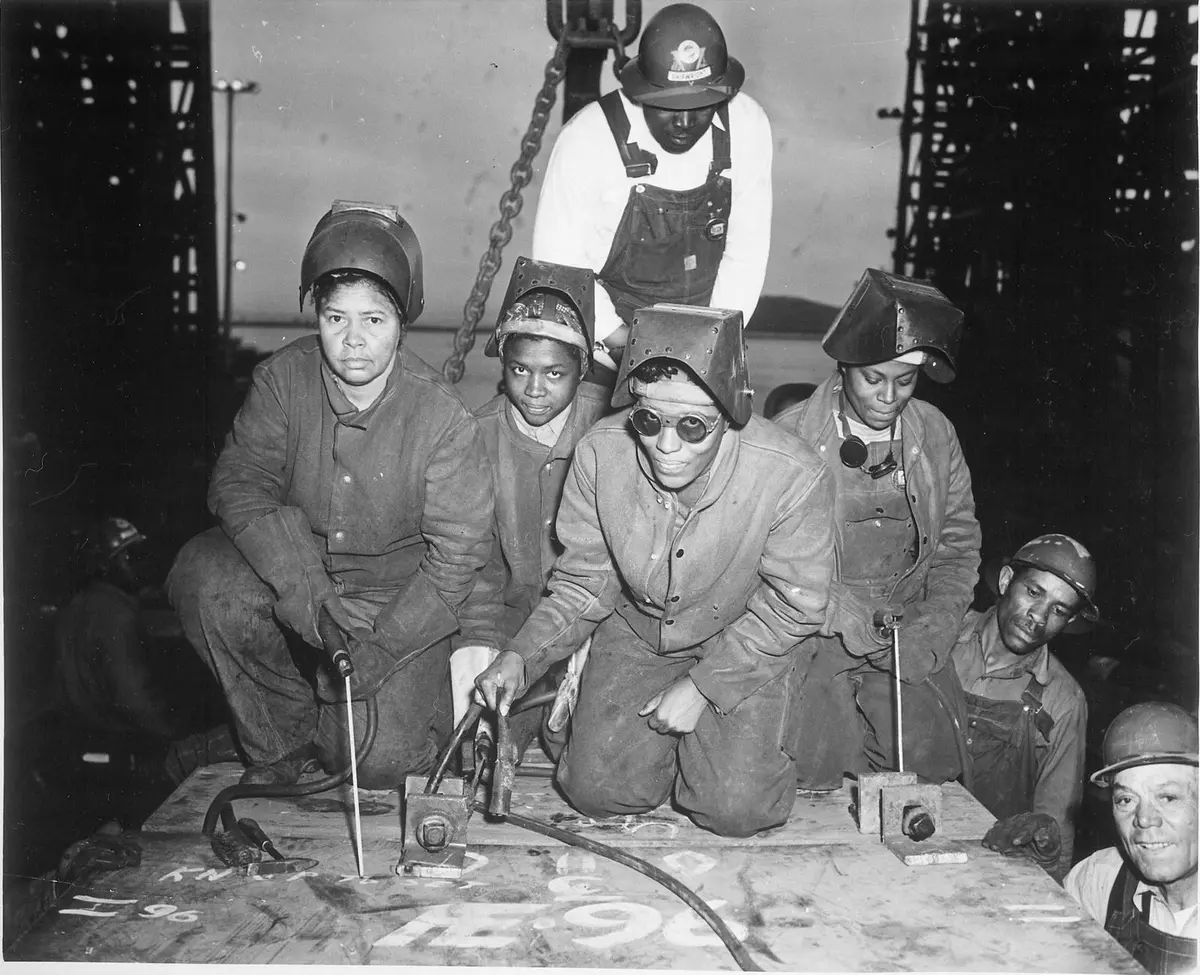
Welders Alivia Scott, Hattie Carpenter and Flossie Burtos get ready to weld their first piece of steel at the Kaiser yards in Richmond, California, about 1943.. Office of War Information / National Archives (535800). Ten days in Portland
At Oregon Shipbuilding, run by Kaiser’s son Edgar, the keel of the SS Joseph N. Teal goes down on 13 September. Ten days later she is launched, with President Roosevelt watching from his car and his daughter Anna swinging the bottle. Down in Richmond, yard manager Clay Bedford, a dam builder who had never built a ship before 1940, sets out to beat it.
Keel down
Yard No. 2 builds its 47th hull in pieces ahead of time and stages them beside the way. At one minute past midnight on Sunday the keel is laid. The bottom shell and inner bottom follow, and the boilers are aboard by mid-morning. Bulkheads and the shaft tunnel go in next. Seventeen banks of welding machines line each side of the hull, ready for the next section.
Up from the ways
On the second day the upper deck goes on, in seven big sections instead of the usual 23, with the forepeak and the fantail. On the third day come the masts, the cargo booms and the deckhouses, lifted aboard already fitted out down to the bunks and the fans. On the fourth day the crews finish the wiring, the welding and the paint, and set the forward gun platform.
Into San Francisco Bay
Four days and fifteen and a half hours after the keel went down, Mrs. James F. Byrnes breaks the bottle and the SS Robert E. Peary slides into San Francisco Bay. About 250,000 parts weighing 14 million pounds have become a ship. She is delivered three days later, and on 22 November she sails for the South Pacific loaded with food and war supplies.
The bridge of ships
Eighteen yards on three coasts build 2,710 Liberty ships between 1941 and 1945, the most ever built to one design. By 1943 the country is turning out about three a day. Kaiser’s seven yards deliver 1,490 ships of all types, 27 percent of everything the Maritime Commission builds, and Richmond’s four yards alone launch 747. The convoys carry the war to every front, and the U-boats lose the race.

The builders

Left school at about 13, then built roads and helped build the Hoover, Bonneville and Grand Coulee dams. He had never built a ship before 1940. His seven wartime yards turned out 1,490 ships, more than a quarter of the Maritime Commission’s total.

Henry’s son. Started as a shovel foreman on Boulder Dam and rose to superintendent of canyon excavation. Ran Oregon Shipbuilding in Portland, where his crews built the Joseph N. Teal in ten days and set the record Richmond went after.

Naval constructor, Naval Academy class of 1902, awarded the Navy Cross for his submarine design work in the First World War. Chaired the Maritime Commission from 1938 and ran the War Shipping Administration from 1942, steering the whole Liberty ship program.

Born at Camp Lewis, Washington. In July 1942 she became one of the first six women welders at the Richmond yards, and her two sisters and mother followed. She welded until the war ended, then fought for decades to honor the Rosies.
By the numbers
In pictures


Watch, listen, see
Films, photographs and first-hand accounts from across the web. Each opens in a new tab.

December 1942 newsreel: Henry Kaiser explains his method with a model, then the Robert E. Peary launches.
British Movietone / AP Archive
How the Bay Area’s Kaiser yards, with a workforce about one quarter women, turned out ships at record speed.
KQED
A welder-trainee at work on the Liberty ship George Washington Carver at Kaiser’s Richmond yards in 1943.
National Archives
More than 250 recorded interviews with the shipyard workers and families of wartime Richmond.
National Park Service and UC Berkeley
The President’s full address of 27 September 1941, the day the first Liberty ship was launched.
The American Presidency Project
A full lesson with maps, readings and photos on the Liberty and Victory ships that carried the war overseas.
National Park Service
Tour or cruise aboard the D-Day veteran Liberty ship, still steaming out of San Francisco.
SS Jeremiah O’Brien
Tours, living history cruises and steam school aboard the Baltimore-built Liberty ship that served off southern France.
Project Liberty Ship“With every new ship, they are striking a telling blow at the menace to our nation and the liberty of the free peoples of the world.”
President Franklin D. Roosevelt, Liberty Fleet Day, 27 September 1941
After
The Robert E. Peary went to war on 22 November 1942. She carried supplies to New Caledonia and Guadalcanal, crossed to the Atlantic in 1943, and on 7 June 1944 brought men and equipment to Omaha Beach. She kept running to Normandy until September.
Two Liberty ships still sail. The Jeremiah O’Brien, built in South Portland, Maine, in 1943, made 11 round trips to Normandy. In 1994 she steamed back across the Atlantic for the 50th anniversary of D-Day, the only large ship of the original fleet to return. The John W. Brown, launched in Baltimore in 1942, made 13 wartime voyages and still steams out of Baltimore.
In 2000 Congress made the old Richmond yards the Rosie the Riveter WWII Home Front National Historical Park. Its memorial stands on the ground of Yard No. 2, where the Peary was built.
Primary sources
- Liberty Ships and Victory Ships, America’s Lifeline in War. Teaching with Historic Places, National Park Service.
- World War II Shipbuilding in the San Francisco Bay Area. National Park Service.
- Address for Liberty Fleet Day, President Franklin D. Roosevelt, 27 September 1941. The American Presidency Project.