Lexington and Concord, Massachusetts · 19 April 1775 · Massachusetts militia and minutemen
The Shot Heard Round the World
Two riders went out in the night. By morning the farmers of Massachusetts were in the road, and by sundown they had chased the King’s regulars all the way back to Charlestown.

The moment · About 09:30 · 19 April 1775
Smoke is rising from Concord. About 400 militiamen march down the hill toward the North Bridge, Acton’s company in front. The regulars fire. Capt. Isaac Davis and Abner Hosmer fall dead. Major John Buttrick gives the order.
Fire, fellow soldiers, for God’s sake, fire!Major John Buttrick
In April 1775 General Thomas Gage ordered his best troops to march on Concord, 18 miles from Boston, and destroy the cannon and powder the colonists kept there. The colonists had planned for this night all winter. Riders, church bells and signal guns would raise the countryside. Before the regulars got there, the countryside was waiting for them.
Two if by sea
Dr. Joseph Warren learns that the regulars are forming at the bottom of Boston Common. He sends William Dawes out over Boston Neck and sends for Paul Revere. Revere has already arranged a signal with friends in Charlestown. A friend climbs the steeple of the Old North Church with two lanterns. Two friends then row Revere across the Charles, right past the British man-of-war Somerset, as the moon rises.
Revere, recalling the planIf the British went out by Water, we would shew two Lanthorns in the North Church Steeple; & if by Land, one, as a Signal.
The midnight ride
In Charlestown, Revere borrows a horse from Deacon John Larkin and sets off about eleven. Two British officers try to cut him off past Charlestown Neck. He turns, outruns them and takes the Medford road. In Medford he wakes the captain of the minutemen, and after that, he wrote, he “alarmed almost every House” until he reached Lexington. He finds John Hancock and Samuel Adams at Rev. Jonas Clarke’s house. Dawes rides in half an hour later.
Captured in Lincoln
Revere and Dawes push on for Concord with young Dr. Samuel Prescott. Halfway there, a British patrol traps them in a pasture. Prescott jumps his horse over a stone wall and carries the alarm to Concord. Dawes gets away. A British major puts a pistol to Revere’s head. Revere tells him that 500 Americans will be there shortly. By now bells and signal guns are ringing in town after town.
Lexington Green
Drummer William Diamond beats to arms. Capt. John Parker forms about 70 men on the Green. Light infantry under Major John Pitcairn come on at the run, and Pitcairn shouts at them to lay down their arms. Parker orders his men to disperse and not to fire. A shot rings out, then British volleys and a bayonet charge. Eight Lexington men die. Jonas Parker, the captain’s cousin, is bayoneted trying to reload.
Concord waits
About 700 grenadiers and light infantry under Lt. Col. Francis Smith march into Concord. Col. James Barrett pulls the militia back across the North Bridge to the high ground above the river. Companies keep arriving from Acton, Bedford, Lincoln and Carlisle. Three companies of regulars hold the bridge while others search Barrett’s farm. In town, the regulars burn gun carriages, and smoke rises over Concord.
The North Bridge
Barrett orders the men forward, with orders not to fire unless fired upon. Major John Buttrick leads about 400 of them toward the bridge, Capt. Isaac Davis’s Acton minutemen in front. His men remembered Davis saying he had not a man afraid to go. The 96 regulars fire. Davis and Abner Hosmer fall dead. Buttrick gives the order, and for the first time Americans fire on the King’s troops by command. Three regulars die. The rest break and run.
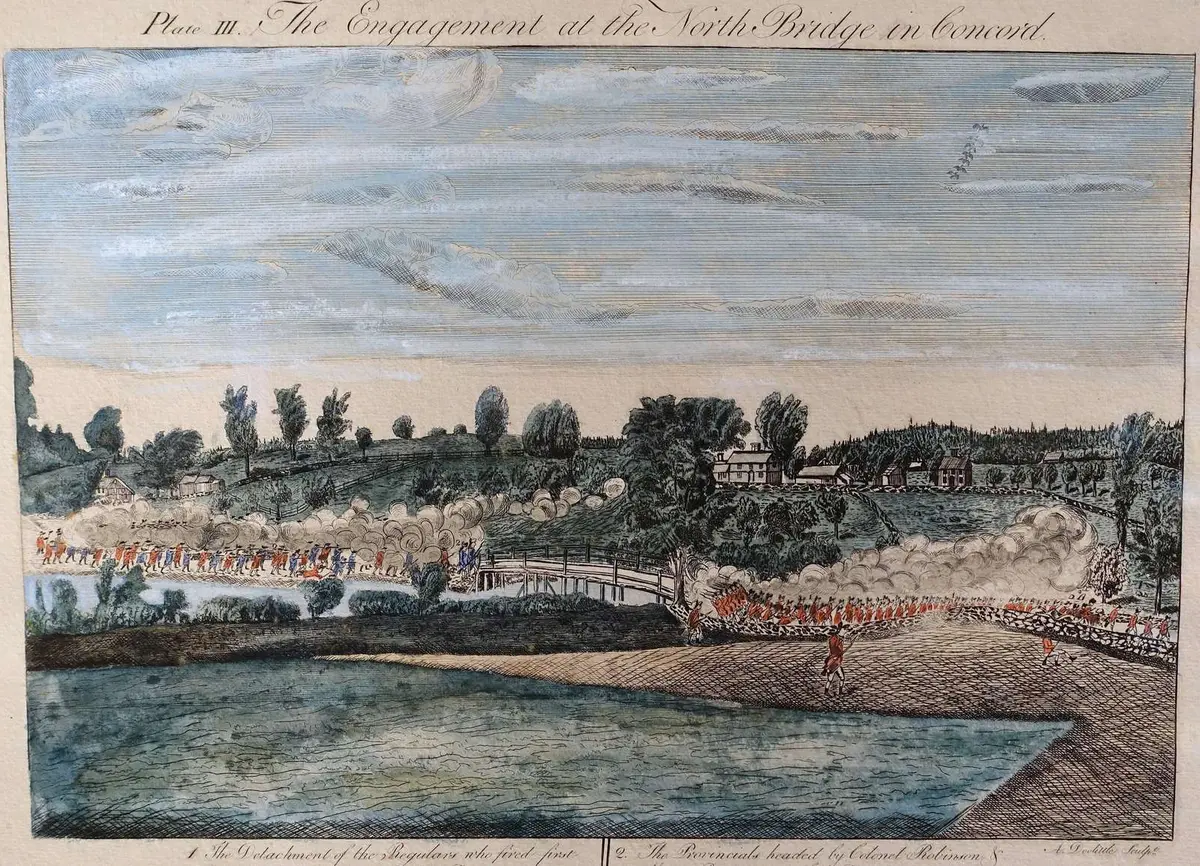
The Engagement at the North Bridge in Concord, Plate III of Amos Doolittle’s 1775 engravings: the regulars fire first at the bridge as Col. Robinson and Major Buttrick lead the militia down to it.. Amos Doolittle after Ralph Earl (1903 reprint) / Concord Museum; photo Daderot. Major Buttrick at the bridgeFire, fellow soldiers, for God’s sake, fire!
Battle Road
At noon Smith starts back for Boston. At Meriam’s Corner fresh companies from Reading, Chelmsford and Billerica open fire, and the running fight begins. At the Bloody Angle, Woburn men under Major Loammi Baldwin pour fire into the column from the woods and kill at least eight. On a rocky hill at the Lincoln line, John Parker’s company, bloodied that morning, waits and strikes the regulars again.
Percy’s rescue
Near Lexington, Smith’s exhausted men meet a relief brigade of about 1,000 men and two cannon under Lord Percy. Together they keep falling back, and the militia keep coming. Gen. William Heath and Dr. Warren rally the companies. At the Foot of the Rocks in Menotomy, a British bullet knocks the pin from Warren’s hair. The fiercest fighting of the day is house to house through Menotomy.
Back to Charlestown
At dusk the column stumbles across Charlestown Neck to the protection of the Navy’s guns. The British have lost 73 killed, 174 wounded and 26 missing. Forty-nine Americans are dead. The next morning the militia start to ring Boston, and within a week about 20,000 of them have the King’s army penned in.

The men

Boston physician and the leading Son of Liberty still in town. He gathered the reports on the regulars, sent Revere and Dawes into the night, then rode out and fought along Battle Road himself. Killed at Bunker Hill eight weeks later.

Boston silversmith and engraver who had carried the patriots’ dispatches to New York and Philadelphia. He set up the lantern signal, rode to Lexington with the alarm and woke nearly every house on the way.

Veteran of the French and Indian War who fought at Louisbourg and Quebec. Sick with tuberculosis, he stood his company on the Green at dawn, then led the survivors back out to hit the regulars again that afternoon. He died that September.

Concord farmer whose land overlooked the North Bridge. He led the march on the bridge and gave the first order for Americans to fire on the King’s troops. He served again in the Saratoga campaign.
By the numbers
In pictures


Watch, listen, see
Films, photographs and first-hand accounts from across the web. Each opens in a new tab.

A short film with actors on Lexington Green and at the North Bridge, the morning the war began.
American Battlefield Trust
A fast, clear telling of 19 April 1775, from the midnight ride to the retreat.
American Battlefield TrustRevere’s handwritten letter of about 1798: the lanterns, the row past the Somerset, his capture and the first shots.
Massachusetts Historical Society
Parker’s sworn statement of 25 April 1775 on the morning his company stood on Lexington Green.
National Archives
Minute Man National Historical Park’s timeline of the day, from Revere’s crossing to Charlestown Neck at dusk.
National Park ServiceObjects from the day: a signal lantern, William Diamond’s drum, a North Bridge beam and Abner Hosmer’s powder horn.
Concord Museum
How Revere, Dawes and Prescott carried the alarm, drawn from Revere’s own written accounts.
Paul Revere House
The Library of Congress page for 19 April, led by Lexington and Concord and “Yankee Doodle.”
Library of Congress“By the rude bridge that arched the flood, their flag to April’s breeze unfurled, here once the embattled farmers stood and fired the shot heard round the world.”
Ralph Waldo Emerson, “Concord Hymn,” sung at the Concord Battle Monument, 4 July 1837
After
The militia did not go home. They dug in around Boston, and on 17 June they made the British pay more than a thousand casualties for Bunker Hill. Joseph Warren died in the redoubt there. John Parker died of tuberculosis that September. Paul Revere served as an artillery officer and later rolled the copper that sheathed the hull of USS Constitution.
Washington took command of the army at Cambridge in July. On 17 March 1776 the British sailed out of Boston for good, eleven months after the regulars had marched out to Concord.
For the battle’s 100th anniversary, Concord unveiled Daniel Chester French’s bronze Minute Man beside the North Bridge, cast from Civil War cannon, with Emerson’s first stanza on its base. Today Minute Man National Historical Park keeps the bridge and miles of the Battle Road as the farmers knew them.
Primary sources
- Letter from Paul Revere to Jeremy Belknap, circa 1798. Massachusetts Historical Society.
- Deposition of Captain John Parker Concerning the Battle at Lexington, 25 April 1775. National Archives, Record Group 360.
- Frank Warren Coburn, The Battle of April 19, 1775, in Lexington, Concord, Lincoln, Arlington, Cambridge, Somerville and Charlestown, Massachusetts. 1912.