Texas Instruments, Dallas · 12 September 1958 · Kilby, Noyce, Hoerni and Moore
The Chip That Jack Built
A new engineer worked through the company vacation and put a whole circuit on one sliver of germanium. Six months later, in California, Robert Noyce worked out how to make them in silicon by the batch.

The moment · 12 September 1958 · Texas Instruments, Dallas
Jack Kilby wires his bar of germanium to an oscilloscope. Texas Instruments’ leaders crowd around the bench, Mark Shepherd and Willis Adcock among them. Kilby presses the switch. A steady sine wave rolls across the screen. One piece of semiconductor is doing the work of a whole circuit.
Eleven years after Bell Labs built the transistor, engineers could design machines with thousands of them. Building those machines was the hard part. Every transistor, resistor and capacitor had to be wired and soldered to the next by hand, and every joint was one more chance to fail. Engineers called it the tyranny of numbers. Two Americans, working half a continent apart, broke it.
Alone in the lab
Jack Kilby joins Texas Instruments in May after eleven years at Centralab in Milwaukee. In July the company shuts down for its summer vacation. Kilby is too new to have earned any time off, so he has the lab nearly to himself. On 24 July he writes in his notebook that resistors, capacitors, transistors and diodes could all be made in one slice of semiconductor. When his boss, Willis Adcock, gets back, Kilby asks to build one.
The sine wave
Kilby works in germanium, the material TI’s lab can etch into the parts he needs. A transistor, a capacitor and resistors are all formed in one bar 7/16 of an inch long, joined by fine gold wires. TI’s leaders gather at the bench: Mark Shepherd, Willis Adcock and others. Kilby hooks the chip to an oscilloscope and switches it on. A steady sine wave crosses the screen. The integrated circuit works. A week later he has a second one running.
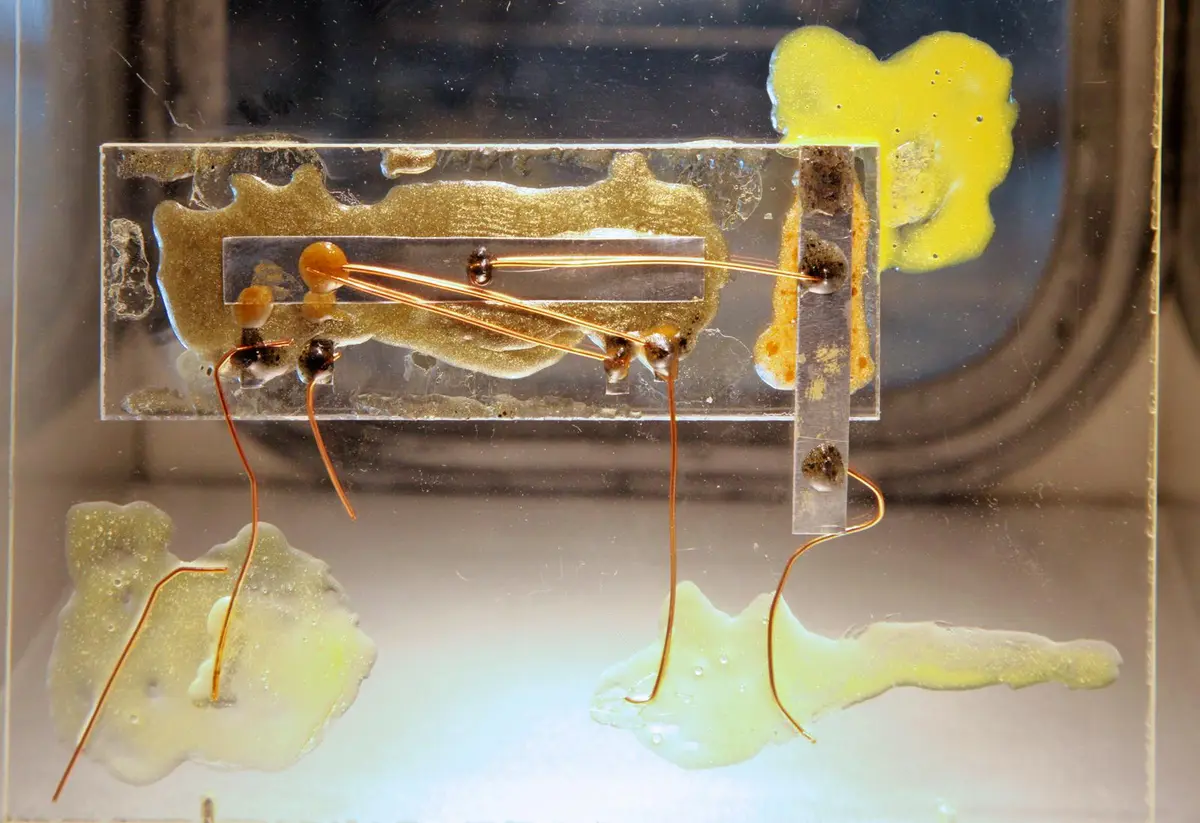
A replica of Jack Kilby’s first integrated circuit of 1958: a germanium bar with its parts joined by fine gold wires, mounted on glass. Florian Schäffer / Heinz Nixdorf MuseumsForum. The planar process
At Fairchild Semiconductor, Swiss-born physicist Jean Hoerni has worked out the planar process, an idea he first wrote down in December 1957. Leave the skin of oxide on the silicon, and it protects the delicate junctions underneath. On 14 January he shows it to Robert Noyce and the company’s patent attorney. Nine days later Noyce writes in his notebook how to build a whole circuit inside silicon under that oxide, wired by metal lines laid right on top.
Robert Noyce, lab notebook, 23 January 1959It would be desirable to make multiple devices on a single piece of silicon, in order to be able to make interconnections between devices as part of the manufacturing process, and thus reduce size, weight, etc. as well as cost per active element.
Solid circuits
Texas Instruments files Kilby’s patent for miniaturized electronic circuits, with every part of the circuit built into one body of semiconductor. The patent says there is no limit upon the complexity or configuration of circuits which can be made in this manner. In March TI shows the solid circuit to the public. Noyce files his own patent on 30 July, for the silicon version with its metal wiring on the oxide. His is granted first, on 25 April 1961.
The first planar chip
Noyce puts Jay Last, a fellow Fairchild founder, in charge of turning the idea into a product. Last’s team designs a flip-flop with four transistors and five resistors on one chip of silicon. A first version works on 26 May 1960. On 27 September the design meant for production works too, its parts isolated inside the silicon itself. Fairchild announces it as Micrologic in March 1961. That October, Texas Instruments brings out its own planar chips.
To the Moon and the missile fields
The first chips cost many times what loose transistors did. Only buyers who needed electronics small, light and sparing with power could pay. NASA led the way. MIT designed the Apollo Guidance Computer around a single Fairchild logic chip, and the program bought about 200,000 of them at $20 to $30 each. It was the biggest buyer of chips through 1965. That year the Minuteman II missile, guided by circuits TI designed, took the lead.
Cramming more components
Gordon Moore, research director at Fairchild, plots the number of parts on the most economical chips each year since 1959. It has doubled every year. In the magazine Electronics he extends the line to 65,000 components on one chip by 1975. In 1975 he resets the pace to a doubling every two years. The industry adopts it as its yardstick, and Caltech professor Carver Mead gives it a name: Moore’s Law.
Gordon Moore, Electronics, 19 April 1965Integrated circuits will lead to such wonders as home computers.
A computer on a chip
In July 1968 Noyce and Moore leave Fairchild and found Intel. The next year Busicom, a Japanese calculator maker, orders a set of custom chips. Ted Hoff and Stanley Mazor propose a general-purpose processor that software can program instead. Federico Faggin, working with Busicom’s Masatoshi Shima, fits it onto one chip of 2,300 transistors. On 15 November 1971 Intel announces the 4004, the world’s first microprocessor.
The Nobel Prize
Jack Kilby, 77, receives the Nobel Prize in Physics for his part in the invention of the integrated circuit. Robert Noyce died in 1990, and the prize is never given after death. In his Nobel biography Kilby writes that he has no doubt they would have shared it. Over his career Kilby earns more than sixty patents, among them one for the handheld electronic calculator he helped invent at TI to show what chips could do.
The inventors

Raised in Great Bend, Kansas. In the war he served as an Army radio operator with OSS Detachment 101 in Asia. Built the first integrated circuit four months after joining TI. Co-invented the handheld calculator. Nobel Prize in Physics, 2000.

A minister’s son from Iowa, raised in Grinnell, with a physics doctorate from MIT. Conceived the silicon chip that could be made by the batch, the design nearly every chip since has followed. Co-founded Intel in 1968. National Medal of Technology, 1987.

Born in Geneva, Switzerland, with doctorates from Geneva and Cambridge. Came to Caltech in 1952 and co-founded Fairchild in 1957. Invented the planar process, which seals a chip’s parts under a layer of oxide. Chips are still made this way.

Son of a San Mateo County lawman, with a chemistry doctorate from Caltech. As Fairchild’s research director he predicted in 1965 that chips would keep doubling in complexity. Co-founded Intel and later led it. Presidential Medal of Freedom, 2002.
By the numbers
In pictures


Watch, listen, see
Films, photographs and first-hand accounts from across the web. Each opens in a new tab.

Jack Kilby tells the story of the integrated circuit in his own words, Stockholm, December 2000.
Nobel Prize
Texas Instruments tells how Jack Kilby invented the integrated circuit in its Dallas lab in 1958.
Texas Instruments
Robert Noyce’s 1984 lecture on how the integrated circuit was born and what it did.
Computer History Museum
Moore recalls the early chip industry and the staying power of Moore’s Law, recorded in 2008.
Computer History Museum
Gordon Moore’s 1965 Electronics article that foresaw home computers and set out Moore’s Law.
Intel
Miniaturized Electronic Circuits, filed for Texas Instruments in February 1959 and granted in 1964.
Google Patents
The museum’s milestone timeline of the chip, from Kilby’s solid circuit to the microprocessor.
Computer History Museum
The Computer History Museum marks fifty years of the Intel 4004, the first microprocessor.
Computer History Museum“It’s been called the technological or information revolution, and as its emblem, one might take the tiny silicon chip, no bigger than a fingerprint. One of these chips has more computing power than a roomful of old-style computers.”
President Ronald Reagan, Moscow State University, 31 May 1988
After
Kilby and Noyce shared the credit. Both received the National Medal of Science and the National Medal of Technology, and both are in the National Inventors Hall of Fame. In 1991 California made the Palo Alto site where Noyce worked a state historical landmark. In 2009 the IEEE set a plaque at Texas Instruments in Dallas marking the first integrated circuit.
Moore’s yardstick held for half a century. Intel’s 4004 of 1971 had 2,300 transistors. NVIDIA’s Blackwell GPU, announced in March 2024, has 208 billion. Texas Instruments and Intel, the company Noyce and Moore founded, still design and build chips in America.
Kilby was a man of few words. When he was inducted into the National Inventors Hall of Fame in 1982, his whole acceptance speech was two words: “Thank you.”
Primary sources
- Milestones: First Semiconductor Integrated Circuit (IC), 1958. IEEE History Center, Engineering and Technology History Wiki.
- The Silicon Engine: A Timeline of Semiconductors in Computers. Computer History Museum.
- Jack S. Kilby, Biographical, and Nobel Lecture, “Turning Potential into Reality: The Invention of the Integrated Circuit,” Nobel Prize in Physics 2000. Nobel Foundation.