Inchon, Korea · 15 September 1950 · 1st Marine Division and the U.S. Navy
Over the Seawall
Thirty-one feet of tide, miles of mud and a stone wall at the top of it. The Marines went over the wall on ladders, and two weeks later Seoul was free.

The moment · 17:31 · 15 September 1950
Red Beach. The tide is racing in, but the seawall still stands four feet above the landing craft ramps. Up go the wooden ladders. Grenades sail over the top. Minutes later the second wave hits the wall, and First Lt. Baldomero Lopez goes over at the head of his platoon.
By September 1950 the North Korean army had the U.S. and South Korean forces pinned in a corner of the peninsula around Pusan. General Douglas MacArthur meant to land behind it at Inchon, the port of Seoul. On the charts, Inchon was about the worst harbor on the coast for a landing. The Joint Chiefs had doubts. MacArthur went anyway.
Inchon will not fail
The Joint Chiefs send their Army and Navy chiefs to Tokyo to talk MacArthur out of Inchon. At the Dai Ichi building the Navy briefs the tides and the mud. Rear Adm. James Doyle closes with the best he can say: Inchon is not impossible. Then MacArthur speaks. Those in the room remember his last words: “We shall land at Inchon, and I shall crush them.” Five days later the Joint Chiefs send their approval.
Two weeks behind the lines
Navy Lt. Eugene Clark goes ashore on Yonghung-do, 14 miles off Inchon, with two South Koreans and a grenade to use on himself if he is caught. He turns the island’s teenagers into coastwatchers, captures sampans and sends agents into Inchon. One night he rows to the seawall and wades into the mud up to his waist. His radio reports tell the planners the mud will not hold men or trucks, and which tide tables to trust.
The sitting ducks
Six destroyers come up the narrow channel in single file on the flood tide. At 11:45 they spot a string of mines and press on, firing at them as they pass. They anchor less than half a mile off Wolmi-do, the fortified island guarding the harbor, and open fire. North Korean guns hit USS Collett nine times. She keeps shooting. The destroyers put more than 1,000 five-inch shells into the island in an hour, and 1,700 more the next day.
The light on Palmi-do
Clark has found that the lighthouse on Palmi-do, the old entrance beacon for the Flying Fish Channel, can still be made to work. Tokyo tells him to light it at midnight. He does. A column of 19 ships led by the destroyer Mansfield snakes up the channel in the dark, and the beacon guides them past one of its worst stretches. Clark earns the Navy Cross.
Green Beach
Rocket ships drench Wolmi-do. Seven landing craft put the first wave of the 3d Battalion, 5th Marines onto a strip of beach less than 50 yards wide at 06:33. Ten tanks follow. At 06:55 Sgt. Alvin Smith ties an American flag to a shattered tree on Radio Hill. MacArthur, watching from USS Mount McKinley, says, “That’s it. Let’s get a cup of coffee.” Lt. Col. Robert Taplett soon radios: “Wolmi-do secured.” Not one Marine is killed.
MacArthur to the fleetThe Navy and Marines have never shone more brightly than this morning.
Waiting on the tide
The tide runs out and the harbor turns to mud. The Marines on Wolmi-do hold alone. After 13:00 the water comes back, and the LSTs and transports start up the channel with it. Landing craft need 25 feet of water to reach the seawall, so H-Hour is set at 17:30, with two hours of daylight left. Some 500 landing craft head in through rain and smoke. One rocket ship fires 2,000 rockets at Red Beach alone.
Red Beach
Lt. Edwin Deptula’s platoon hits the seawall at 17:31. The wall still stands four feet above the ramps. Grenades go over, then the ladders go up. Two minutes later Company A reaches the wall and takes fire from bunkers. The second wave brings in 1st Lt. Baldomero Lopez. He knocks out one bunker with a grenade and is hit pulling the pin on another. He smothers the blast to save his men. At 17:55 a flare signals Cemetery Hill is taken.
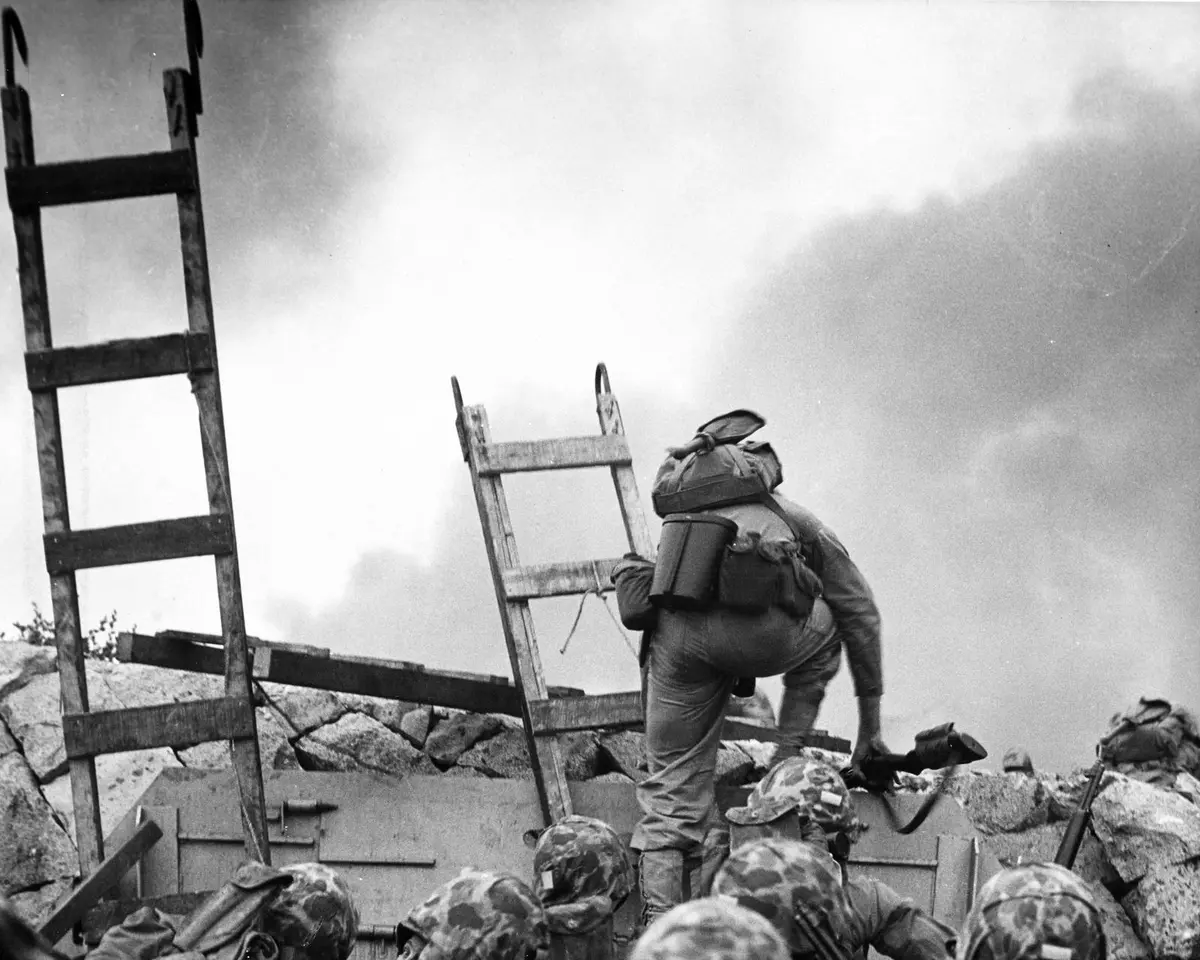
1st Lt. Baldomero Lopez leads the 3d Platoon, Company A, 1st Battalion, 5th Marines over the Red Beach seawall, 15 September 1950. He was killed minutes later (NH 96876).. U.S. Marine Corps photograph / Naval History and Heritage Command. Chesty Puller’s regiment
Three miles south, Col. Lewis “Chesty” Puller’s 1st Marines ride amphibian tractors 5,500 yards through smoke and mortar fire to Blue Beach. Company I goes over the seawall on aluminum ladders, some of which buckle under the weight. Engineers hang cargo nets for the waves behind. By midnight the division holds every objective set for the day. On Red Beach, all eight LSTs make it in. Planners had counted on six. They sit on the mud all night, unloading.
The capital comes back
The 5th Marines take Kimpo, the largest airfield in Korea, 50 hours and 35 minutes after H-Hour. Marine fighters fly from it within days. On 20 September the Marines cross the Han River. The Army’s 7th Infantry Division drives on their right. On 27 September the 5th Marines take the government compound and raise the American flag. Two days later MacArthur hands the capital back to President Syngman Rhee and closes the ceremony with the Lord’s Prayer.

The men

First in his West Point class of 1903, he earned the Medal of Honor defending the Philippines and accepted Japan’s surrender in 1945. He chose Inchon, talked down the doubters in Tokyo and watched the landing from USS Mount McKinley.

A former enlisted man and veteran amphibious sailor from South Dakota. He spent two weeks on the islands off Inchon scouting the mud, the seawall and the guns, then relit the Palmi-do lighthouse to guide the fleet in. Navy Cross and Silver Star.

Born in Tampa to a father from Asturias, Spain. Enlisted in the Navy at 17, went on to the Naval Academy and served with the Marines in China. He took his platoon at Pusan days before the landing and died on Red Beach. Medal of Honor.

Took command at Camp Pendleton on 26 July 1950 and had the division at war strength, across the Pacific and combat-loaded in seven weeks. He called Wolmi-do “the key to the whole operation” and took it on the morning tide.
By the numbers
In pictures


Watch, listen, see
Films, photographs and first-hand accounts from across the web. Each opens in a new tab.

The Defense Department’s own documentary of the landing and the drive to Seoul, shot by combat cameramen.
Department of Defense
Raw Navy footage from 15 September 1950: the bombardment, Wolmi-do and the landing craft going in.
National Archives
Army Signal Corps film of MacArthur touring the Inchon beachhead on 16 and 17 September 1950.
National Archives
The Navy’s history command tells the story of the landing in three minutes of period footage.
Naval History and Heritage Command
Official photographs of Operation Chromite, from the Wolmi-do bombardment to LSTs stranded on the mud.
Naval History and Heritage Command
The director of naval history on Chromite: Clark’s islands, the sitting ducks, D-Day and the drive on Seoul.
Naval History and Heritage Command
The Marine Corps’ illustrated history of Inchon, minute by minute, with maps and portraits of the men.
Marine Corps Historical CenterThe Academy’s page for its graduate, with the full citation for his sacrifice on the Red Beach seawall.
U.S. Naval Academy“Few operations in military history can match either the delaying action where you traded space for time in which to build up your forces, or the brilliant maneuver which has now resulted in the liberation of Seoul.”
President Harry S. Truman to General MacArthur, 29 September 1950
After
On 30 August 1951 the Secretary of the Navy presented Baldomero Lopez’s Medal of Honor to his parents in Washington. Eugene Clark received the Navy Cross. The 1st Marine Division received the Presidential Unit Citation for “an operation without parallel in the history of amphibious warfare.”
The landing cut the North Korean army off from its supplies. The Eighth Army broke out of the Pusan Perimeter and drove north. On 26 September alone, units of the 1st Cavalry Division advanced more than 100 miles. By the end of the month the Eighth Army had taken about 23,600 prisoners, and the invasion of South Korea was broken.
Within weeks the 1st Marine Division sailed again, for the east coast of Korea and the Chosin Reservoir. Today a Navy cargo ship carries the name USNS 1st Lt. Baldomero Lopez.
Primary sources
- U.S. Marine Operations in Korea 1950–1953, Vol. II: The Inchon-Seoul Operation. Lynn Montross and Capt. Nicholas A. Canzona, USMC, Historical Branch, HQMC, 1955.
- Over the Seawall: U.S. Marines at Inchon. Brig. Gen. Edwin H. Simmons, USMC (Ret.), Marine Corps Historical Center, 2000.
- Message Congratulating General MacArthur on the Liberation of Seoul. President Harry S. Truman, 29 September 1950. Truman Library.