Albany to Buffalo, New York · 26 October 1825 · Clinton and the canal builders
The Wedding of the Waters
The country had almost no trained engineers. New York dug 363 miles anyway, mostly by hand, and lifted boats 568 feet from the Hudson to Lake Erie.

The moment · 4 November 1825 · Off Sandy Hook
The fleet gathers where New York Harbor meets the open sea. DeWitt Clinton lifts a keg of water drawn from Lake Erie and pours it into the Atlantic. Eight years of digging. Three hundred sixty-three miles. The Great Lakes and the ocean are joined.
May the God of Heavens and Earth smile most propitiously on this work, and render it subservient to the best interests of the human race.Gov. DeWitt Clinton
In 1816 a ton of goods cost about $100 to haul from Buffalo to New York, and the trip took two weeks by stagecoach. Gov. DeWitt Clinton wanted a canal across the state, 363 miles long, climbing 568 feet from the Hudson to Lake Erie. Critics called it Clinton’s Ditch. New York built it with its own money.
Clinton’s Ditch
DeWitt Clinton has sat on the state canal commission since 1810, and the War of 1812 has stalled everything. Now the former mayor of New York City writes a memorial to the Legislature for a canal from Lake Erie to the Hudson. Meetings across the state back him, and petitions for the canal gather more than 100,000 signatures. Critics mock it as Clinton’s Ditch. He keeps pushing.
First furrow
On 15 April the Legislature authorizes the canal and $7 million to build it. On 1 July Clinton takes office as governor. Three days later, at sunrise on the Fourth of July, a crowd gathers outside Rome, New York. Cannon boom. Judge John Richardson, who holds the first construction contract, drives his team of oxen forward and plows the first furrow of the Erie Canal.
Engineers who taught themselves
The country has almost no trained civil engineers. The job goes to men like Benjamin Wright and James Geddes, judges who learned surveying settling land disputes upstate. They teach themselves to run levels. When they check their work around a 100-mile loop, the two ends close within two inches. Wright’s assistant Nathan Roberts is a schoolteacher with a gift for mathematics. They learn by building.
Cement that sets underwater
Ordinary lime mortar washes out of lock walls. Canvass White, a 27-year-old engineer, has just come home from England, where he walked more than 2,000 miles of canals at his own expense. Near Chittenango a limestone turns up that, burned and ground, makes a cement that hardens underwater. White perfects the process and patents it in 1820. The canal takes more than 400,000 bushels.
The first boat
Contractors have invented machines for the wilderness: a cable and crank that pull down big trees, a stump puller on 16-foot wheels worked by a team of oxen, and a plow that slices through roots two inches thick. The middle section fills with water, and the boat Chief Engineer, named for Benjamin Wright, carries officials and a band from Rome to Utica while church bells ring.
Over the Genesee
At Rochester the canal crosses the Genesee River on a stone aqueduct 802 feet long, carried on 11 arches. East of town the Great Embankment carries it 76 feet above Irondequoit Creek. That October the whole eastern section opens, and boats run from the Genesee to the Hudson at Albany. They are paying tolls before the canal is even finished.
Up the escarpment
The last great obstacle is the Niagara Escarpment, a wall of hard rock. Nathan Roberts designs two flights of five locks side by side, one for boats going up and one for boats coming down. Each lock lifts 12 feet, 60 feet in all. Above them, crews blast a channel two miles long through solid rock. In April 1824 Clinton’s enemies throw him off the canal board. That November the voters make him governor again.
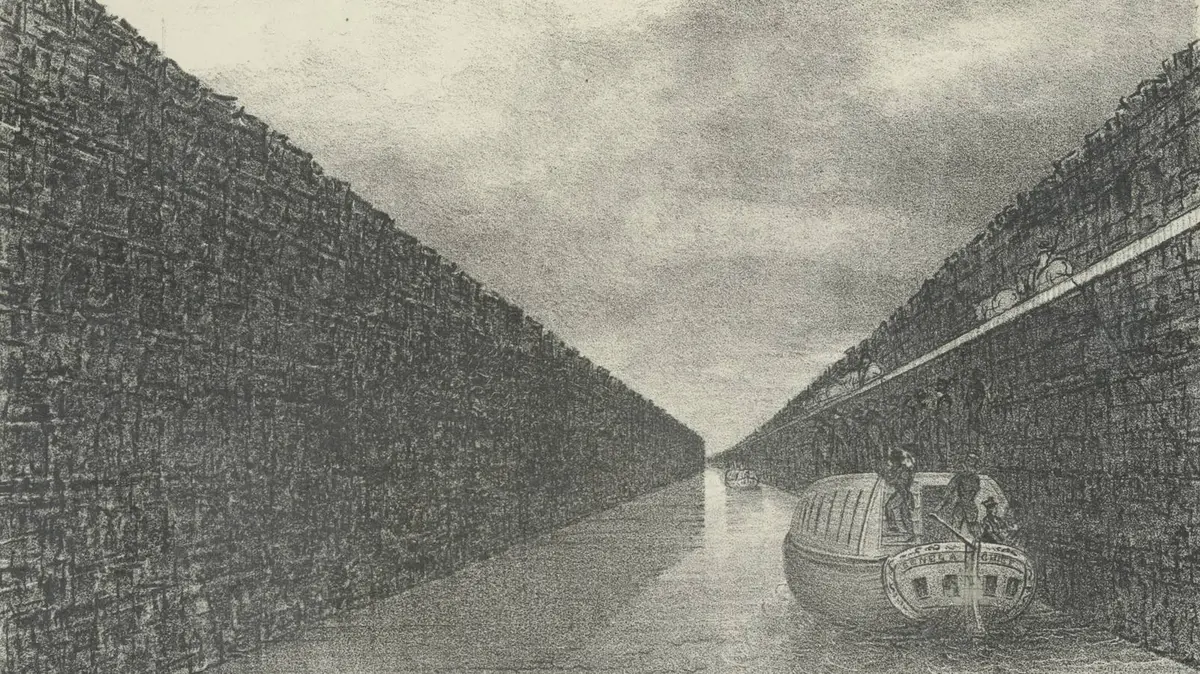
The Deep Cut at Lockport, blasted through solid rock above the locks, drawn by George Catlin for Colden's Memoir of the celebration, 1825. George Catlin, lithograph by Anthony Imbert, in Cadwallader D. Colden, Memoir (1825). The Grand Salute
At Buffalo, Governor Clinton boards the canal boat Seneca Chief, with Jesse Hawley, whose essays first laid out the canal, beside him. A cannon fires. Down the line, gun crews posted along the canal and down the Hudson fire in turn as each hears the gun before. At 11:20 the guns of New York City announce the news, an hour and twenty minutes after the first shot. Then the salute rolls back to Buffalo.
The Wedding of the Waters
After nine days of banquets, speeches and fireworks along the route, steamboats tow the canal boats down the Hudson. A fleet escorts them out to Sandy Hook, where the harbor meets the open sea. Clinton lifts a keg of water drawn from Lake Erie and pours it into the Atlantic. Then Dr. Samuel L. Mitchill pours in water from the Thames, the Seine, the Elbe and other great rivers.
Clinton, over the waterMay the God of Heavens and Earth smile most propitiously on this work, and render it subservient to the best interests of the human race.
The builders

Former New York City mayor and U.S. senator. He sat on the canal commission from 1810, wrote the 1816 memorial that rallied the state and drove it through as governor. Thrown off the canal board in 1824, he was elected governor again and opened it.

Connecticut-born surveyor and county judge from Rome, New York, with no formal engineering training. He surveyed the route, ran construction of the middle section and then took charge of the eastern section too. The canal’s first boat was named Chief Engineer in his honor.

Self-taught engineer from Whitestown, New York. In 1817 he crossed to England at his own expense and walked more than 2,000 miles of canals to learn the trade. Back home he perfected a cement that hardens underwater, and the canal’s locks were built with it.

Schoolteacher with a gift for mathematics, hired by Benjamin Wright in 1816 with no surveying experience. He solved the canal’s hardest problem, the Niagara Escarpment, with a double flight of five locks at Lockport. He later served as chief engineer on Pennsylvania’s state canals.
By the numbers
In pictures


Watch, listen, see
Films, photographs and first-hand accounts from across the web. Each opens in a new tab.

An hour-long documentary on how upstate New Yorkers with no canal experience engineered and dug 363 miles.
PBS
A museum educator walks the famous locks that carry the canal up the Niagara Escarpment.
Erie Canal Museum · YouTube
The State Museum’s senior historian explains a small medallion and the big canal story behind it.
New York State Museum · YouTube
A curator’s tour of the Enterprising Waters exhibition, on the passengers and packet boats of the early canal.
New York State Museum · YouTube
The official 1825 account: the cannon relay from Buffalo, the harbor fleet and Clinton’s words over the water.
Cadwallader D. Colden, 1825
The state’s own history of the canal, from Jesse Hawley’s prison essays to the Wedding of the Waters.
New York State Canal Corporation
Why engineers honor the Erie: built with hand tools and horses, and full of new inventions.
American Society of Civil Engineers
The national heritage corridor’s history of the canal, from the Lockport flight to the packet boats.
Erie Canalway National Heritage Corridor“The city will, in the course of time, become the granary of the world, the emporium of commerce, the seat of manufactures, the focus of great moneyed operations.”
DeWitt Clinton, memorial to the New York Legislature in favor of the canal, 1816
After
Within 15 years New York was the busiest port in America, moving more freight than Boston, Baltimore and New Orleans combined. New York City grew from about 124,000 people in 1820 to more than 500,000 in 1850. Buffalo, Rochester, Syracuse and Utica boomed along the route, and nearly 80 percent of upstate New Yorkers still live within 25 miles of the canal.
The canal was America’s first school of engineering. Benjamin Wright went on to be chief engineer of the Chesapeake and Ohio Canal. John B. Jervis, who started on the Erie with a survey crew, built the Croton Aqueduct that brought clean water to New York City. Canvass White became chief engineer of the Delaware and Raritan Canal. In 1969 the American Society of Civil Engineers named Wright the Father of American Civil Engineering.
DeWitt Clinton died in office in February 1828. Starting in 1835 the canal was enlarged to 70 feet wide and 7 feet deep. At Lockport a flight of five stone locks, rebuilt on Roberts’s plan, still stands beside the modern locks that lift boats up the escarpment today. In 2000 Congress made the canal’s path the Erie Canalway National Heritage Corridor.
Primary sources
- Cadwallader D. Colden, Memoir Prepared at the Request of a Committee of the Common Council of the City of New York, at the Celebration of the Completion of the New York Canals, 1825. Appendix.
- Canal History. New York State Canal Corporation.
- Erie Canal, Historic Civil Engineering Landmark. American Society of Civil Engineers.