Brandenburg Gate, West Berlin · 12 June 1987 · Ronald Reagan
Mr. Gorbachev, Tear Down This Wall
For a quarter of a century the Wall split Berlin in two. An American president stood in front of it and told the Soviet leader to take it down. Twenty-nine months later Berliners were standing on top of it.

The moment · About 14:00 · 12 June 1987
Ronald Reagan stands behind panes of bulletproof glass with the Brandenburg Gate and the Wall at his back. East Berlin lies beyond them. His own State Department has fought for weeks to cut the next line. He says it anyway.
Mr. Gorbachev, open this gate! Mr. Gorbachev, tear down this wall!President Ronald Reagan
In the summer of 1961 nearly 2,000 East Germans a day were escaping to the West through Berlin. The Communists answered with barbed wire, then concrete. For a generation the Wall was the face of the Soviet empire. In 1963 President Kennedy went to Berlin to stand beside its people. Twenty-four years later President Reagan went back and told Moscow to tear it down.
Barbed wire Sunday
In the dark, East German police and soldiers seal every road into the American, British and French sectors of Berlin. They tear up streets and rail lines and string barbed wire across the city. In early August nearly 2,000 East Germans a day had been fleeing west. By morning the door is shut. Concrete soon replaces the wire. President Kennedy calls 148,000 Guardsmen and Reservists to active duty.
Tanks at Friedrichstrasse
East German guards stop the top American diplomat in Berlin on his way into the Soviet sector and demand his papers. General Lucius Clay, Kennedy’s envoy in the city, refuses to accept it. Military Police escort American cars through, backed by M48 tanks. Ten Soviet tanks roll up on the other side. They face each other 100 yards apart through the night. The next morning the Soviets pull back first.
Ich bin ein Berliner
Kennedy climbs a platform to look over the Wall at the Brandenburg Gate and at Checkpoint Charlie. Then he speaks from the steps of the Schöneberg city hall to a crowd of well over 100,000 West Berliners. Freedom has its difficulties, he tells them, but we have never had to put a wall up to keep our people in.
Kennedy, Rudolph Wilde PlatzAll free men, wherever they may live, are citizens of Berlin, and, therefore, as a free man, I take pride in the words “Ich bin ein Berliner.”
Dinner with the Elzes
White House speechwriter Peter Robinson, 30, flies to Berlin to research the President’s speech. The ranking American diplomat there warns him off: no chest-thumping, and nothing inflammatory about the Wall, because Berliners have gotten used to it. That night at a dinner party, hostess Ingeborg Elz pounds her fist into her palm. If Gorbachev is serious about reform, she says, he can get rid of this wall.
That wall has to come down
The speechwriters meet the President to go over his drafts for the trip to Europe. Robinson’s comes last. Reagan says he likes it. Robinson tells him the speech will be heard by radio across East Germany and asks if there is anything he wants to say to the people on the other side. Reagan thinks for a moment. That wall has to come down, he says. That is what he would like to say.
Seven drafts without the line
The State Department and the National Security Council try to kill the line by telephone, memo and cable. It is naïve, they say, and needlessly provocative. They submit no fewer than seven alternate drafts. None calls for the Wall to come down. Secretary of State George Shultz objects twice. On 5 June, in Italy, deputy chief of staff Ken Duberstein lays out the objections. Reagan smiles. “Let’s leave it in.”
Tear down this wall
In the limousine on the way to the Wall, Reagan tells Duberstein the boys at State are going to kill him, but it is the right thing to do. At the Brandenburg Gate he speaks to tens of thousands of West Berliners. He reads a line someone spray-painted on the Wall: “This wall will fall. Beliefs become reality.” His diary counts 28 interruptions for cheers.
Reagan, at the Brandenburg GateMr. Gorbachev, open this gate! Mr. Gorbachev, tear down this wall!
The cracks spread
In May, Hungary starts cutting the barbed wire on its border with Austria. By September it lets East Germans through, and thousands drive west in their Trabants. On 9 October, 70,000 people march through Leipzig and the security forces do not open fire. Every Monday the crowds grow. In East Berlin the Communist government is running out of answers.
Immediately, without delay
At a televised press conference, Politburo member Günter Schabowski reads out new travel rules. A reporter asks when they take effect. Schabowski shuffles his papers and answers: immediately, without delay. East Berliners pour to the checkpoints. At Bornholmer Strasse the crowd grows into the thousands, and at about 23:30 the guards give up and raise the barrier. By morning Berliners are standing on top of the Wall at the Brandenburg Gate.
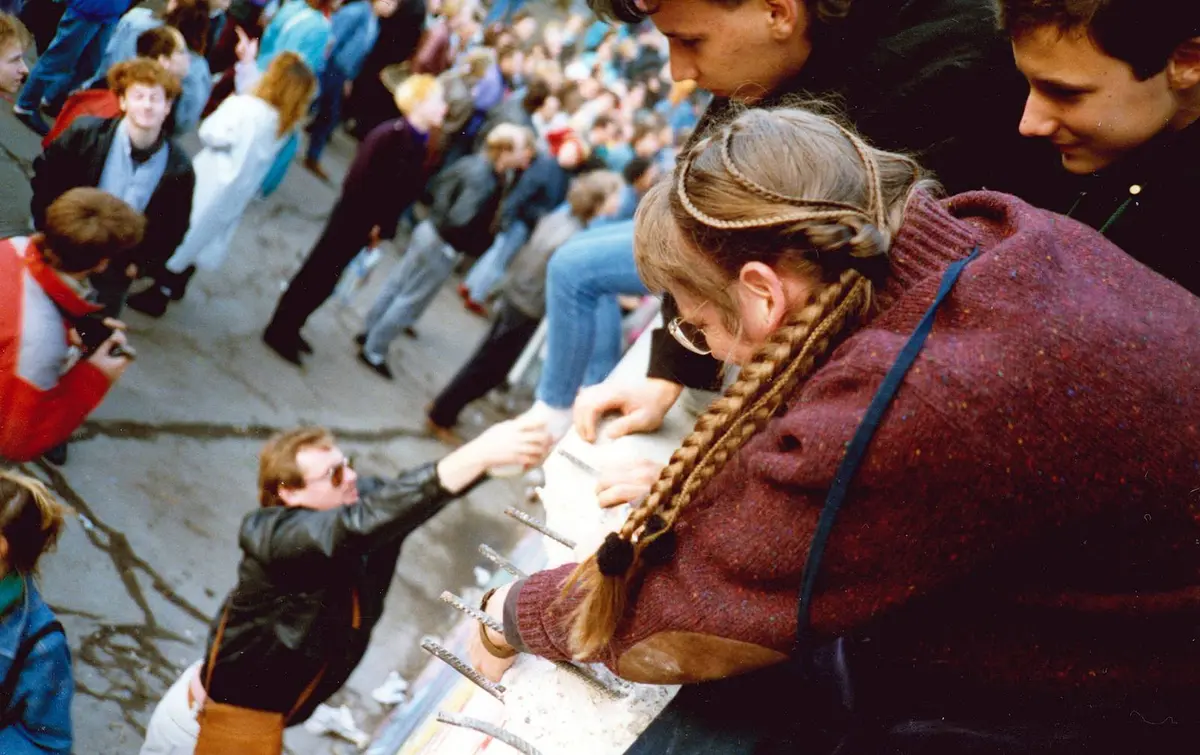
Berliners pull each other up onto the Wall, 10 November 1989, the day after it opened. Viet / Wikimedia Commons.
The Americans

Lifeguard, radio announcer, film star and two-term governor of California. As President he rebuilt American strength and called the Soviet Union an evil empire. In Berlin he overruled his own diplomats and delivered the line himself.

Dartmouth and Oxford graduate who wrote speeches for Vice President Bush, then more than 300 for President Reagan. He took a Berlin hostess’s challenge to Gorbachev, made it the heart of the speech and defended it against seven rival drafts.

Navy PT boat skipper who saved his crew after a Japanese destroyer cut PT-109 in half in 1943. As President he reinforced West Berlin when the Wall went up and told its people in 1963 that he was one of them.
By the numbers
In pictures


Watch, listen, see
Films, photographs and first-hand accounts from across the web. Each opens in a new tab.

President Reagan’s complete address at the Brandenburg Gate, 12 June 1987.
Ronald Reagan Presidential Foundation
Speechwriter Peter Robinson on how Reagan’s most famous line nearly went unsaid.
Stanford University
President Kennedy’s address to West Berlin on 26 June 1963, from the CBS News archive.
CBS News
NBC News special report from the Brandenburg Gate on the night the Wall opened.
C-SPAN American History TVPeter Robinson’s own account of the Berlin dinner, the seven alternate drafts and Reagan’s decision.
National Archives, Prologue
America’s deputy ambassador in East Berlin describes the crowds breaking through at Bornholmer Strasse.
Association for Diplomatic Studies and Training
Declassified records from Washington, Moscow and Berlin on the night the Wall opened.
National Security Archive
The State Department’s story of the Wall, with film of the 1961 crisis, Kennedy and Reagan.
National Museum of American Diplomacy“Yes, across Europe, this wall will fall. For it cannot withstand faith; it cannot withstand truth. The wall cannot withstand freedom.”
President Ronald Reagan, Brandenburg Gate, 12 June 1987
After
The Brandenburg Gate opened on 22 December 1989. On 3 October 1990 Germany reunited as one free country, inside NATO. On 25 December 1991 the Soviet flag came down over the Kremlin for the last time. The free world, led by the United States, had outlasted the Soviet empire without a shot fired between them.
In September 1990 Ronald Reagan came back to Berlin and took a hammer and chisel to the Wall himself. A section of it now stands at the Reagan Library in Simi Valley, California.
American soldiers stood guard over West Berlin for nearly half a century. Their Berlin Brigade, formed in the crisis of 1961, cased its colors in 1994 with the city whole and free.
Primary sources
- Remarks on East-West Relations at the Brandenburg Gate in West Berlin, President Ronald Reagan, 12 June 1987. Ronald Reagan Presidential Library.
- Peter Robinson, “Tear Down This Wall: How Top Advisers Opposed Reagan’s Challenge to Gorbachev, But Lost.” Prologue, National Archives, Summer 2007.
- A Brief History of the Berlin Crisis of 1961. National Declassification Center, National Archives.